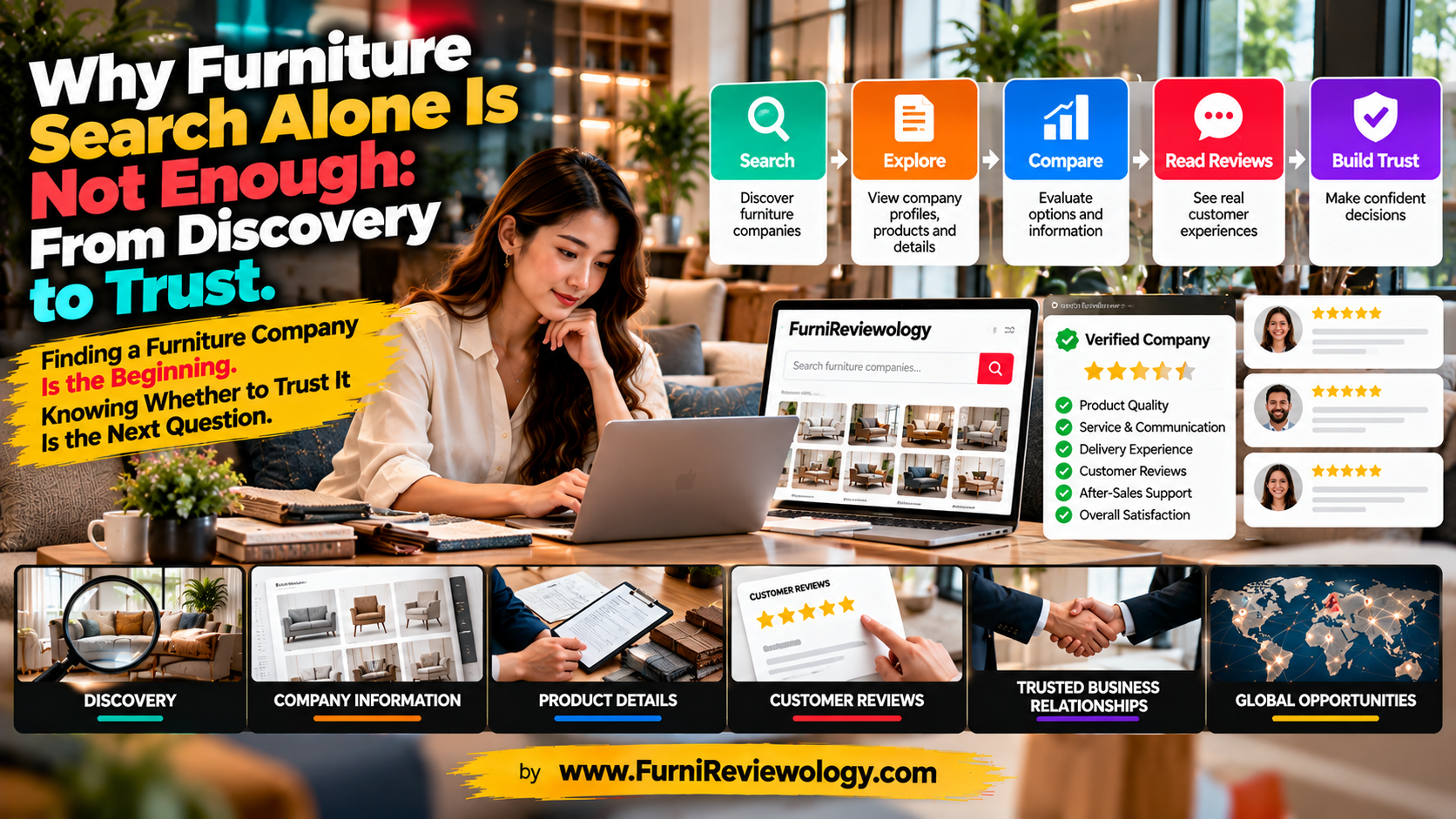
For years, the furniture industry's digital problem has often been described as a visibility problem.
Can buyers find the manufacturer?
Can designers discover the supplier?
Can hotels find the right hospitality furniture company?
Can an importer identify an exporter?
Can a retailer discover a new furniture brand?
Can a procurement team find a manufacturer with the required capability?
These are important questions.
But there is another question waiting immediately behind them:
“Now that I have found them, can I trust them?”
That changes everything.
Because search is not the final destination.
Search creates discovery.
Discovery creates consideration.
Consideration creates investigation.
And investigation eventually creates a question of trust.
This is why the furniture ecosystem needs more than a search layer.
It needs a connected journey:
SEARCH → DISCOVER → UNDERSTAND → EVALUATE → TRUST → CONNECT
That is where FISE and FurniReviewology become complementary.
FISE helps the world find them.
FurniReviewology helps the world trust them.
And alongside them:
TFT tells their story.
The Problem With “Found”
Imagine a buyer searching for a furniture manufacturer.
They enter:
“Hotel furniture manufacturer”
The search produces several companies.
Great.
The buyer has discovered potential suppliers.
But the work has only started.
The buyer now wants to know:
What does this company actually manufacture?
Where is it located?
How long has it been operating?
Does it export?
Has it worked with hospitality clients?
What products does it make?
What materials does it use?
Can it handle custom production?
What projects has it completed?
What do customers say?
How does it respond to problems?
Is the information current?
How can the buyer contact the company?
Finding a company does not answer all of those questions.
That is the gap between discovery and trust.
Search Answers “Who Exists?”
A search engine is fundamentally useful because it helps users discover information.
For the furniture industry, discovery can involve far more than company names.
A buyer may search by:
Product
Category
Material
Capability
Country
City
Industry
Market
Business type
Manufacturing speciality
Application
That is the opportunity for FISE.
FISE helps the world find them.
The objective is to make furniture businesses and their capabilities more discoverable within an industry-specific environment.
But discovery is only Stage One.
Trust Answers a Different Question
Once the buyer discovers a company, the question changes.
It becomes:
“Should I investigate this company further?”
And eventually:
“Should I buy from, work with, specify, or partner with this company?”
This is where trust becomes important.
A buyer may examine:
Company information
Product information
Previous projects
Customer experiences
Reviews
Business responses
Warranty information
Delivery experiences
Quality experiences
Service experiences
Independent information
Other available evidence
The U.S. Federal Trade Commission advises consumers to examine sellers and products carefully and not rely on star ratings alone, noting that reviews and ratings can be fake or misleading.
That lesson applies directly to the broader furniture information ecosystem:
A search result is not a recommendation.
A listing is not proof.
A star rating is not the whole story.
This Is Why Furniture Reviews Matter
Furniture is not always an impulse purchase.
A sofa may be used for years.
A dining table may become part of a home for a decade.
Hotel furniture can affect guest experience.
Office furniture can affect daily working environments.
Outdoor furniture must withstand its intended environment.
A retailer may need consistent supply.
A developer may need hundreds or thousands of units.
A hospitality project may involve specifications, customisation, manufacturing, logistics and installation.
The consequences of a poor decision can therefore extend far beyond the initial purchase.
That makes experience information valuable.
FurniReviewology: The Trust Layer
This is the role of FurniReviewology.
FurniReviewology helps the world trust them.
It is not simply about collecting stars.
It is about creating a richer information layer around furniture companies, products, services and real-world experiences.
A meaningful review can explore:
Quality
Materials
Construction
Comfort
Durability
Delivery
Installation
Customer service
Communication
Warranty
After-sales support
Long-term experience
Value relative to expectations
That creates context.
And context is important.
A Five-Star Rating Cannot Tell the Whole Story
Imagine two furniture companies both receiving:
★★★★★
The number looks identical.
But the experiences could be completely different.
One buyer may praise:
Product quality
Another may praise:
Delivery
Another may praise:
Customer service
Another may praise:
Design
Another may praise:
Customisation
Another may have a completely different experience.
The star number compresses information.
A detailed review can explain the information.
That is why FurniReviewology's role is broader than simply producing a score.
Search Gives You Options. Trust Helps You Investigate Them.
Consider the journey from a buyer's perspective.
STEP 1 — SEARCH
“I need a hospitality furniture supplier.”
↓
STEP 2 — DISCOVER
Several companies appear.
↓
STEP 3 — UNDERSTAND
The buyer examines products, capabilities, location and markets.
↓
STEP 4 — INVESTIGATE
The buyer looks for projects, company information and experiences.
↓
STEP 5 — REVIEW
The buyer examines relevant reviews and feedback.
↓
STEP 6 — VALIDATE
The buyer contacts the company and checks details.
↓
STEP 7 — DECIDE
The buyer determines whether the company fits the requirement.
This is a much more realistic digital journey than:
Search → Buy
TFT Has an Important Role Too
Where does The Furniture Times fit?
At the beginning—and throughout the journey.
TFT tells their story.
A company may appear in:
News
Press releases
Interviews
Product launches
Company features
Project stories
Executive interviews
Industry analysis
Innovation stories
Event coverage
Awards
Startup coverage
This gives the company editorial context.
A buyer may discover a company through its story before ever searching for its products.
That creates another pathway:
STORY → DISCOVERY → INVESTIGATION → TRUST
Three Layers, One Journey
This creates the connected model:
TFT
THE STORY LAYER
Who are they?
What are they doing?
What have they achieved?
What are they building?
FISE
THE DISCOVERY LAYER
Who is out there?
What do they make?
Where are they?
What can they supply?
Which markets do they serve?
FURNIREVIEWOLOGY
THE TRUST LAYER
What experiences exist?
What can buyers learn?
How does the company perform?
How does it respond?
What evidence is available?
STORY → SEARCH → TRUST
This is the larger architecture.
TFT tells their story.
↓
FISE helps the world find them.
↓
FurniReviewology helps the world trust them.
This does not mean every company automatically becomes trusted simply because it is listed or featured.
That distinction is critical.
Visibility cannot manufacture trust.
A listing cannot manufacture trust.
A press release cannot manufacture trust.
Trust has to be earned through real performance, transparent information and genuine experiences.
Trust Cannot Be Manufactured
This is where the furniture industry must be careful.
If reviews become purely promotional, their value decreases.
If companies publish only positive experiences, buyers receive an incomplete picture.
If businesses manipulate reviews, the entire ecosystem suffers.
The FTC's guidance for review platforms emphasizes reasonable processes for genuine reviews, transparency, equal treatment of positive and negative feedback, and disclosure of material connections.
That gives the furniture industry an important principle:
The purpose of a trust layer should be to improve information—not manufacture reputation.
Negative Reviews Are Part of Trust Too
A serious trust ecosystem cannot mean:
Only publish praise.
Real businesses sometimes make mistakes.
Products can arrive damaged.
Delivery can be delayed.
Communication can fail.
A specification can be misunderstood.
A customer can have a disappointing experience.
What matters is not pretending that problems never happen.
The more useful questions can be:
What happened?
Was the complaint legitimate?
How did the company respond?
Was the issue resolved?
What did the customer experience?
What can future buyers learn?
A professional response to criticism can itself provide useful information.
Trust Is Not the Same as Perfection
A company with no negative feedback is not automatically more trustworthy than a company that has some criticism.
The real information may be found in the broader pattern.
Does the company communicate?
Does it respond?
Does it address problems?
Does it provide clear information?
Does it stand behind its products?
Do customer experiences broadly align with its promises?
These are more meaningful questions than simply asking:
“How many stars?”
The Furniture Industry Needs Better Information, Not Just More Information
The internet already contains enormous quantities of furniture information.
The challenge is that information is often:
Scattered
Duplicated
Incomplete
Outdated
Promotional
Difficult to compare
Difficult to verify
Separated across different platforms
The answer is not necessarily to create more noise.
The opportunity is to create better-connected information.
That means:
Story
Business Information
Product Information
Searchability
Reviews
Experience
Evidence
=
A Stronger Furniture Information Ecosystem
What This Means for Furniture Companies
Furniture companies should no longer think only:
“How do we advertise our products?”
They should also ask:
How do we become discoverable?
How do we explain our capabilities?
How do we document our achievements?
How do we communicate our story?
How do we make customer experiences visible?
How do we respond to feedback?
How do we build a trustworthy digital identity?
This is a different approach to furniture marketing.
It moves from:
PROMOTION
toward:
INFORMATION + DISCOVERY + EVIDENCE + TRUST
The Opportunity for Buyers
Buyers also benefit from a connected ecosystem.
Instead of beginning with a company they already know, they can potentially begin with a requirement.
For example:
“I need a manufacturer capable of producing outdoor hospitality furniture.”
The journey becomes:
Requirement
↓
FISE Search
↓
Company Discovery
↓
TFT Company Story / Industry Coverage
↓
Product & Capability Investigation
↓
FurniReviewology Reviews & Experiences
↓
Direct Company Validation
↓
Commercial Decision
This does not eliminate due diligence.
It can make the information-gathering stage more structured.
The Opportunity for SMEs
This is particularly important for smaller furniture businesses.
A small manufacturer may not have the marketing budget of a global brand.
But it may have:
Excellent craftsmanship
Specialist capabilities
Experienced employees
Competitive production
Export knowledge
Custom manufacturing
Unique products
Strong customer relationships
The challenge may simply be discovery.
FISE can help create the discovery layer.
TFT can help tell the story.
FurniReviewology can provide a place for relevant experiences and reviews to be part of the information picture.
Three layers. One opportunity to become better understood.
Don't Confuse Visibility With Trust
This distinction deserves to be remembered:
Visibility gets attention.
Search creates discovery.
Information creates understanding.
Experience creates evidence.
Trust supports confident evaluation.
A company can be highly visible and still have questions around trust.
A company can be trustworthy and still be difficult to discover.
A company can have excellent products and still be poorly understood online.
The objective is to connect these pieces.
The New Furniture Digital Journey
The old approach:
BE ONLINE
The emerging approach:
BE VISIBLE
↓
BE DISCOVERABLE
↓
BE UNDERSTANDABLE
↓
BE EVALUABLE
↓
BE TRUSTWORTHY
That is a much bigger ambition.
Furniture Companies: Start Building All Three Layers
Don't rely on one digital channel.
With TFT:
Tell your story.
Submit:
News
Press releases
Interviews
Product launches
Projects
Milestones
Innovations
Achievements
With FISE:
Make your business discoverable.
List:
Company
Products
Categories
Capabilities
Materials
Locations
Markets
Business type
With FurniReviewology:
Build the trust information layer.
Encourage genuine experiences.
Provide accurate information.
Respond professionally.
Let real-world performance become part of your digital identity.
The Three Questions Every Furniture Company Should Answer
1. Can people find us?
FISE
2. Can people understand us?
TFT + FISE
3. Can people investigate and evaluate us?
FurniReviewology + company information + direct due diligence
If the answer to all three is yes, the company has moved far beyond simply having a website.
It has begun building a connected digital industry identity.
From Discovery to Trust
The furniture industry should stop thinking of search as the finish line.
Search is the doorway.
Once the buyer walks through that doorway, the real investigation begins.
Who are you?
What do you make?
Can you deliver?
Where have you worked?
What do your customers say?
How do you handle problems?
What evidence supports your claims?
What does the industry know about you?
These questions are the bridge between discovery and trust.
The Bigger TFT Group Vision
The furniture industry already has products.
It already has factories.
It already has designers.
It already has suppliers.
It already has buyers.
It already has markets.
What it needs is stronger digital infrastructure connecting the information around all of them.
TFT
Tells their story.
FISE
Helps the world find them.
FurniReviewology
Helps the world trust them.
And together:
STORY → SEARCH → TRUST
That is not the end of the furniture buyer journey.
It is the beginning of a better-informed one.
The Call to the Furniture Industry
Furniture companies:
Don't only advertise. Inform.
Don't only publish. Become discoverable.
Don't only seek visibility. Build evidence.
Don't only collect attention. Build trust.
Tell the industry what you are doing.
List your business where buyers can discover it.
Document your capabilities.
Encourage genuine customer experiences.
Respond to feedback professionally.
Keep your digital information accurate.
Because the next generation of furniture discovery will not simply ask:
“Who sells furniture?”
It will increasingly ask:
“Who can meet this requirement—and what can I learn about them before I decide?”
That is the difference between search and intelligent discovery.
And that is why furniture search alone is not enough.
The Global Furniture Ecosystem
The Furniture Industry is a $1 Trillion USD Ecosystem in the world
TFT tells their story.
FISE helps the world find them.
FurniReviewology helps the world trust them.
Story → Search → Trust → Connection
The furniture industry does not simply need to be found.
It needs to be understood, investigated and trusted.
Discovery is the beginning.
Trust is the next critical layer.
The Furniture Times (TFT) Editorial Desk