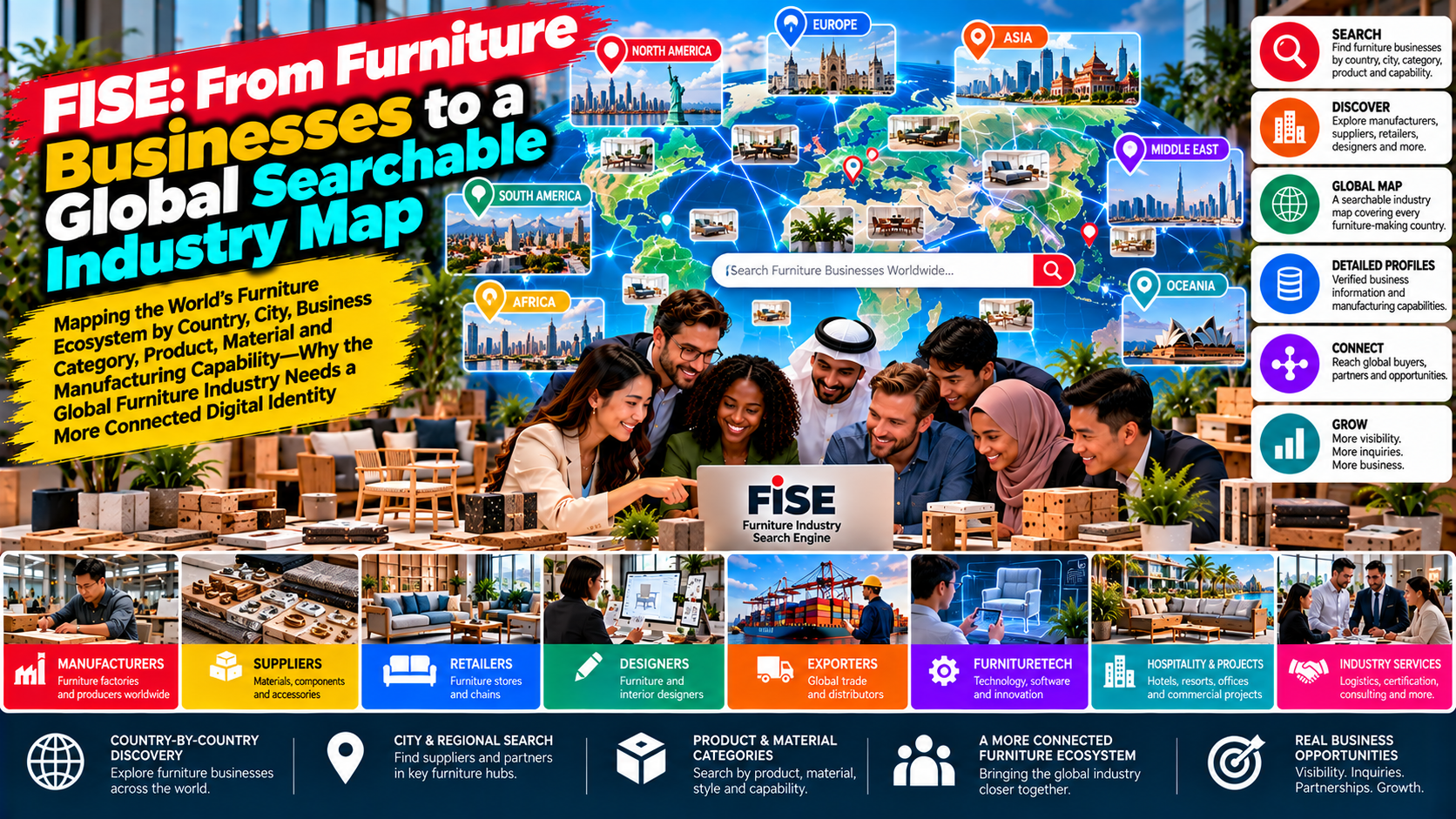
By The Furniture Times (TFT) Editorial Desk | Furniture Industry Search Engine — FISE | Global Furniture Ecosystem | Furniture Industry Mapping | Country-by-Country Discovery | Furniture Manufacturers | Suppliers | Industry Search | B2B Sourcing | Digital Transformation | Global Industry Intelligence
The World Makes Furniture Everywhere. But Can the World Find Everyone Who Makes It?
A furniture buyer in Germany is looking for outdoor furniture manufacturers in Malaysia.
A hotel developer in Saudi Arabia needs customized bedroom furniture from Asia.
An importer in the United States wants to identify upholstery manufacturers in Vietnam.
A furniture manufacturer in India is searching for hardware suppliers in China.
An interior designer in Australia wants to find solid-wood furniture producers in Indonesia.
A retailer in South Africa is exploring new furniture brands from Europe.
A furniture startup in Brazil wants to connect with component manufacturers in other markets.
These businesses have different requirements.
But they face a common challenge.
How do you discover the right furniture company, in the right country, with the right products and capabilities?
The global furniture industry has an enormous number of businesses, yet no single source can be assumed to provide a complete, accurate and continuously updated map of all of them.
Information exists across websites, catalogues, marketplaces, industry associations, trade fairs, social media platforms and personal networks.
But it is fragmented.
A buyer may know which country to search.
A manufacturer may know which product it needs.
A designer may know which material is required.
A procurement manager may know the necessary production capability.
What is often missing is a structured way to connect these requirements with relevant businesses.
This is the strategic opportunity behind Furniture Industry Search Engine — FISE.
FISE's vision is to help transform scattered furniture business information into a more searchable global industry ecosystem.
Not merely a list of company names.
Not simply a directory of websites.
But a structured discovery environment connecting countries, categories, companies, products and capabilities.
The furniture industry needs a digital map that helps people understand not only where businesses are located, but also what those businesses can actually do.
1. What Is a Global Furniture Industry Map?
A global furniture industry map is more than a geographic display.
It is a structured collection of information about businesses participating in the furniture value chain.
It should help users answer questions such as:
Which countries have manufacturers of a particular furniture category?
Where can buyers find specialized upholstery suppliers?
Which businesses offer OEM or contract manufacturing?
Which companies produce furniture components?
Where are commercial outdoor furniture suppliers located?
Which businesses provide CNC machining or furniture finishing services?
Which countries contain relevant furniture industry clusters?
How can a buyer identify potential suppliers beyond existing networks?
The objective is to connect multiple dimensions of industry information.
<box border radius="xl" padding={3} gap={2}> <text weight="medium">The five dimensions of a searchable furniture industry map</text> <grid columns={2} gap={2}> {#each [ {n:"1",name:"Countries & Cities",desc:"Where businesses operate"}, {n:"2",name:"Business Types",desc:"What role each company plays"}, {n:"3",name:"Product Categories",desc:"What products they offer"}, {n:"4",name:"Materials & Capabilities",desc:"What they work with and can do"} ] as x} <grid-item> <box background="surface-secondary" padding={3} radius="lg" gap={1} minHeight="108px"> <text color="secondary" size="xs">{x.n}</text> **{x.name}** <text color="secondary" size="xs">{x.desc}</text> </box> </grid-item> {/each} <grid-item span={2}> <box border radius="lg" padding={3} align="center" gap={1}> <icon name="search" size="lg"/> **5. Search & Discovery** <text color="secondary" size="xs" textAlign="center">Connect the dimensions to identify relevant businesses</text> </box> </grid-item> </grid> <caption>Conceptual framework for global industry discovery, not a representation of currently available FISE database coverage.</caption> </box>
A map becomes commercially useful when users can move from broad geography to specific business capabilities.
2. Why Country-Based Furniture Discovery Matters
Countries play an important role in furniture sourcing.
Different markets have developed expertise in particular materials, production methods, design traditions and commercial segments.
For example, buyers may investigate:
Malaysia for furniture manufacturing and export opportunities.
Vietnam for furniture production and international sourcing.
China for broad manufacturing and component supply capabilities.
Indonesia for wood, rattan and furniture craftsmanship.
India for diverse furniture production, materials and artisanal capabilities.
Italy for furniture design and specialized manufacturing.
Germany for furniture engineering, machinery and industrial capabilities.
Poland for furniture manufacturing and European supply chains.
Türkiye for furniture manufacturing and regional trade.
Brazil for furniture production and domestic-market scale.
These are broad industry associations, not claims that every supplier in a country has the same capabilities.
The challenge is that a country name alone is not enough.
A buyer needs to identify specific companies.
Country-based search should be the beginning of discovery—not the end of it.
3. From Country to City: Why Local Furniture Clusters Matter
Furniture manufacturing is often concentrated in regional clusters.
These clusters may contain factories, component suppliers, machinery providers, logistics businesses and specialized workers.
Searching by country may produce too many possibilities.
Searching by city or industrial region can help narrow the investigation.
Consider a buyer researching furniture businesses in Malaysia.
The buyer may wish to explore companies around Muar, a recognized furniture manufacturing center.
A buyer researching Indonesia may investigate Jepara for wood furniture and carving traditions.
A buyer examining Indian furniture production may explore Jodhpur.
A buyer interested in furniture manufacturing in China may investigate Foshan.
A buyer researching Italian furniture design and production may explore the Brianza area.
These locations illustrate the value of regional industry discovery.
A useful digital map should allow businesses to be associated with relevant cities, regions and industrial clusters.
But geography should not become a substitute for verification.
Being located in a recognized furniture cluster does not automatically establish a company's quality, capacity or suitability.
4. Business Categories: The Furniture Industry Is More Than Manufacturers
One of the most important requirements for an industry map is accurate business classification.
The global furniture ecosystem includes many different types of organizations.
A buyer searching for a finished furniture manufacturer should not have to sort through unrelated retail listings.
A manufacturer searching for component suppliers should not receive only consumer furniture stores.
A hotel developer looking for contract furniture providers needs a different set of businesses from a homeowner searching for a dining table.
Major business categories
| Business Category | Examples |
|---|---|
| Manufacturers | Residential, office, hospitality and outdoor furniture factories |
| Component Suppliers | Hardware, mechanisms, fittings and structural components |
| Material Suppliers | Timber, metal, foam, fabrics, leather and composites |
| Machinery Providers | CNC machines, woodworking equipment and industrial systems |
| Exporters & Importers | International furniture trade businesses |
| Wholesalers & Distributors | Bulk supply and distribution networks |
| Retailers | Showrooms, online stores and furniture chains |
| Designers | Furniture designers, interior designers and design studios |
| Service Providers | Installation, repair, restoration and logistics |
| Technology Companies | FurnitureTech, DesignTech and ManufacturingTech |
| Professional Organizations | Associations, councils and industry networks |
| Education & Training | Furniture academies, technical institutes and training providers |
This classification helps users understand where a business fits into the industry.
A company may belong to multiple categories.
For example, a manufacturer may also export and operate retail showrooms.
A searchable industry map should reflect the actual business model rather than forcing every company into one rigid label.
5. Product Categories: Helping Buyers Search for What They Need
Furniture is a broad product industry.
A single search for “furniture manufacturer” may not identify the right supplier.
Buyers often have specific product requirements.
Residential Furniture
Sofas, beds, dining tables, chairs, cabinets, wardrobes and storage.
Office Furniture
Workstations, ergonomic seating, desks, meeting tables and filing systems.
Hospitality Furniture
Hotel beds, headboards, guestroom furniture, restaurant seating and lobby furniture.
Outdoor Furniture
Garden sets, parasols, poolside loungers, benches and outdoor dining furniture.
Educational Furniture
Classroom desks, chairs, storage and institutional furnishings.
Healthcare Furniture
Specialized seating, beds, cabinets and related institutional products.
Contract Furniture
Furniture manufactured or supplied for commercial projects.
Furniture Components
Hardware, frames, mechanisms, legs, foam, textiles and fittings.
A business profile should identify the relevant categories accurately.
The more precise the information, the easier it becomes for buyers to identify potential matches.
Product categories transform a generic company listing into useful sourcing information.
6. Manufacturing Capabilities: The Most Valuable Information Buyers Often Cannot Find
Two factories may produce the same furniture category but have very different capabilities.
One may specialize in standardized mass production.
Another may focus on custom projects.
A third may offer OEM manufacturing.
A fourth may have specialized CNC machinery.
A fifth may focus on upholstery.
A sixth may manufacture metal furniture.
A buyer needs to understand these differences.
Important capability attributes
OEM manufacturing
ODM and product development
Custom furniture production
CNC machining
Woodworking and joinery
Metal fabrication
Upholstery
Injection molding
Powder coating
Surface finishing
Knock-down furniture production
Contract furniture manufacturing
Prototype development
Assembly and packaging
Export-oriented production
Capabilities should be described carefully.
A company should not claim a process it does not actually perform.
Where a capability is outsourced, that distinction may matter to buyers.
The future of furniture sourcing depends increasingly on finding companies by what they can do—not merely what they call themselves.
7. Materials: Another Important Dimension of Global Search
Material requirements can determine which suppliers are suitable.
A buyer may need solid teak furniture.
Another may require stainless steel.
A designer may specify rattan.
A manufacturer may need engineered wood.
A hospitality project may require particular upholstery performance.
A searchable industry map can organize businesses around material expertise.
Examples include:
Solid wood.
Plywood.
MDF.
Particleboard.
Bamboo.
Rattan.
Steel.
Aluminum.
Stainless steel.
Glass.
Plastic.
Recycled materials.
Foam.
Fabric.
Leather.
Synthetic upholstery.
Composite materials.
Material-based discovery can help connect manufacturers, suppliers and designers.
But material claims should be specific.
For example, “solid wood furniture” does not explain species, grade, sourcing or construction.
Material search improves discovery, while technical specifications remain essential for procurement.
8. An Example: How a Buyer Could Use a Global Furniture Industry Map
Imagine a hotel procurement manager searching for outdoor furniture.
The requirement is:
Commercial outdoor dining chairs.
Aluminum frames.
Weather-resistant materials.
Customization options.
Potential supply from Southeast Asia.
The buyer could approach discovery through several dimensions.
<box border radius="xl" padding={3} gap={2}> <text weight="medium">Illustrative sourcing pathway</text> <list marker="number" connector="solid" gap={2}> <list-item>**Region:** Southeast Asia</list-item> <list-item>**Business type:** Manufacturer or contract supplier</list-item> <list-item>**Product:** Commercial outdoor dining chairs</list-item> <list-item>**Material:** Aluminum and suitable outdoor upholstery</list-item> <list-item>**Capability:** Customization and project supply</list-item> <list-item>**Next step:** Verify specifications, capacity, testing, lead times and commercial terms</list-item> </list> <caption>Example of a structured discovery process; it does not represent a confirmed live FISE search result.</caption> </box>
This approach is more precise than searching for “furniture suppliers” and examining hundreds of unrelated results.
It also helps the buyer communicate requirements more clearly.
The value of structured search lies in reducing irrelevant discovery—not eliminating the need for procurement due diligence.
9. Furniture SMEs: A Global Map Can Make Smaller Businesses Easier to Discover
Large furniture manufacturers may already have established international visibility.
They may participate in trade fairs.
They may maintain export offices.
They may have marketing teams.
They may work with major distributors.
Small and medium-sized furniture businesses often operate with fewer resources.
A workshop may specialize in custom furniture.
A small factory may have strong upholstery expertise.
A component producer may serve only a limited local network.
A furniture designer may be capable of working internationally but have few industry connections.
Structured digital discovery can offer these businesses another way to communicate their capabilities.
What SMEs should prepare
A clear company description.
Accurate business category.
Product information.
Materials expertise.
Production capabilities.
Location.
Official contact details.
Relevant documentation.
Professional photographs.
A maintained website or company profile.
A smaller company should not have to become a large company before it can be found.
10. Furniture Startups Need a Place on the Industry Map
New furniture businesses face a particular challenge.
They may not yet have established distribution networks.
They may have limited customer histories.
They may still be developing products.
But they can still provide useful information about their activities.
A FurnitureTech startup can explain its software.
A designer can present a prototype.
A manufacturer can describe its intended product range.
A sustainable materials startup can share verified technical information.
A repair business can explain its services.
A startup should communicate its development stage honestly.
A prototype should not be presented as an established commercial product.
A proposed manufacturing facility should not be described as operational.
A planned certification should not be represented as already obtained.
A searchable industry map should make emerging businesses visible without encouraging exaggerated claims.
11. Why Exporters and Importers Need Better Global Discovery
International furniture trade depends on identifying suitable business partners.
Exporters need potential customers.
Importers need reliable suppliers.
Manufacturers need distributors.
Retailers need product sources.
Procurement teams need alternatives.
A global industry map can help structure early-stage research.
An exporter may communicate:
Product categories.
Manufacturing location.
Export markets served.
Relevant experience.
Packaging capabilities.
Applicable documentation.
An importer may describe:
Product categories handled.
Markets served.
Distribution capabilities.
Commercial specialization.
But inclusion in a searchable database does not establish regulatory compliance or financial reliability.
Discovery is the first stage of international trade. Verification and commercial execution remain separate responsibilities.
12. Why the Map Must Include Components, Machinery and Services
A global furniture industry map would be incomplete if it covered only finished furniture.
Consider a manufacturer searching for:
Cabinet hinges.
Drawer runners.
Foam.
Upholstery fabrics.
Metal frames.
Furniture coatings.
CNC machinery.
Packaging.
Freight services.
Testing laboratories.
Installation partners.
These businesses are essential to the furniture value chain.
A manufacturer may have no difficulty finding finished sofas online but struggle to locate a specialized mechanism supplier.
That is why FISE's broader industry vision matters.
The furniture industry map must include the businesses that make furniture production possible.
13. The Importance of Structured Company Profiles
A company name and website link provide only limited information.
A structured profile can make business capabilities easier to understand.
Illustrative Profile Structure
| Profile Field | Why It Matters |
|---|---|
| Company Name | Establishes business identity |
| Country & City | Supports geographic discovery |
| Business Category | Clarifies industry role |
| Product Categories | Shows what the company offers |
| Materials | Identifies relevant material expertise |
| Manufacturing Capabilities | Helps assess technical suitability |
| Target Markets | Indicates intended customers |
| Export Information | Supports international sourcing research |
| Certifications | Provides relevant documented claims |
| Website | Links to official information |
| Contact Details | Enables direct business communication |
| Last Updated | Helps users assess information freshness |
These attributes can improve search relevance.
They also help companies identify missing information in their own digital presence.
A structured business profile is not just a listing. It is a clearer description of the company's place in the furniture ecosystem.
14. A Global Furniture Map Must Be Built on Accurate Information
A searchable industry map faces an important challenge.
Business information changes.
Companies relocate.
Product ranges evolve.
Factories expand or close.
Contact details become outdated.
Certifications expire.
Ownership changes.
Websites disappear.
A useful platform therefore needs processes for updating and correcting information.
Important principles
Accurate company identification.
Clear business categories.
Consistent product terminology.
Transparent source information.
Appropriate verification processes.
Correction mechanisms.
Protection against impersonation.
Responsible handling of business data.
Distinction between self-reported and verified claims.
A company profile should not automatically be interpreted as an endorsement.
The credibility of a global industry map depends on information quality—not simply the number of businesses included.
15. From Country Lists to Industry Intelligence
A structured global furniture map may eventually support broader analysis.
For example:
Which product categories appear across different markets?
Where are specialized manufacturing capabilities concentrated?
Which regions contain emerging furniture technology businesses?
What types of component suppliers are represented?
Where are gaps in available industry information?
How does business participation change over time?
These questions can support industry research.
But the answers must be interpreted carefully.
A database containing voluntary listings does not necessarily represent the entire industry.
A country with more listed companies is not automatically a larger or more productive furniture market.
Search data can reflect platform adoption as much as economic activity.
Industry mapping becomes intelligence only when data coverage, definitions and limitations are understood.
16. AI and the Future of Furniture Industry Mapping
AI-assisted search may help users express complex requirements in natural language.
For example:
“Find companies manufacturing custom hotel furniture in Southeast Asia.”
“Identify suppliers of upholstery materials suitable for commercial seating.”
“Search for furniture factories with CNC machining capabilities.”
“Find outdoor furniture manufacturers working with aluminum.”
These questions combine geography, product categories and capabilities.
A structured industry database can provide a useful foundation for interpreting them.
However, AI search systems can make mistakes.
They may misunderstand company descriptions.
They may confuse products with capabilities.
They may rely on outdated information.
They may generate unsupported recommendations.
Human verification remains important.
AI can improve the search experience, but dependable results require accurate underlying industry data.
17. The Global Furniture Industry Map Should Be Inclusive
The furniture industry is not limited to a few major manufacturing countries.
It includes businesses across:
Asia.
Europe.
Africa.
North America.
South America.
Oceania.
The Middle East.
Every region has different capabilities, traditions, markets and development opportunities.
A global map should make space for:
Large manufacturers.
Small workshops.
Artisans.
Exporters.
Retailers.
Designers.
Technology companies.
Associations.
Training providers.
Service businesses.
The aim should be broad representation, not simply collecting the most recognizable brands.
The global furniture ecosystem is strongest when discovery extends beyond established industry centers.
18. A Practical FISE Participation Roadmap for Furniture Companies
Furniture businesses can begin preparing for structured industry discovery today.
Step 1 — Identify Your Business Type
Manufacturer, supplier, exporter, retailer, designer, service provider or another relevant category.
Step 2 — Define Your Product Categories
Use clear, widely understood product descriptions.
Step 3 — Document Your Materials
Identify the materials relevant to your products or services.
Step 4 — Describe Your Capabilities
Explain what your business can actually manufacture, supply or perform.
Step 5 — Confirm Your Location
Use accurate country, city and business contact information.
Step 6 — Prepare Product Information
Include dimensions, specifications and photographs where relevant.
Step 7 — Review Your Claims
Ensure certifications, capacities and experience statements are supportable.
Step 8 — Explore FISE
Visit the platform and review current opportunities to participate.
Step 9 — Maintain Your Profile
Keep information updated as the business changes.
Becoming searchable begins with organizing your own business information.
19. What Could a Fully Connected Furniture Ecosystem Look Like?
Imagine a buyer beginning with a broad requirement.
The buyer selects a country.
Then a city.
Then a business category.
Then a product.
Then a material.
Then a manufacturing capability.
The system identifies potentially relevant companies.
The buyer examines company information.
The buyer visits official websites.
The buyer reviews available documentation.
The buyer contacts shortlisted businesses.
The buyer conducts appropriate due diligence.
The buyer progresses toward a commercial discussion.
This is the strategic vision behind structured industry discovery.
It is not a claim that every feature described is already available or that every furniture company worldwide has been mapped.
Building such a system requires time, data, technology and participation.
The long-term objective is to make the global furniture industry easier to navigate without removing the independence of its businesses.
20. TFT + FISE + FurniReviewology: Mapping More Than Company Names
A searchable industry map helps users identify businesses.
But discovery is only one part of the buyer journey.
Buyers may also want to understand company developments, market conditions and customer experiences.
This creates an opportunity for complementary information layers.
Furniture Industry Search Engine — FISE
FISE helps the world find them.
Structured discovery of businesses, products, categories and capabilities.
The Furniture Times — TFT
TFT tells their story.
Industry news, interviews, business developments and market information.
FurniReviewology
FurniReviewology helps the world trust them.
A review-oriented layer that can contribute customer-experience information.
These platforms have different roles.
A business listing does not certify quality.
Editorial coverage does not guarantee commercial reliability.
Customer reviews do not replace technical testing.
But together, they can support a more informed discovery process.
SEARCH → DISCOVER → UNDERSTAND → VERIFY → CONNECT
21. The Opportunity for Industry Associations and Governments
Furniture associations, trade organizations and relevant public agencies often hold valuable information about local industry structures.
They may understand:
Manufacturing clusters.
Export-oriented businesses.
Regional specialties.
Training requirements.
Industry events.
Technology adoption.
Business development challenges.
There may be opportunities for collaboration in improving industry information.
For example, associations could encourage members to maintain accurate business profiles.
Training organizations could help SMEs improve digital readiness.
Industry bodies could support standardized business categories.
Any collaboration should respect privacy, data ownership, consent and applicable requirements.
Better industry mapping can support economic development when it is built on reliable information and responsible cooperation.
22. The Biggest Challenge Is Participation
Technology alone cannot create a comprehensive global furniture map.
Businesses must participate.
Manufacturers need to describe their capabilities.
Suppliers need to organize their products.
Retailers need to maintain accurate information.
Designers need to present their expertise.
Associations can support member awareness.
Startups need to explain their innovations.
Buyers can encourage clearer supplier information.
Without participation, even a sophisticated search platform may have incomplete coverage.
The global furniture industry map will become more useful as more relevant businesses contribute accurate, current information.
23. Furniture Businesses: Put Your Company on the Global Industry Map
If you manufacture furniture, make your capabilities discoverable.
If you supply components, identify your products.
If you work with specialized materials, communicate your expertise.
If you export furniture, describe your markets and capabilities.
If you design furniture, organize your portfolio.
If you provide furniture technology, explain the problem your solution addresses.
If you operate a small workshop, present your craftsmanship.
If you are launching a startup, introduce your business accurately.
The furniture industry contains far more businesses than the names buyers already recognize.
A searchable industry ecosystem should help make that broader landscape visible.
Your company may already be part of the global furniture supply chain. The next step is making your role easier to discover.
Explore Furniture Industry Search Engine:
Conclusion: One Global Furniture Industry Deserves a More Searchable Digital Map
The global furniture industry is built across countries, cities, manufacturing clusters and business networks.
Its products involve countless materials, components, processes and services.
Its buyers operate across residential, commercial, hospitality, institutional and industrial markets.
Yet much of the information needed to connect these participants remains scattered.
A global searchable industry map offers a more organized approach.
It can connect countries with companies.
Companies with product categories.
Products with materials.
Materials with capabilities.
Capabilities with buyers.
And buyers with potential business partners.
The vision is ambitious.
It cannot be completed overnight.
It requires accurate information, consistent classification, technical infrastructure and ongoing participation.
But the direction is clear.
The Furniture Industry Should Not Be Difficult to Navigate Simply Because Its Businesses Are Spread Across the World.
From Countries to Categories, From Companies to Capabilities—The Future Is a More Searchable Global Furniture Ecosystem.
FISE — Search. Connect. Discuss. Deal.
The Global Furniture Ecosystem
The Furniture Industry is a $1 Trillion USD Ecosystem in the world.
Furniture Industry Search Engine — FISE helps the world find them.
The Furniture Times — TFT tells their story.
FurniReviewology helps the world trust them.