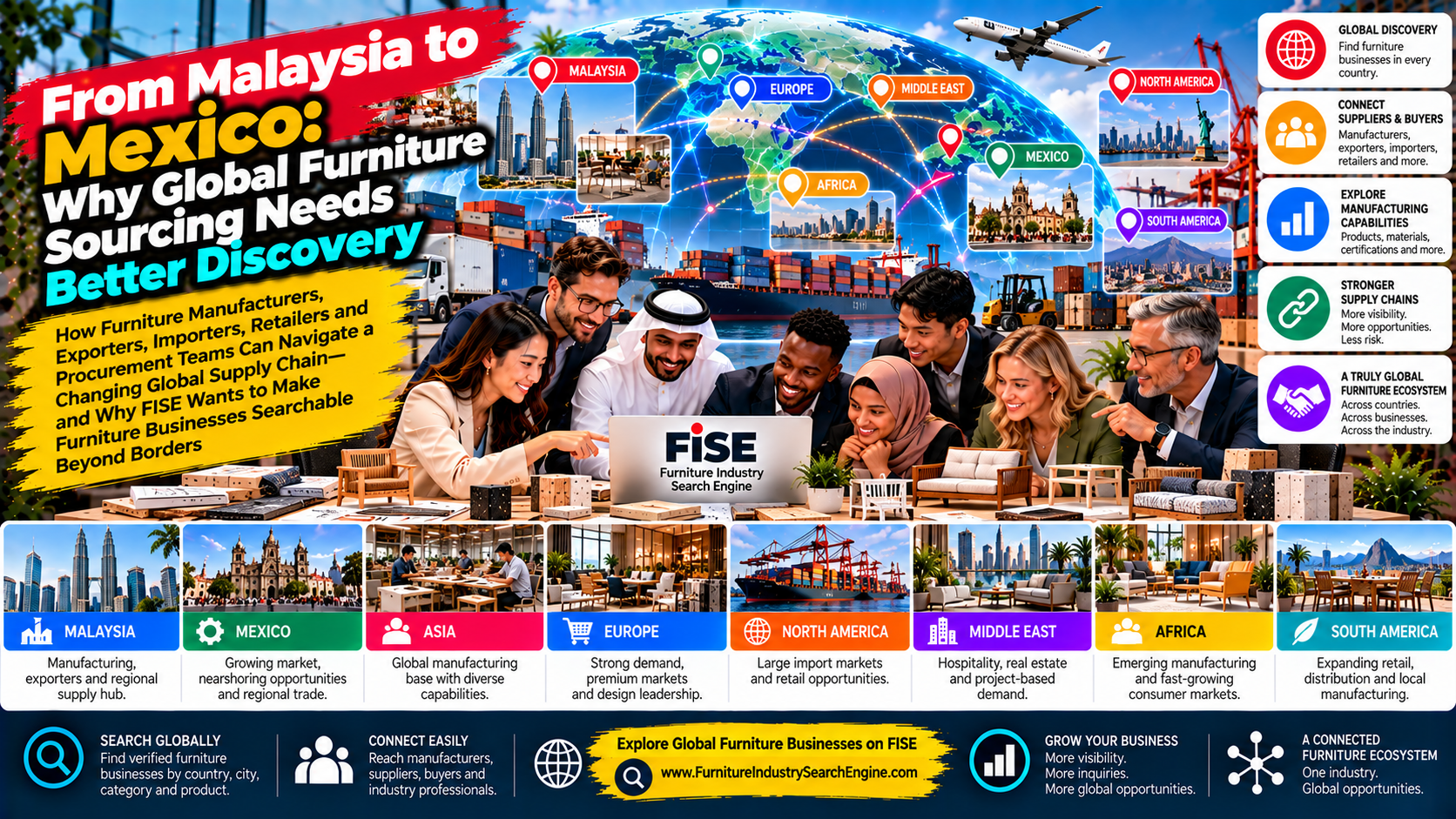
By The Furniture Times (TFT) Editorial Desk | Furniture Industry Search Engine — FISE | Global Furniture Sourcing | Malaysia Furniture Industry | Mexico Furniture Industry | International Furniture Trade | Supplier Discovery | Manufacturing Capabilities | B2B Procurement | Global Furniture Ecosystem
October 2026 | Global Furniture Trade & Industry Discovery Series
The Furniture Industry Is Global. Its Supplier Discovery System Is Still Fragmented.
A furniture retailer in the United States wants to diversify its sourcing network.
Its existing suppliers are located in Asia, but the company is considering additional manufacturers closer to its North American distribution operations.
A hotel developer in the Middle East is searching for outdoor furniture manufacturers capable of supplying a large hospitality project.
A European importer wants to identify reliable solid-wood furniture producers.
A Mexican furniture manufacturer needs specialized components that may be available from suppliers in Malaysia, China, Germany or elsewhere.
A Malaysian manufacturer wants to reach buyers in markets where it has never exhibited or established a distributor.
These situations illustrate a fundamental challenge.
Global furniture sourcing is no longer simply about knowing which countries manufacture furniture. It is about identifying the right companies, understanding their capabilities and evaluating whether they can serve specific commercial requirements.
The global furniture industry has manufacturers, component suppliers, exporters, importers, designers and logistics providers distributed across many markets.
Yet their information remains scattered.
Buyers search through company websites, trade fair catalogues, general search engines, B2B marketplaces, business directories, social media platforms and industry contacts.
Each source may contain useful information.
But no single source should be assumed to provide a complete, verified and continuously updated picture of every furniture supplier worldwide.
This is where Furniture Industry Search Engine — FISE presents a different vision.
Rather than treating global furniture sourcing as a series of disconnected country searches, FISE aims to help organize furniture businesses into a more searchable industry ecosystem.
From Malaysia to Mexico.
From Vietnam to Poland.
From Indonesia to Italy.
From India to Brazil.
From China to Türkiye.
From South Africa to the United States.
The future of furniture sourcing depends not only on where products are manufactured, but on how effectively buyers can discover, understand and evaluate the businesses behind them.
1. Why Malaysia and Mexico Represent an Important Global Sourcing Conversation
Malaysia and Mexico illustrate two different geographic positions within international furniture trade.
Malaysia is part of Southeast Asia's manufacturing and export ecosystem, with established furniture production capabilities and connections to regional supply chains.
Mexico operates within North America's industrial and commercial environment, with manufacturing capabilities and geographic proximity to the United States.
For a furniture buyer, these markets may represent different sourcing considerations.
Malaysia may be relevant when exploring Southeast Asian furniture manufacturing networks, export-oriented production and regional material or component supply relationships.
Mexico may be relevant when evaluating North American supply-chain proximity, regional production opportunities and distribution requirements.
But country-level assumptions are not enough.
A buyer cannot conclude that a Malaysian supplier will always offer a lower price.
Nor can the buyer assume that a Mexican supplier will always deliver faster.
Actual outcomes depend on factory location, product type, production capacity, materials, logistics routes, order size, customs requirements and commercial arrangements.
The real sourcing decision must be made at the company and product level—not through country stereotypes.
2. The Global Furniture Supply Chain Is Being Reconsidered
Furniture sourcing decisions are influenced by multiple commercial factors.
These include:
Manufacturing costs.
Labor availability.
Material supply.
Product quality.
Production capacity.
Lead times.
Shipping costs.
Trade regulations.
Import duties.
Currency movements.
Geopolitical risks.
Customer demand.
Sustainability requirements.
Supplier reliability.
Businesses may reassess their sourcing networks when one or more of these conditions changes.
Some buyers explore additional countries to diversify supply.
Others prioritize proximity to end markets.
Some seek specialized manufacturing expertise.
Others focus on cost, flexibility or product innovation.
There is no universally correct sourcing country.
The strongest sourcing strategy begins with the buyer's actual requirements and evaluates suppliers against those requirements.
3. The Difference Between Country Discovery and Supplier Discovery
A buyer may begin with the question:
“Which countries manufacture outdoor furniture?”
That is a useful starting point.
But it does not identify the right supplier.
The next questions are more specific.
Which companies manufacture outdoor furniture?
What materials do they use?
Do they produce for commercial projects?
Can they customize products?
What is their production capacity?
Which markets do they serve?
What documentation can they provide?
How can the buyer contact them?
These questions require structured business information.
Country Search Versus Supplier Search
| Country-Level Question | Company-Level Question |
|---|---|
| Does Malaysia manufacture furniture? | Which Malaysian factories produce the required furniture category? |
| Is Mexico relevant to North American sourcing? | Which Mexican suppliers can meet the buyer's specifications and delivery requirements? |
| Does Vietnam export furniture? | Which Vietnamese companies offer the required materials and manufacturing capabilities? |
| Is Poland a furniture manufacturing market? | Which Polish suppliers can serve the intended commercial segment? |
| Does Indonesia produce wooden furniture? | Which Indonesian manufacturers meet the project's product and sourcing requirements? |
Knowing where an industry exists is different from knowing which business can fulfill an order.
4. Malaysia: A Furniture Manufacturing Ecosystem With International Relevance
Malaysia has an established furniture manufacturing industry serving domestic and international markets.
Its furniture ecosystem includes:
Wood furniture manufacturers.
Upholstered furniture producers.
Outdoor furniture companies.
Office furniture businesses.
Furniture component suppliers.
Material providers.
Exporters.
Wholesalers.
Retailers.
Design and project furnishing businesses.
Manufacturing clusters such as Muar are well known within the country's furniture industry.
However, the presence of a recognized manufacturing cluster does not mean every business has the same capabilities.
Some companies specialize in dining furniture.
Others manufacture bedroom furniture.
Some produce upholstered products.
Others serve hospitality or commercial markets.
A buyer searching for Malaysian furniture suppliers needs to move beyond broad national descriptions.
What Malaysian Furniture Companies Should Make Searchable
Their product categories.
Manufacturing location.
Materials expertise.
OEM or ODM capabilities.
Customization options.
Export experience.
Relevant certifications.
Official company information.
Commercial contact channels.
Malaysia's international furniture visibility depends partly on how clearly individual companies communicate what they can supply.
5. Mexico: Geographic Proximity Is Valuable, but Supplier Information Still Matters
Mexico occupies a different position in global furniture sourcing.
Its geographic relationship with the United States can make it relevant to buyers evaluating North American production and distribution.
But proximity alone does not determine commercial suitability.
A buyer must still consider:
Product specialization.
Factory capacity.
Material availability.
Labor and production costs.
Technical capabilities.
Quality requirements.
Transportation arrangements.
Customs procedures.
Applicable trade rules.
Delivery performance.
A supplier located closer to the destination market may offer certain logistical advantages, but these need to be calculated for the actual project.
Similarly, a supplier in a more distant market may remain competitive because of product specialization, scale or manufacturing efficiency.
The value of Mexico in a sourcing strategy should be assessed through specific suppliers, products and total delivered costs.
6. From Malaysia to Mexico: A Practical Sourcing Comparison
Consider a hypothetical U.S. retailer evaluating two manufacturers for a new dining furniture collection.
One supplier is based in Malaysia.
The other is based in Mexico.
Both appear capable of producing the required products.
How should the retailer compare them?
| Evaluation Factor | Malaysian Supplier | Mexican Supplier |
|---|---|---|
| Product Capability | Verify product expertise and production methods | Verify product expertise and production methods |
| Factory Capacity | Confirm available capacity and lead times | Confirm available capacity and lead times |
| Materials | Assess sourcing, consistency and availability | Assess sourcing, consistency and availability |
| Factory Price | Obtain a comparable quotation | Obtain a comparable quotation |
| Logistics | Calculate actual international freight and handling | Calculate actual transport and handling |
| Customs & Duties | Determine applicable treatment for the product | Determine applicable treatment for the product |
| Quality | Review samples, testing and quality systems | Review samples, testing and quality systems |
| Delivery | Assess realistic production and transit schedules | Assess realistic production and transit schedules |
| Commercial Risk | Evaluate supplier and market-specific risks | Evaluate supplier and market-specific risks |
The table does not identify a winner.
It demonstrates why sourcing comparisons require evidence.
The appropriate choice may vary by product, order size, destination, timing and buyer priorities.
Better discovery creates a stronger shortlist. Better evaluation determines which supplier is suitable.
7. The Real Cost of Furniture Sourcing Is More Than Factory Price
A common procurement mistake is comparing suppliers only by quoted unit price.
A lower factory price does not necessarily mean a lower total procurement cost.
A more complete comparison considers the total landed cost and relevant operating risks.
Illustrative Total Landed Cost
Total Landed Cost = Product Cost + Packaging + Freight + Insurance + Applicable Duties and Taxes + Handling + Other Relevant Import Costs
The exact calculation depends on the agreed Incoterms, destination market and commercial arrangements.
Buyers may also need to consider:
Inspection costs.
Quality failures.
Product damage.
Inventory carrying costs.
Delayed delivery.
Replacement parts.
Warranty obligations.
Supplier communication.
Working capital requirements.
These factors may affect the commercial outcome even when they do not appear directly in the initial quotation.
A sourcing strategy should optimize total value and risk—not simply chase the lowest quoted price.
8. Why Furniture Buyers Need More Than a List of Manufacturers
A basic supplier directory may provide:
Company name.
Address.
Website.
Telephone number.
Business category.
This is useful.
But a serious B2B buyer often needs more.
For example, a hotel developer sourcing 1,000 guestroom chairs may need to know whether a manufacturer has experience with contract furniture.
A retailer sourcing outdoor dining sets may need suppliers familiar with appropriate materials and packaging.
An importer sourcing upholstered furniture may need technical information relevant to the destination market.
A designer may need a factory capable of customized dimensions and finishes.
These requirements cannot always be answered through a generic company listing.
Global furniture sourcing needs structured information about products, materials, capabilities and applications.
9. How FISE Can Support a More Searchable Global Sourcing Ecosystem
Furniture Industry Search Engine — FISE is built around the vision of making the wider furniture industry easier to discover.
Its guiding principle is:
Search. Connect. Discuss. Deal.
A structured furniture search ecosystem can help organize information around multiple dimensions.
Geographic Discovery
Country.
City.
Manufacturing region.
Business Classification
Manufacturer.
Exporter.
Importer.
Supplier.
Wholesaler.
Distributor.
Retailer.
Designer.
Service provider.
Product Categories
Residential furniture.
Office furniture.
Hospitality furniture.
Outdoor furniture.
Components.
Materials.
Machinery.
Manufacturing Capabilities
OEM.
ODM.
Customization.
CNC machining.
Upholstery.
Metal fabrication.
Contract manufacturing.
Other relevant specializations.
This approach can make the initial sourcing process more focused.
It does not eliminate supplier verification or guarantee commercial outcomes.
The purpose of FISE is to help buyers discover relevant businesses more efficiently while giving furniture companies a clearer industry identity.
10. Global Sourcing Should Not Be Limited to Familiar Countries
Furniture buyers often begin with countries they already know.
This can be practical because established sourcing relationships reduce uncertainty.
But excessive reliance on familiar networks may cause buyers to overlook relevant suppliers elsewhere.
A broader search can include:
Vietnam.
Indonesia.
India.
China.
Malaysia.
Thailand.
Poland.
Italy.
Germany.
Türkiye.
Mexico.
Brazil.
United States.
Canada.
South Africa.
Other emerging and established furniture markets.
These countries have different industry structures and capabilities.
Not every country will be suitable for every sourcing requirement.
But a more searchable global ecosystem can make it easier to investigate alternatives.
The goal is not to source from everywhere. It is to know which relevant options exist before making a decision.
11. Why Furniture Manufacturers Need to Become Discoverable Beyond Their Existing Markets
Many manufacturers depend on established customers.
Some work with long-term importers.
Others supply domestic retailers.
Some participate in trade fairs.
Others rely on agents or distributors.
These relationships remain valuable.
But manufacturers may also want to reach new markets.
A Malaysian outdoor furniture manufacturer may be interested in hospitality buyers outside Southeast Asia.
A Mexican cabinet manufacturer may want to explore additional commercial customers.
An Indian component supplier may seek furniture factories in other countries.
A Polish furniture producer may want broader international recognition.
A Brazilian manufacturer may be interested in new distribution partnerships.
Structured industry profiles can help these businesses communicate their capabilities.
A Manufacturer Should Make Clear:
What it manufactures.
Which materials it uses.
Whether customization is available.
Which customer segments it serves.
Its production location.
Its relevant export experience.
Its official contact information.
A manufacturer cannot expect every potential international buyer to already know its name.
12. The Hidden Role of Furniture Components in Global Sourcing
Finished furniture sourcing receives significant attention.
But manufacturers also need components.
A Mexican furniture factory may require specialized hardware.
A Malaysian manufacturer may need upholstery materials.
A European furniture producer may seek metal fittings.
A U.S. manufacturer may need engineered components.
These supply relationships cross borders.
The relevant businesses include:
Hardware manufacturers.
Foam suppliers.
Metal component producers.
Textile manufacturers.
Drawer slide suppliers.
Recliner mechanism companies.
Furniture leg manufacturers.
Fastener producers.
Machinery suppliers.
Packaging companies.
A global furniture search ecosystem should represent these upstream businesses.
International furniture sourcing is not only about buying finished furniture. It is also about connecting the manufacturers and suppliers that make production possible.
13. Why Furniture SMEs and MSMEs Need Better International Visibility
Large manufacturers may have established export departments and international marketing teams.
Smaller businesses often have fewer resources.
A family-owned furniture factory may have suitable capabilities but limited exposure.
A component manufacturer may serve only regional customers.
A specialized workshop may depend on referrals.
A furniture startup may struggle to reach its first international buyer.
Better structured discovery can help reduce some of these barriers.
But a listing alone does not establish export readiness.
A small company seeking international business must also consider:
Production capacity.
Product consistency.
Packaging.
Documentation.
Commercial terms.
Logistics.
Payment risk.
Customer service.
Applicable standards.
Visibility creates the possibility of international enquiries. Operational readiness determines whether a company can fulfill them.
14. Supplier Diversification: More Options, Not More Confusion
Supply-chain diversification can reduce dependence on a single supplier or market.
But diversification is not automatically beneficial.
Managing too many suppliers can increase complexity.
New relationships may require additional qualification.
Different countries may involve different regulations and logistics arrangements.
A better approach is structured diversification.
A Practical Process
Identify critical products or components.
Assess current supplier concentration.
Define alternative sourcing requirements.
Discover potential suppliers in relevant markets.
Compare technical and commercial suitability.
Conduct due diligence.
Test and qualify suppliers where appropriate.
Establish realistic backup arrangements.
A searchable industry ecosystem can support the discovery stage.
It should not replace the other steps.
Supplier diversification works best when buyers expand their options without sacrificing control over quality and risk.
15. The Importance of Manufacturing Capability Search
Two companies may both describe themselves as furniture manufacturers.
Yet one specializes in mass-produced dining furniture.
Another focuses on custom hotel projects.
Another manufactures office seating.
Another produces outdoor furniture.
Another supplies components.
For buyers, these differences matter more than the general label.
Capability-Based Search Examples
“Custom hospitality furniture manufacturers in Malaysia.”
“Commercial outdoor furniture factories in Southeast Asia.”
“Office chair component manufacturers in China.”
“Wooden furniture manufacturers offering OEM production.”
“Contract furniture suppliers in Mexico.”
“Upholstery manufacturers serving commercial seating projects.”
These examples illustrate the value of combining geography with specific capabilities.
The future of furniture sourcing is not simply searching by country. It is searching by country, product, material and capability together.
16. Searchability in the Age of AI
AI-assisted research is changing how buyers formulate sourcing questions.
Instead of typing only a few keywords, users may ask:
“Which furniture manufacturing markets should I investigate for outdoor hospitality furniture?”
“Find potential suppliers of customized hotel wardrobes.”
“What information should I compare when sourcing furniture from Malaysia and Mexico?”
“Which companies manufacture commercial seating with specified materials?”
These questions require clear information about companies and products.
Structured business data can improve the ability of digital systems to interpret relevant attributes.
However, AI systems may provide incomplete or incorrect information.
They may confuse manufacturers with distributors.
They may rely on outdated websites.
They may generate unsupported claims about supplier capabilities.
AI can support research, but buyers should verify supplier information directly before making commercial decisions.
17. Why Country-by-Country Industry Mapping Matters
A global furniture sourcing system becomes more useful when business information is organized geographically.
A country-based industry map may help users investigate:
Manufacturing clusters.
Business categories.
Product specializations.
Component suppliers.
Export-oriented companies.
Design businesses.
Technology providers.
Industry associations.
However, a database of participating companies should not be confused with a complete national industry census.
A country with more listings may simply have higher platform participation.
Similarly, the absence of a company from a search database does not mean it does not exist.
Country mapping is valuable when its coverage and limitations are transparent.
18. Trade Fairs Still Matter—but Discovery Should Continue Beyond the Exhibition Hall
International furniture exhibitions remain important venues for meeting suppliers.
Buyers can inspect products.
Manufacturers can present collections.
Business partners can meet face to face.
Designers can observe trends.
But exhibitions are limited by time, geography and participation costs.
Not every capable manufacturer attends every event.
Not every buyer can visit every country.
And not every supplier discovered at an exhibition will remain easy to find afterward.
A structured digital industry presence can complement physical trade fairs.
Companies can maintain searchable information throughout the year.
Buyers can continue researching after an event.
New businesses can become visible even without exhibiting.
The furniture industry's digital discovery infrastructure should complement trade fairs—not attempt to replace the relationships they create.
19. Why Industry Associations Have a Role in Better Global Discovery
Furniture associations and trade organizations often understand their local industry structures.
They may know:
Manufacturing clusters.
Exporting businesses.
Regional specializations.
Industry events.
Training needs.
Business development challenges.
These organizations can support awareness of structured business information.
They may encourage members to maintain accurate company profiles.
They may help promote clearer industry classification.
They may contribute to industry research where appropriate.
Any data-sharing arrangement should respect privacy, consent, ownership and applicable requirements.
A more searchable global furniture industry benefits from cooperation between businesses, industry organizations and digital platforms.
20. A Practical Global Furniture Sourcing Checklist
Before approaching suppliers in Malaysia, Mexico or any other market, buyers should prepare a clear sourcing brief.
Product Requirements
Product category and intended use
Dimensions and specifications
Materials and finishes
Required quantities
Customization needs
Applicable performance requirements
Supplier Requirements
Manufacturing capability
Production capacity
Relevant experience
Quality control processes
Technical documentation
References where appropriate
Commercial Requirements
Comparable quotation basis
Incoterms
Payment terms
Production lead time
Shipping arrangements
Applicable duties and taxes
Warranty and replacement arrangements
Risk Management
Supplier identity verification
Sample or prototype evaluation
Inspection or testing where necessary
Logistics risk assessment
Contractual protections
Alternative supplier planning
A clear sourcing brief improves both supplier discovery and the quality of subsequent negotiations.
21. A 30-Day Plan for Furniture Exporters to Improve Global Discoverability
Manufacturers seeking international buyers can begin with a focused visibility program.
Week 1: Define Your Export Identity
Clarify your product categories.
Identify target markets.
Review your manufacturing capabilities.
Prepare a concise company description.
Week 2: Organize Product Information
Update catalogues.
Confirm specifications.
Prepare accurate photographs.
Document relevant materials and customization options.
Week 3: Strengthen Your Digital Presence
Review your website.
Update business contact details.
Prepare structured company information.
Explore industry-specific discovery platforms such as FISE.
Week 4: Develop Relevant Market Connections
Identify target buyer categories.
Prepare professional introductions.
Participate in appropriate industry networks.
Monitor qualified enquiries.
Improve unclear or incomplete information.
International visibility is most useful when it is supported by accurate information and operational readiness.
22. TFT + FISE + FurniReviewology: From Supplier Discovery to Better-Informed Decisions
Global sourcing involves more than finding a company name.
Buyers may also want to understand the business and evaluate its reputation.
Three complementary information layers can contribute to that process.
Furniture Industry Search Engine — FISE
FISE helps the world find them.
Structured discovery of furniture businesses, categories, locations and capabilities.
The Furniture Times — TFT
TFT tells their story.
Industry news, company developments, interviews and market information.
FurniReviewology
FurniReviewology helps the world trust them.
A review-oriented platform focused on customer experiences and reputation information.
These layers serve different purposes.
A company listing does not certify quality.
Editorial coverage does not guarantee supplier reliability.
Reviews do not replace factory audits or technical testing.
But together, they can help users build a more informed understanding of potential business partners.
SEARCH → DISCOVER → UNDERSTAND → VERIFY → CONNECT
23. The FISE Global Participation Invitation
Furniture manufacturers, suppliers, exporters, importers, distributors and service providers across the world are encouraged to strengthen their digital industry identities.
Whether your business operates in Malaysia, Mexico, Vietnam, India, Indonesia, China, Poland, Italy, Brazil, Türkiye, South Africa or another market, accurate and structured information can make your capabilities easier to understand.
Prepare Your Business Profile
Company Name: Registered or operating business name.
Country and City: Where your business operates.
Business Type: Manufacturer, exporter, supplier, distributor or other relevant category.
Products: Main furniture categories.
Materials: Relevant materials and specifications.
Capabilities: OEM, ODM, customization, contract manufacturing or other specializations.
Target Markets: Customer segments and relevant geographic markets.
Export Experience: Where applicable and supportable.
Website: Official company website.
Contact: Authorized business communication details.
Explore Furniture Industry Search Engine:
Participation and available listing functionality depend on the platform's current processes.
24. The Future of Global Furniture Sourcing Is Better Information
Furniture sourcing has always involved relationships.
Trust.
Product quality.
Price.
Delivery.
Communication.
Commercial reliability.
These fundamentals remain important.
But the discovery stage can improve.
A buyer should not have to rely exclusively on existing contacts to identify potential suppliers.
A capable manufacturer should not remain invisible simply because it operates outside a buyer's familiar sourcing network.
A component supplier should be easier to find by specialization.
A furniture exporter should be able to communicate its capabilities clearly.
A procurement team should have better tools for building relevant shortlists.
The global furniture industry needs a more organized way to connect supply with demand.
Conclusion: From Malaysia to Mexico, Furniture Discovery Must Become More Connected
Malaysia and Mexico illustrate an important reality.
Furniture manufacturing exists across different economic regions, industrial structures and supply-chain environments.
Each market offers distinct opportunities and constraints.
Neither geography nor reputation alone determines the right sourcing decision.
Buyers need reliable information about actual companies.
They need to understand products.
They need to assess materials.
They need to evaluate capabilities.
They need to compare total costs.
They need to verify commercial suitability.
And they need to identify potential partners beyond familiar networks.
A searchable furniture industry ecosystem can help support this process.
FISE's vision is to bring greater structure to global furniture discovery.
Not by replacing existing business relationships.
Not by guaranteeing supplier performance.
But by making relevant companies and capabilities easier to find.
The Future of Furniture Sourcing Is Not About Choosing One Country Over Another.
It Is About Discovering the Right Supplier, Wherever That Supplier Operates.
From Malaysia to Mexico. From Local Factories to Global Buyers. One More Searchable Furniture Ecosystem.
FISE — Search. Connect. Discuss. Deal.
The Global Furniture Ecosystem
The Furniture Industry is a $1 Trillion USD Ecosystem in the world.
Furniture Industry Search Engine — FISE helps the world find them.
The Furniture Times — TFT tells their story.
FurniReviewology helps the world trust them.