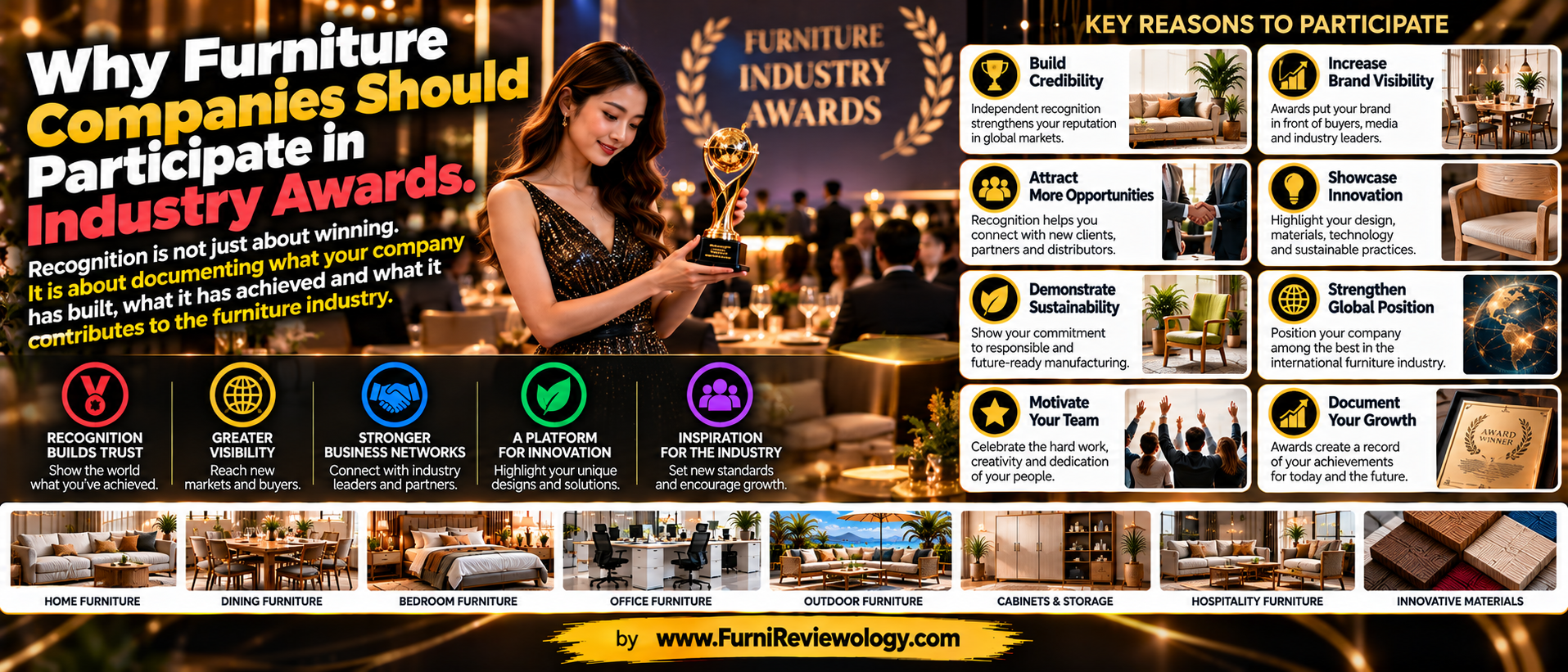
The global furniture industry is filled with companies doing important work—manufacturing products, developing new designs, improving production processes, investing in sustainability, training people, serving customers, expanding into new markets and solving complex supply-chain challenges.
Yet not every achievement becomes visible beyond the company itself.
That is one reason industry awards matter.
Participating in a furniture industry award gives a company an opportunity to put a specific achievement, project, product, person or contribution forward for formal consideration.
It does not guarantee an award, publicity, sales, investment or new customers.
But it can create a structured moment to ask an important business question:
What have we actually achieved—and can we demonstrate it?
Awards Turn Achievements Into Documented Stories
A company may have spent years developing a manufacturing capability.
A designer may have created an innovative furniture collection.
A retailer may have transformed its customer experience.
A manufacturer may have invested in sustainability, training or technology.
A startup may have introduced a new approach to furniture production.
These achievements can remain inside company presentations, websites and internal records.
An award submission provides another way to document them.
Many current furniture and design awards use categories that go beyond a single product. For example, current programmes recognise areas including innovation, sustainability, quality, leadership, retail, education, craftsmanship, service and industry contribution.
That means companies should not think of awards only as competitions for a new chair, sofa or table.
The achievement may be the business behind the furniture.
Participation Starts With Evidence
A strong award entry should not simply say:
“We are an excellent furniture company.”
It should demonstrate what the company has done.
Consider the difference.
Instead of:
“We are innovative.”
Document:
What was developed?
What problem did it address?
When was it introduced?
Who developed it?
What was different about the approach?
What evidence demonstrates the result?
What lessons were learned?
Instead of:
“We care about sustainability.”
Explain:
What materials or processes were changed?
What initiative was implemented?
What was the objective?
How was progress measured?
What evidence is available?
What remains to be improved?
This approach makes awards participation useful even before the result is announced.
The company is forced to examine its own work.
Recognition Can Cover the Whole Furniture Ecosystem
Furniture awards are increasingly broader than traditional product competitions.
Current programmes demonstrate recognition across different parts of the ecosystem.
The British Furniture Association's 2026 Future of Furniture awards, for example, recognised areas including education and training, sustainability, ESG reporting and individual leadership.
The 2026 JFS Furniture Awards expanded recognition to areas including retailers, independent retailers, startups, marketing, women in furniture and lifetime achievement, alongside categories such as design innovation, sustainability and service.
The Singapore Furniture Industries Council's Sol Awards also spans areas such as enterprise, customer experience, sustainability, emerging businesses and individual contribution.
This matters because the furniture industry is much larger than the finished product.
It includes:
Manufacturers → Designers → Suppliers → Component Makers → Retailers → Exporters → Importers → Hospitality Specialists → Logistics Companies → Technology Providers → Educators → Entrepreneurs → Industry Professionals
Every part of that chain can have achievements worth documenting.
Your Company Does Not Have to Be the Biggest
One misconception about awards is that only large companies should participate.
That is not necessarily how industry recognition programmes are structured.
Some awards explicitly include emerging businesses, independent retailers, startups, young designers and new entrants.
That creates an important opportunity for smaller furniture businesses.
A smaller manufacturer may have developed an exceptional production process.
A family-owned workshop may have preserved specialist craftsmanship.
A startup may have created a new furniture technology.
An independent retailer may have developed a distinctive customer experience.
A supplier may have solved a difficult sourcing problem.
The scale of the company and the significance of a particular achievement are not necessarily the same thing.
The relevant question is:
What have you done that is worth documenting and presenting?
Awards Can Encourage Companies to Define Their Own Achievements
There is another benefit to participation that receives less attention.
Preparing an entry requires clarity.
A company must often identify:
The challenge → The approach → The investment → The execution → The result → The evidence → The contribution
That exercise can reveal achievements that were previously difficult to articulate.
It can also help a company identify where evidence is missing.
For example:
A sustainability initiative may exist, but perhaps its objectives were never measured.
A product innovation may be impressive, but perhaps the development story has never been documented.
A training programme may be valuable, but perhaps participation and outcomes were never recorded.
An award submission can therefore become a useful internal documentation exercise.
Recognition Is Stronger When the Criteria Are Clear
Not every award programme operates in the same way.
Furniture companies should examine the rules before entering.
Look for information about:
eligibility
categories
judging criteria
judging panel
submission requirements
evidence requirements
entry fees
deadlines
conflicts of interest
use of submitted materials
finalist and winner publicity
intellectual-property considerations
For example, the JIDA Designer's Choice Award describes evaluation around areas including innovation and creativity, product quality and functionality, while its programme also identifies objectives such as recognising industry excellence, encouraging innovation and strengthening collaboration.
The MIFF 2026 Furniture Design Competition used criteria including creativity, functionality, ergonomics, safety, sustainability and presentation.
The lesson is simple:
Read the criteria before preparing the submission.
Do not submit the same generic company profile to every award.
Build the entry around the actual category.
Don't Enter Everything
More awards do not automatically mean more recognition.
A better approach is relevance.
Ask:
Does the category genuinely match our achievement?
If your strongest achievement is manufacturing innovation, enter where manufacturing or innovation is actually evaluated.
If your strongest contribution is sustainability, look for a relevant sustainability category.
If your achievement concerns a designer or product, consider design-focused recognition.
If your business has developed a successful training initiative, investigate education or skills categories.
The goal should be relevant participation, not simply collecting award logos.
Build an “Awards Evidence File”
Furniture companies can prepare throughout the year instead of starting from zero whenever an award deadline appears.
Create a simple internal folder containing:
Company
company history
key milestones
certifications
major investments
manufacturing capabilities
Products
product photographs
technical specifications
development stories
prototypes
new collections
Innovation
new processes
technologies
machinery
research
design development
Sustainability
materials
waste reduction initiatives
energy initiatives
responsible sourcing
measurable environmental programmes
People
leadership achievements
employee development
apprenticeships
training
community initiatives
Market
export development
new markets
partnerships
customer programmes
Evidence
photographs
project documentation
data
testimonials where appropriate
certifications
independent references
When an appropriate award appears, the company is ready.
Turn One Achievement Into a Complete Industry Story
Awards participation should not necessarily end with the submission.
An achievement can become part of a broader industry communication programme.
For example:
Achievement
↓
Award Entry
↓
Company Profile
↓
Industry Story
↓
Interview
↓
Product / Project Feature
↓
Industry Recognition
↓
Searchable Company Information
↓
Long-Term Industry Record
This is where the wider furniture information ecosystem becomes important.
A company should not allow an achievement to exist only inside an award submission form.
Tell the story.
Document the product.
Explain the process.
Show the people behind it.
Make the achievement understandable.
The Recognition Layer of the Furniture Ecosystem
This is an important role for The Furniture Times (TFT) and its connected ecosystem.
TFT can provide the story layer—reporting company achievements, interviews, launches, awards and industry developments.
FISE — Furniture Industry Search Engine provides the discovery layer—helping structure furniture businesses, categories, capabilities, locations and other industry information for discovery.
FurniReviewology provides the trust layer—creating a dedicated environment for furniture reviews, experiences and reputation-related information.
And an Awards ecosystem provides another important layer:
Recognition.
Together:
Story → Discovery → Trust → Recognition
That creates a much richer industry identity than a company website alone.
An Award Should Become Part of Your Company History
Winning is obviously meaningful to the recipient.
But even beyond winning, the process of documenting achievements contributes to the historical record of an industry.
Who was developing new furniture technology?
Who was investing in apprenticeships?
Who was creating new materials?
Who was building export markets?
Who was experimenting with sustainable production?
Who was developing new retail models?
Who was supporting emerging designers?
Who was creating new furniture businesses?
These stories matter.
An industry without documentation can easily lose the memory of its own development.
Awards can become one source of that documentation.
Participation Is Also a Signal of Engagement
Entering an industry award can demonstrate that a company is willing to place a particular achievement into a formal recognition process.
That is different from simply publishing an advertisement saying:
“We are the best.”
A structured award programme may ask the entrant to explain the achievement against defined criteria and, depending on the programme, submit it for review by judges or other evaluation mechanisms.
That distinction matters.
Self-promotion says what you believe about yourself.
An award submission gives you an opportunity to demonstrate a specific achievement against stated criteria.
The two should not be confused.
Prepare Your Entry Like a Journalist
Before submitting, ask five questions:
1. What happened?
State the achievement clearly.
2. Why does it matter?
Explain the industry, customer, design, manufacturing or business context.
3. What did you actually do?
Describe the work rather than using general marketing language.
4. What evidence supports the claim?
Use measurable information wherever it is genuinely available.
5. What can another industry professional learn from it?
This final question can transform an ordinary company submission into a meaningful industry story.
Furniture Companies: Start Building Your Recognition Record
Do not wait until an award deadline to discover that your best achievements were never properly documented.
Start now.
Create your achievement archive.
Photograph your projects.
Document your product development.
Record your innovations.
Track sustainability initiatives.
Document employee development.
Record major milestones.
Collect supporting evidence.
Identify the categories that genuinely match your work.
Then watch for relevant awards from credible furniture, design, trade and professional organisations.
The objective is not to enter every competition.
The objective is to make sure that meaningful work has a chance to be recognised, documented and remembered.
The Call to the Furniture Industry
Furniture companies should not wait for someone else to tell their story.
If you have built something meaningful, document it.
If you have created something innovative, explain it.
If your team has achieved something significant, recognise them.
If your company has contributed to the industry, put that contribution forward.
Manufacturers — document your manufacturing achievements.
Designers — submit your strongest work.
Retailers — document the experiences and innovations you have built.
Suppliers — show the contribution you make to the furniture value chain.
Startups — document the problem you are solving.
Artisans — preserve and present your craftsmanship.
Furniture professionals — document your contribution.
And when a credible, relevant award opportunity appears:
Consider participating.
Not because recognition is guaranteed.
Not because an award automatically creates business.
But because the furniture industry needs its achievements to be seen, documented, discussed and remembered.
The Global Furniture Ecosystem
The Furniture Industry is a $1 Trillion USD Ecosystem in the world
Furniture Industry Search Engine — FISE helps the world find them.
The Furniture Times — TFT tells their story.
FurniReviewology helps the world trust them.
Recognition gives the industry another question:
Who is contributing to the future of furniture—and how will that contribution be remembered?
Get your achievement documented.
Find the right category.
Prepare the evidence.
Participate where it genuinely fits.
Become part of the industry's evolving record.
The future of furniture is being built today. Its achievements deserve to be documented today too.