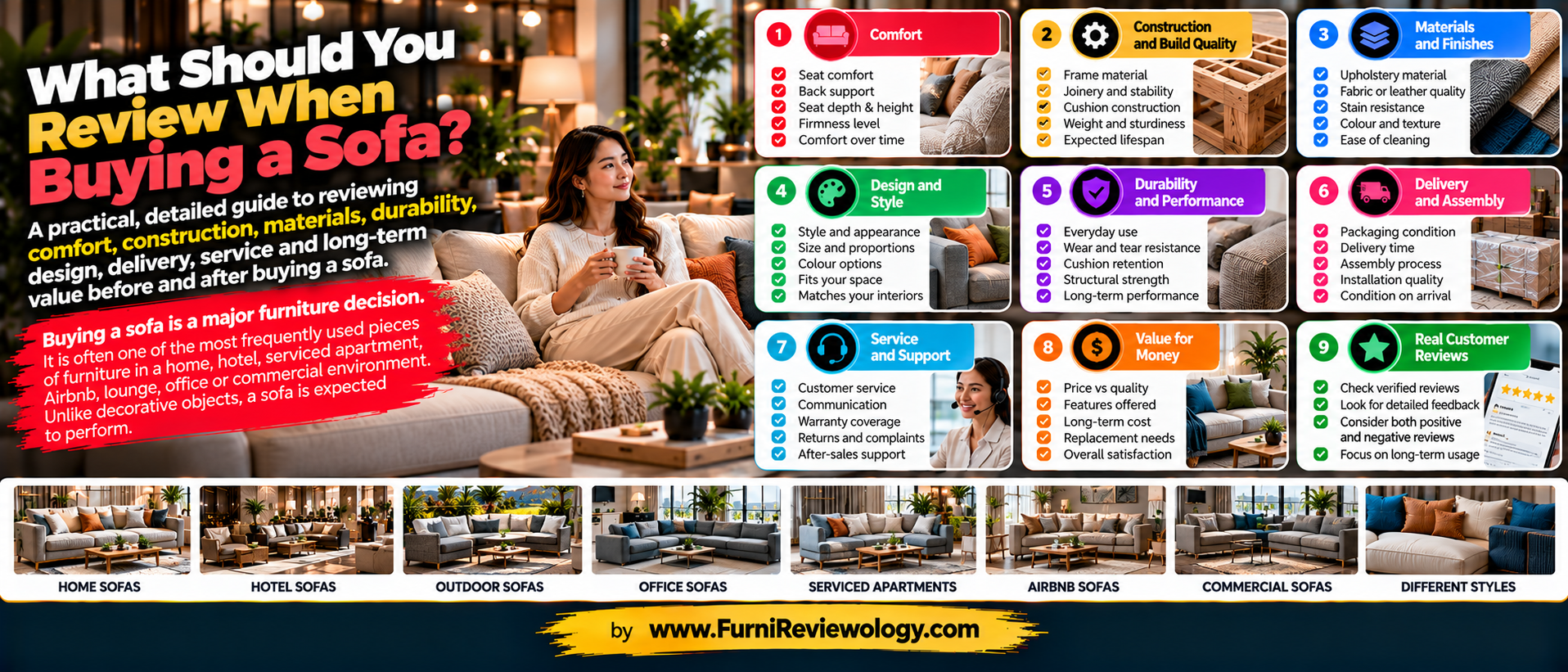
It is often one of the most frequently used pieces of furniture in a home, hotel, serviced apartment, Airbnb, lounge, office or commercial environment. Unlike decorative objects that may be looked at more often than they are used, a sofa is expected to perform.
People sit on it.
They sleep on it.
They relax on it.
Children may climb on it.
Guests may use it.
Pets may interact with it.
In commercial environments, hundreds or thousands of people may use it over its lifetime.
That makes the sofa-review process particularly important.
A photograph can show a sofa's appearance. A catalogue can provide dimensions and specifications. A star rating can provide a quick sentiment signal.
But a detailed sofa review can answer the questions that buyers actually need to understand:
Is it comfortable? Is it well constructed? How does it perform after months of use? Is the fabric practical? Does the frame remain stable? Was delivery handled properly? And did the furniture business stand behind the product?
A good sofa review should therefore examine much more than appearance.
It should evaluate the complete ownership experience.
1. Start With the Overall Buying Experience
Before reviewing the sofa itself, consider the entire journey.
The experience may include:
Search → Inquiry → Selection → Ordering → Payment → Production → Delivery → Assembly → Usage → Maintenance → After-Sales Service
Every stage can affect the customer's perception of the purchase.
For example, a sofa may be excellent once installed, but the overall experience may be affected by:
- unclear product information
- unexpected delivery delays
- poor packaging
- difficult assembly
- communication problems
- damaged components
Conversely, a minor delivery problem may be handled exceptionally well by the business.
A complete sofa review should therefore consider both:
the product
and
the experience surrounding the product.
2. Review the Sofa's Comfort
Comfort is usually one of the first things people want to know.
But comfort is subjective.
A buyer who prefers a firm sofa may dislike a soft sofa. Another buyer may have exactly the opposite preference.
Therefore, avoid simply writing:
“Very comfortable.”
Instead, explain the experience.
Consider:
- seat firmness
- seat depth
- back support
- cushion thickness
- armrest height
- seat height
- sitting posture
- suitability for long periods
- sleeping comfort if relevant
For example:
“The seats are relatively firm and provide good support for sitting for several hours.”
This tells another buyer considerably more.
3. Review the Seat Depth
Seat depth can significantly affect comfort.
A deep sofa may be comfortable for some people who like to lounge.
But it may be less suitable for people who prefer an upright sitting position.
When reviewing seat depth, consider:
- Who uses the sofa?
- Is it suitable for adults of different heights?
- Can users sit upright comfortably?
- Is it better suited to lounging?
- Does the back cushion compensate for the depth?
Where possible, provide actual dimensions rather than relying entirely on subjective descriptions.
4. Review Seat Height
Seat height is another practical consideration.
A sofa that looks excellent may be uncomfortable if the seat is too low or too high for the intended users.
Reviewers can consider:
- ease of sitting down
- ease of standing up
- suitability for older users
- relationship between seat height and table height
- overall posture
For hospitality or commercial furniture, these factors can become particularly important because the sofa may be used by a wide range of people.
5. Review Cushion Quality
The cushions are among the most important components of a sofa.
A review can examine:
- firmness
- softness
- rebound
- shape retention
- filling
- stitching
- removable covers
- maintenance
- movement during use
One particularly useful question is:
How have the cushions changed over time?
A sofa can feel excellent on the first day but change significantly after months of use.
A long-term review can explain whether the cushions:
- retain their shape
- become softer
- develop permanent compression
- require regular adjustment
- remain comfortable
6. Review the Frame
The frame is the structural foundation of the sofa.
Where information is available, examine:
- frame material
- construction
- joint quality
- stability
- weight
- visible structural components
- manufacturer specifications
A reviewer should avoid making technical claims that cannot be verified.
Instead of:
“This is definitely the strongest frame available.”
a responsible review might say:
“The manufacturer specifies a solid-wood frame, and after one year of daily use the sofa remains stable with no noticeable structural movement.”
The second statement is much more evidence-based.
7. Review the Sofa's Stability
A good sofa should feel stable during normal use.
Consider whether:
- the sofa rocks
- the legs remain secure
- joints loosen
- the frame moves
- cushions shift excessively
- sections separate unexpectedly
For modular sofas, examine how individual sections connect.
This is especially important when the sofa is frequently rearranged.
8. Review the Legs and Base
The legs may appear like a minor detail, but they contribute to stability, appearance and maintenance.
Consider:
- material
- attachment
- height
- stability
- floor protection
- ease of cleaning underneath
- resistance to loosening
Tall sofa legs may make cleaning underneath easier.
Low bases may create a different aesthetic and potentially reduce accessible cleaning space.
Neither is universally better.
The important question is:
Does the design work for the intended environment?
9. Review the Upholstery
Upholstery affects:
- appearance
- comfort
- durability
- maintenance
- cleaning
- touch
- temperature perception
When reviewing upholstery, consider:
Texture
Is it pleasant to touch?
Appearance
Does it look like the photographs?
Wear
Does it show signs of use?
Cleaning
Is it easy to maintain?
Staining
How does it respond to spills?
Fading
If exposed to sunlight, does the color change?
Stitching
Are seams neat and consistent?
A good review should distinguish personal preference from observable performance.
10. Review Fabric Practicality
Fabric can look beautiful in a showroom but behave differently in daily life.
Consider the intended household or environment.
For example:
Family home
Potential concerns may include:
- food spills
- children
- frequent sitting
- pets
Airbnb
Potential concerns may include:
- frequent guest turnover
- cleaning
- stain resistance
- durability
Hotel
Potential concerns may include:
- intensive use
- cleaning cycles
- commercial maintenance
A useful review should explain the environment.
11. Review Leather or Synthetic Upholstery Carefully
For leather or synthetic upholstery, examine:
- texture
- comfort
- stitching
- surface finish
- cleaning
- cracking
- peeling where applicable
- aging
- temperature feel
Avoid assuming that all leather or synthetic materials perform identically.
Different constructions and grades can behave very differently.
The most useful review identifies the actual material when the information is available.
12. Review the Stitching and Finishing
Small details can reveal a lot about manufacturing consistency.
Look at:
- seam alignment
- stitching consistency
- piping
- corners
- joins
- upholstery tension
- exposed surfaces
- finishing details
This does not mean that a single cosmetic imperfection automatically indicates poor furniture quality.
But repeated inconsistencies may be worth documenting.
Photographs can be particularly useful here.
13. Review the Sofa's Dimensions
A sofa should be reviewed in relation to the space where it will be used.
Important dimensions include:
- overall width
- overall depth
- overall height
- seat height
- seat depth
- armrest dimensions
- clearance requirements
- doorway access
A large sofa can look perfect in a spacious showroom but become overwhelming in a small apartment.
A detailed review should therefore consider scale and proportion.
14. Review How the Sofa Fits Through the Door
This is one of the most overlooked furniture-buying questions.
Before purchasing a large sofa, buyers should consider:
- entrance door width
- corridor width
- lift dimensions
- staircase turns
- apartment access
- packaging dimensions
- whether the sofa can be separated into modules
A review that mentions delivery access can save future buyers considerable trouble.
15. Review Assembly Requirements
Some sofas arrive almost completely assembled.
Others require:
- attaching legs
- connecting modules
- installing backrests
- assembling frames
- joining sectional pieces
Review:
- clarity of instructions
- tools required
- number of people needed
- assembly time
- difficulty
- final stability
For a modular sofa, also review whether the sections remain properly aligned after assembly.
16. Review Modular and Sectional Sofas Differently
Sectional sofas have their own review criteria.
Consider:
- how modules connect
- whether they separate during use
- flexibility of configuration
- corner-unit comfort
- movement of individual sections
- ease of rearrangement
- availability of additional modules
A modular sofa may be particularly useful for customers whose living spaces change over time.
But the review should explain how the system performs in practice.
17. Review Sleeping Functionality if It Is a Sofa Bed
A sofa bed needs to be reviewed as two products:
sofa
and
bed.
Consider:
Sofa mode
- comfort
- support
- appearance
- seating space
Bed mode
- conversion mechanism
- mattress thickness
- sleeping surface
- ease of opening
- ease of closing
- stability
- storage
A sofa bed should not be judged solely on how attractive it looks when folded.
18. Review Storage Features
Some sofas include:
- storage compartments
- adjustable headrests
- reclining mechanisms
- charging ports
- cup holders
- movable armrests
- sleeper mechanisms
Each feature should be reviewed for actual usefulness.
Ask:
- Does it work reliably?
- Is it easy to operate?
- Is it durable?
- Is it easy to maintain?
- Does the feature justify the additional cost?
More features do not automatically mean better value.
19. Review Reclining Mechanisms Carefully
For reclining sofas, evaluate:
- smoothness
- noise
- speed
- stability
- mechanical operation
- electrical components where applicable
- remote controls
- ease of maintenance
A review should ideally be based on repeated use rather than a single demonstration.
20. Review the Sofa's Durability Over Time
This may be the most important part of a long-term sofa review.
Ask:
How does the sofa look and perform after six months?
Then:
After one year?
Then:
After two years or more?
Look for:
- cushion compression
- frame movement
- fabric wear
- seam problems
- leg loosening
- squeaking
- color changes
- stains
- sagging
- mechanism problems
The longer the furniture has been used, the more useful the review can potentially be for durability assessment.
21. Review the Sofa According to Usage Intensity
A sofa used occasionally by two adults is very different from one used every day by a large family.
Likewise:
Residential use ≠ hotel use ≠ restaurant use ≠ office use.
A good review identifies the environment.
For example:
“This sofa has been used daily in a family living room for approximately 18 months.”
is much more informative than:
“This sofa is durable.”
22. Review Cleaning and Maintenance
A sofa requires maintenance.
A useful review can explain:
- how easy it is to vacuum
- whether cushions can be removed
- whether covers are washable
- how stains are handled
- whether special cleaning products are required
- how often maintenance is needed
For commercial environments, maintenance can become a major component of the total cost of ownership.
23. Review Pet and Family Friendliness Where Relevant
If a sofa is used in a household with:
- children
- dogs
- cats
- frequent guests
then the review can discuss practical experience.
For example:
- Does pet hair collect easily?
- Does the fabric snag?
- Are spills easy to clean?
- Does the structure tolerate frequent use?
- Are removable covers useful?
Again, the review should describe personal experience rather than making universal claims.
24. Review Color Accuracy
Furniture displayed online may appear differently depending on:
- screen settings
- lighting
- photography
- surrounding colors
A customer review can mention whether the actual sofa broadly matched the advertised appearance.
This is especially important for:
- neutral fabrics
- textured materials
- leather
- wood finishes
- custom colors
Where possible, customer photographs can help provide additional context.
25. Review the Packaging
Furniture can be damaged before it reaches the living room.
Review:
- packaging quality
- corner protection
- wrapping
- internal protection
- moisture protection where relevant
- damage upon arrival
A well-designed sofa can still create a poor customer experience if it arrives damaged because of inadequate packaging.
26. Review Delivery
Delivery is an important part of furniture quality from the customer's perspective.
Ask:
- Was the promised delivery date accurate?
- Was the delivery team professional?
- Was the sofa handled carefully?
- Was the packaging removed?
- Was installation provided?
- Did the furniture arrive without damage?
A review should distinguish between:
manufacturer performance
and
delivery-provider performance
where possible.
27. Review Customer Service
Customer service becomes especially important when something goes wrong.
Consider:
- response time
- communication
- professionalism
- willingness to investigate
- clarity of information
- problem resolution
A company cannot necessarily prevent every issue.
But its response can significantly affect the customer's overall experience.
28. Review Warranty and After-Sales Support
Before buying a sofa, buyers should understand:
- warranty duration
- what components are covered
- exclusions
- repair process
- replacement policies
- service locations
- claim requirements
A review can document how the warranty worked in practice.
For example:
“After a mechanism issue developed, the company arranged an inspection and replaced the component.”
This can be more informative than simply stating:
“Good warranty.”
29. Review Replacement Parts
This can be particularly important for long-term ownership.
Ask whether the business can provide:
- legs
- cushions
- covers
- hardware
- mechanisms
- electrical components
- replacement modules
Furniture that can be repaired rather than completely replaced may have practical long-term advantages.
30. Review Value for Money
Value is not simply price.
Consider:
Price + Quality + Durability + Comfort + Maintenance + Service + Expected Lifespan
A lower-priced sofa is not automatically better value.
A higher-priced sofa is not automatically better quality.
The useful review question is:
Did the overall experience justify the money paid?
And importantly:
Why?
31. Review the Sofa Against Its Intended Purpose
A sofa should be judged according to what it is designed to do.
For example:
Living room sofa
Prioritize:
- comfort
- aesthetics
- durability
- family use
Hotel lounge sofa
Prioritize:
- commercial durability
- cleanability
- design
- maintenance
Airbnb sofa
Prioritize:
- durability
- easy maintenance
- guest comfort
- appearance
Office sofa
Prioritize:
- professional appearance
- comfort
- frequent use
- maintenance
The same sofa may receive different evaluations depending on the application.
32. Review the Sofa's Design Longevity
A sofa's design is subjective.
But reviewers can still consider whether the style appears likely to work with changing interiors.
Questions include:
- Does the design feel timeless?
- Is it heavily trend-dependent?
- Does the color work with multiple interiors?
- Can cushions or accessories change its appearance?
- Is the sofa likely to remain visually appropriate?
These are opinions, so they should be presented as such.
33. Don't Review Only What You Like
A strong review should identify both strengths and limitations.
For example:
Strengths
- comfortable seating
- stable frame
- attractive upholstery
- easy cleaning
Limitations
- heavy
- difficult to move
- deep seating
- requires two people for assembly
This gives future buyers a more realistic picture.
The goal is not to praise or criticize.
The goal is to inform.
34. Don't Assume One Experience Represents Everyone
A single review is one experience.
It should not automatically become a universal conclusion.
For example:
“The sofa is uncomfortable.”
could actually mean:
“The sofa was too firm for my personal preference.”
Those are very different statements.
A trustworthy reviewer should distinguish:
personal preference
from
observable product performance.
35. Compare Reviews From Different Ownership Periods
When researching a sofa, look at:
New-owner reviews
Useful for:
- delivery
- packaging
- appearance
- assembly
- first impressions
Medium-term reviews
Useful for:
- comfort
- maintenance
- early wear
- cushion performance
Long-term reviews
Useful for:
- durability
- structural performance
- upholstery aging
- service experience
This creates a more complete picture.
36. Look for Patterns Across Reviews
Suppose one customer says:
“The cushions became soft.”
That is one data point.
Suppose twenty independent customers mention similar cushion changes after approximately one year.
That deserves closer attention.
Likewise, if many customers independently praise:
- frame stability
- customer service
- fabric performance
the recurring pattern can be useful.
But patterns should still be evaluated in context.
37. Verified Reviews Can Add Another Layer of Confidence
Where a platform provides verification, buyers can look for indicators such as:
- verified purchase
- verified ownership
- verified transaction
- verified project
- authenticated review
Verification can provide additional confidence that the reviewer has a legitimate relationship with the furniture.
It does not guarantee that every opinion is objectively correct.
But it can strengthen the foundation on which the review is evaluated.
38. What a Strong Sofa Review Could Look Like
A useful sofa review might contain:
Product: Three-seat fabric sofa
Usage: Family living room
Ownership: 14 months
Frequency: Daily
Comfort: Medium-firm seating; good for extended sitting
Frame: Remains stable
Cushions: Slightly softer after one year
Fabric: Easy to vacuum; minor staining cleaned successfully
Assembly: Legs required installation
Delivery: Arrived on the promised date
Service: Responsive when a minor issue was reported
Limitation: Sofa is relatively deep for smaller users
Overall experience: Good fit for buyers seeking a firm, spacious family sofa
Notice the difference.
This is not simply:
★★★★★
It is a record of experience.
39. The Sofa Review Checklist
Before publishing a sofa review, ask:
Product
- Did I identify the exact sofa?
- Did I mention important specifications?
Comfort
- Is the seat firm or soft?
- Is the depth comfortable?
- Is the back supportive?
Construction
- Does the sofa feel stable?
- Are the frame and legs performing well?
Materials
- What are the upholstery and frame materials?
- How have they performed?
Durability
- How long have I used the sofa?
- What has changed over time?
Maintenance
- Is cleaning easy?
- What maintenance is required?
Practicality
- Does it fit the intended room?
- Was assembly easy?
- Was delivery manageable?
Service
- How was the seller?
- Was customer support responsive?
Value
- Did the overall experience justify the price?
- Why?
Evidence
- Can I provide photographs?
- Can I explain specific examples?
40. The Most Important Question: Would You Buy It Again?
A useful final question is:
Knowing what you know now, would you buy the sofa again?
But even this question should be accompanied by an explanation.
For example:
“Yes, because the comfort and durability have met our expectations. The only drawback is that the fabric requires more maintenance than we originally expected.”
That is much more useful than:
“Yes, 5 stars!”
The reason behind the conclusion is what future buyers need.
41. How Furniture Businesses Can Benefit From Sofa Reviews
Furniture manufacturers and retailers should treat sofa reviews as valuable product feedback.
If customers repeatedly mention:
- cushion sagging
- difficult assembly
- excellent comfort
- fabric staining
- strong customer service
- delivery problems
the business has actionable information.
Reviews can therefore support:
Product Development
Quality Control
Customer Service
Marketing
Logistics
After-Sales Improvement
A review is not merely something to display on a website.
It can become a source of business intelligence.
42. From Sofa Reviews to Furniture Intelligence
When thousands of sofa reviews are structured and analyzed, much more information becomes possible.
A furniture intelligence system could potentially identify patterns around:
- comfort
- materials
- durability
- pricing
- delivery
- service
- maintenance
- customer expectations
AI can potentially summarize those patterns and help buyers ask more precise questions.
For example:
“Customers using this sofa in high-use residential environments frequently mention its firm seating and stable frame, while some report that the cushions soften over time.”
That is far more useful than simply displaying:
4.7 stars.
43. Why Sofa Reviews Matter to the Global Furniture Ecosystem
The sofa is just one furniture category.
The same review principles can be applied to:
- dining tables
- chairs
- beds
- wardrobes
- cabinets
- office furniture
- outdoor furniture
- hotel furniture
- resort furniture
- Airbnb furniture
- custom furniture
Each category has different review criteria.
But the underlying principle remains the same:
Furniture should be evaluated through real experience, not appearance alone.
44. FurniReviewology: Making Furniture Experiences More Useful
This is where FurniReviewology can play an important role in the broader furniture ecosystem.
The objective is not simply to collect more stars.
It is to help transform customer experiences into useful information.
A meaningful sofa review can connect:
Product → Experience → Evidence → Comparison → Trust
And when reviews are combined with furniture discovery and industry information, they can contribute to a larger ecosystem:
Search → Discover → Review → Understand → Trust → Decide
This creates a stronger information pathway for buyers and businesses.
Conclusion: Review the Sofa You Actually Lived With
A sofa should not be reviewed only when it arrives.
The most useful sofa review develops over time.
At first, you can review:
- appearance
- packaging
- delivery
- assembly
- first comfort impressions
After months, you can review:
- comfort
- cushion performance
- maintenance
- fabric
- stability
After years, you may be able to discuss:
- durability
- structural performance
- upholstery aging
- repairs
- warranty
- long-term value
That is why the best sofa reviews are not simply about how the sofa looks.
They are about how the sofa lives.
When reviewing a sofa, examine:
Comfort.
Construction.
Materials.
Dimensions.
Upholstery.
Cushions.
Durability.
Maintenance.
Delivery.
Assembly.
Customer service.
Warranty.
After-sales support.
Value.
Long-term performance.
And above all, provide the context behind your experience.
Because the most useful sofa review is not:
“★★★★★ — Great sofa!”
It is:
“Here is what I bought, how I used it, how long I have owned it, what worked, what could be improved, and what another buyer should know before making the same decision.”
That is the difference between a rating and a review.
And that is how individual customer experiences can become a valuable source of trust and intelligence for the global furniture industry.
The Global Furniture Ecosystem
FISE - Furniture Industry Search Engine helps the world find them.
TFT - The Furniture Times tells their story.
FurniReviewology helps the world trust them.