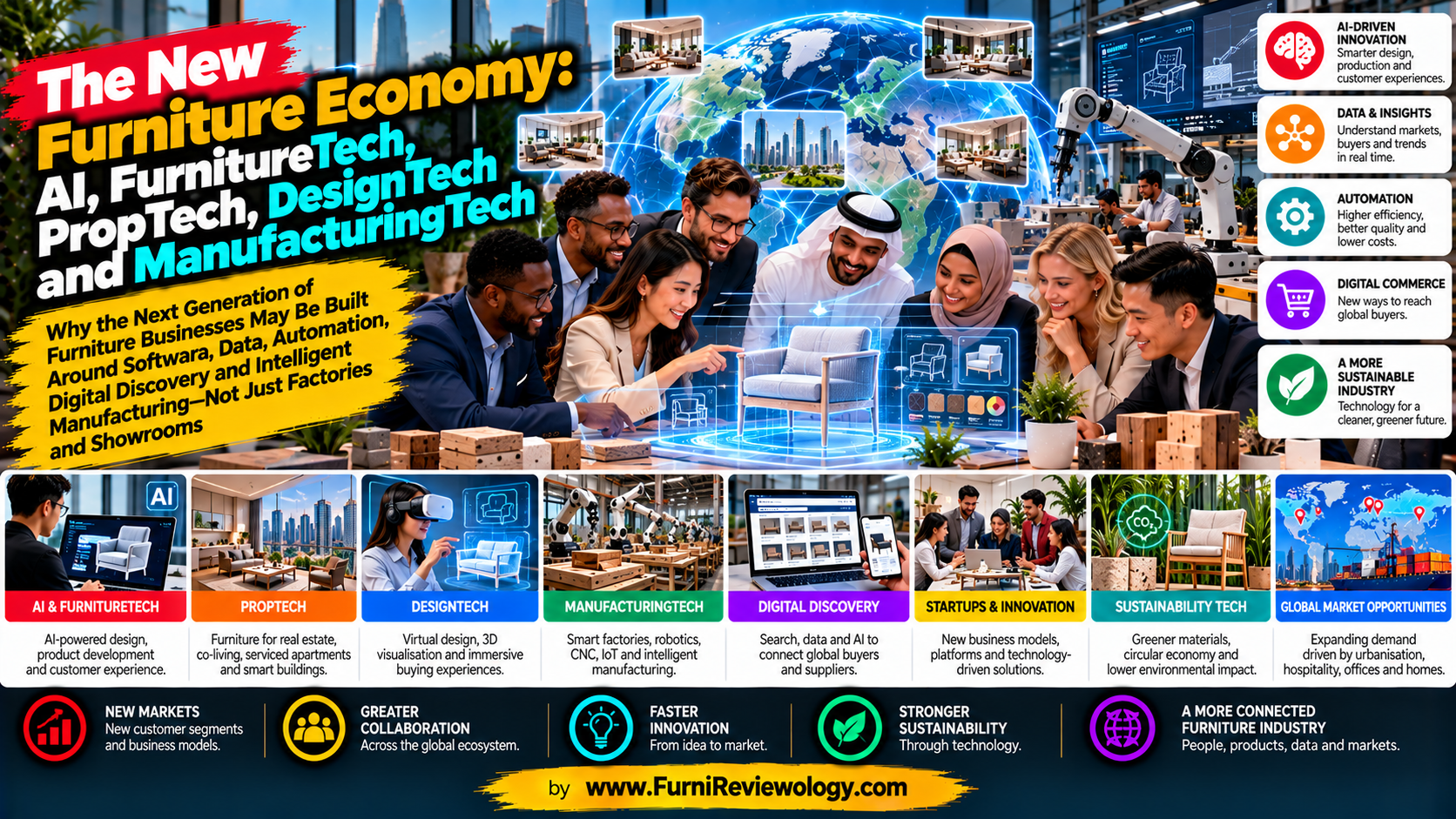
By The Furniture Times (TFT) Editorial Desk | October 20, 2026 | Furniture Startups | AI & Future Technology | FurnitureTech | PropTech | DesignTech | ManufacturingTech | Digital Commerce | Global Industry Intelligence
The Next Furniture Industry Leader May Not Own a Furniture Factory
For decades, furniture businesses have competed through manufacturing capacity, product quality, materials, design, distribution and price.
Those capabilities remain fundamental.
But an important transformation is taking place around them.
New technology businesses are addressing problems that have affected the furniture industry for years:
Slow product development.
Expensive photography.
Inaccurate product visualization.
Fragmented supplier discovery.
Complex customization.
Production waste.
Disconnected inventory systems.
Manual quotations.
Uncertain delivery schedules.
Limited customer information.
Poor integration between design and manufacturing.
These problems create opportunities for technology startups.
A software company may help a manufacturer reduce design-to-production errors.
An AI startup may help a retailer generate product imagery.
A PropTech platform may coordinate furniture procurement for residential developments.
A DesignTech company may make customized furniture easier to visualize.
A ManufacturingTech startup may improve production scheduling or machine utilization.
The new furniture economy is not about technology replacing furniture. It is about technology improving the systems that make furniture businesses work.
1. Understanding the Five Technology Forces
The terms FurnitureTech, PropTech, DesignTech and ManufacturingTech overlap. They describe different commercial opportunities rather than universally standardized industry classifications.
| Technology Sector | Main Focus | Furniture Industry Applications |
|---|---|---|
| Artificial Intelligence | Prediction, generation, analysis and automation | Product imagery, demand forecasting, customer support |
| FurnitureTech | Furniture-specific digital products and platforms | Search, catalogues, sourcing, reviews, retail technology |
| PropTech | Technology for property development and management | Furnishing procurement, rental properties, space planning |
| DesignTech | Digital design, visualization and product development | 3D models, AR, configurators, generative design |
| ManufacturingTech | Digital and automated industrial operations | CAD/CAM, CNC, robotics, quality inspection, production planning |
The greatest opportunities may emerge where these technologies intersect.
For example, a startup could combine AI, 3D visualization, automated quotations and manufacturing software to help customers configure furniture that can actually be produced.
That is more commercially meaningful than simply generating an attractive product image.
2. Artificial Intelligence: From Furniture Inspiration to Business Operations
AI has applications across the furniture value chain.
AI-Assisted Product Visualization
Furniture companies traditionally invest significant resources in photography, physical room sets and product rendering.
AI-assisted tools can help generate lifestyle imagery, explore visual concepts and create variations.
However, generated images must be checked carefully.
AI may alter dimensions, materials, stitching, construction details or product features.
A visually convincing image is not necessarily an accurate product representation.
AI Customer Support
Furniture retailers often receive repetitive questions about dimensions, materials, delivery, assembly and warranties.
AI-assisted systems can help answer common enquiries and route complex issues to staff.
AI Demand Forecasting
Retailers and manufacturers can analyze sales history, seasonality, inventory and other relevant data to improve forecasting.
Forecasts remain uncertain, particularly when markets change abruptly.
AI Product Data Management
AI can help classify catalogues, organize product attributes and identify incomplete descriptions.
AI Supplier Discovery
Industry-specific search systems can help buyers identify potentially relevant suppliers based on categories, capabilities and locations.
The startup opportunity
Build AI products that solve a measurable furniture-industry problem.
Do not sell AI merely as a fashionable feature.
The question is not whether a furniture company uses AI. It is whether AI improves an important business outcome.
3. FurnitureTech: Building the Digital Infrastructure of the Industry
FurnitureTech can be understood as technology specifically designed around furniture-industry needs.
Potential business models include:
Furniture supplier search platforms.
Digital catalogues.
Furniture product databases.
B2B sourcing software.
Furniture retail management systems.
Product configuration.
Procurement platforms.
Inventory synchronization.
Customer review infrastructure.
Delivery coordination.
Repair and refurbishment marketplaces.
Furniture rental management.
The opportunity is substantial because furniture transactions involve complex information.
A buyer may need to compare dimensions, materials, finishes, quantities, lead times, certifications and supplier capabilities.
A manufacturer may need to manage thousands of product variants.
A retailer may need to synchronize online listings with warehouse stock.
A hospitality buyer may need to coordinate hundreds of furniture items across multiple project locations.
General-purpose software can support these tasks, but specialized tools may address furniture-specific requirements more effectively.
What successful FurnitureTech startups should understand
Furniture is not a uniform product.
A sofa, wardrobe, office chair and hotel bed involve different specifications, logistics and buying decisions.
The strongest FurnitureTech businesses will understand those differences.
Industry expertise can be as important as software engineering.
4. PropTech: Connecting Property Development With Furniture Procurement
PropTech is often associated with property transactions, building management, leasing and real-estate operations.
But property and furniture are closely connected.
Every furnished apartment, hotel, student accommodation project, serviced residence and commercial office creates furniture-related requirements.
Consider a developer preparing 300 residential units for occupancy.
The project may require:
Beds.
Wardrobes.
Dining furniture.
Sofas.
Workstations.
Lighting.
Storage.
Curtains and interior furnishings.
Delivery.
Installation.
Maintenance.
Replacement planning.
A PropTech platform that integrates furnishing requirements with property management could help coordinate procurement and operational information.
Opportunities for startups
Furnishing-as-a-Service: Furniture packages and ongoing support for property operators.
Rental Property Furnishing: Standardized furnishing solutions for rental units.
Short-Term Rental Technology: Inventory, maintenance and replacement management for Airbnb and homestay properties.
Digital Property Fit-Out: Coordinating room specifications, product selections and installation.
Furniture Asset Management: Tracking furniture location, condition, warranty and replacement cycles.
The commercial challenge
Property projects have budgets, deadlines and complex procurement requirements.
A startup must demonstrate reliability and measurable value.
A beautiful digital interface is not enough if furniture arrives late or does not fit the property.
PropTech creates an opportunity to connect the property lifecycle with the furniture lifecycle.
5. DesignTech: From Sketches to Configurable Furniture
DesignTech is changing how furniture concepts are created, presented and refined.
Traditionally, designers may produce drawings, prototypes and renderings before a product reaches manufacturing.
Digital tools can connect these activities more closely.
Applications include:
3D modeling.
Parametric design.
Virtual prototyping.
Material visualization.
Product configuration.
Augmented reality.
Generative design.
Collaborative design review.
Technical drawings.
Manufacturing preparation.
A useful real-world example is Autodesk Fusion, which supports furniture-related modeling, documentation and CNC manufacturing workflows. Its furniture-specific materials describe integrated CAD/CAM processes, parametric modeling and production preparation. <Cite refs={["turn826440search0","turn826440search3"]}/>
Why this matters
A designer changing the width of a cabinet may need corresponding updates to drawings, panels and machining information.
Connected design systems can reduce the manual work involved in maintaining these relationships.
But digital design still requires engineering validation.
A generated concept is not automatically structurally sound or manufacturable.
The future of furniture design is not only faster creativity. It is a stronger connection between creative intent and production reality.
6. ManufacturingTech: The Factory as a Connected Digital System
ManufacturingTech addresses the industrial side of furniture production.
Potential applications include:
CNC automation.
Robotic handling.
Machine monitoring.
Production scheduling.
Digital work instructions.
Automated nesting.
Material optimization.
Quality inspection.
Maintenance prediction.
Factory data collection.
Digital bills of materials.
Inventory and procurement integration.
The objective is not necessarily to replace workers.
Many technologies aim to improve consistency, reduce repetitive work, identify errors earlier and support better production decisions.
Example: Panel Furniture Manufacturing
A cabinet manufacturer receives an order with customized dimensions.
A connected workflow could:
Capture the customer's configuration.
Generate approved production specifications.
Produce a bill of materials.
Prepare cutting and machining instructions.
Optimize panel utilization.
Schedule production.
Track progress.
Support final inspection and delivery.
The value comes from reducing disconnected steps.
Why adoption can be difficult
Factories may operate older machinery.
Product data may be inconsistent.
Employees may need training.
Software systems may not communicate with one another.
Implementation costs can exceed expectations.
ManufacturingTech succeeds when it fits real factory operations—not when a factory is forced to reorganize itself around an unsuitable system.
7. Real Examples: Technology Is Already Entering the Furniture Value Chain
The emerging furniture technology economy is not purely theoretical.
Several established businesses and newer technology providers illustrate the range of approaches.
<Entity category="company" value="IKEA"/> Kreativ — Digital Room Visualization
IKEA introduced its AI-driven Kreativ experience to help customers visualize furniture in their own spaces using digital room-design technology.
The company describes capabilities involving spatial computing, machine learning and 3D visualization. <Cite ref="turn826440search4"/>
The broader lesson is that furniture retailers increasingly compete on the quality of the buying experience—not only product selection.
<Entity category="company" value="Threekit"/> — 3D Product Configuration
Threekit offers furniture-focused 3D configurators and augmented-reality visualization.
Its platform describes connections between configurable product choices and manufacturing information, including bills of materials and related outputs. <Cite ref="turn826440search1"/>
This illustrates the opportunity to connect customization with operational processes.
<Entity category="company" value="Autodesk"/> Fusion — Design-to-Manufacturing Workflows
Autodesk Fusion provides integrated tools for 3D design, documentation and computer-aided manufacturing.
For furniture and woodworking applications, its published workflows include CNC preparation, shop drawings and design variations. <Cite ref="turn826440search0"/>
Furniture-Focused AI Providers
In March 2026, Furniture Today reported on technology businesses including Presti.ai, Intiaro and Solvea, highlighting applications in AI product imagery, 3D production and customer-response automation. <Cite ref="turn826440search8"/>
These examples are not all early-stage startups. They illustrate active technology categories and possible business models rather than a ranking or endorsement.
The important trend is that technology providers are addressing specific commercial problems across furniture design, selling and operations.
8. The Ten FurnitureTech Startup Opportunities Worth Exploring
The industry contains numerous problems that startups could address.
Opportunity 1 — AI Furniture Catalogue Management
Software that organizes product specifications, photographs, materials, finishes and categories across large furniture catalogues.
Opportunity 2 — B2B Furniture Supplier Discovery
Industry-specific search tools that help buyers find manufacturers, components, materials and specialized capabilities.
Opportunity 3 — Digital Furniture Configuration
Systems that allow buyers to select dimensions, materials, colors and options while maintaining accurate production rules.
Opportunity 4 — Furniture Manufacturing Software for SMEs
Affordable production planning, inventory, job tracking and quotation systems designed for smaller factories.
Opportunity 5 — Hospitality Furniture Procurement Technology
Platforms connecting developers, designers, suppliers, budgets, specifications and delivery schedules.
Opportunity 6 — Furniture Lifecycle Management
Technology for tracking warranties, repairs, replacement parts and furniture assets.
Opportunity 7 — Furniture Recycling and Refurbishment
Digital services connecting used furniture, repair providers, commercial buyers and material recovery businesses.
Opportunity 8 — Furniture Quality Inspection Technology
Computer vision and data systems that assist with defect detection, inspection records and traceability.
Opportunity 9 — Furniture Delivery and Installation Coordination
Tools for complex deliveries, assembly scheduling, customer communication and service management.
Opportunity 10 — Furniture Industry Intelligence
Platforms organizing market information, business data, product categories, industry news and relevant company developments.
These are opportunity areas, not guarantees of startup success.
Each requires validation of customer demand, willingness to pay, technical feasibility and competition.
9. The Biggest Technology Opportunity May Be the Problem Nobody Wants to Solve: Data Fragmentation
Furniture businesses frequently store information in disconnected systems.
Product photographs in one folder.
Dimensions in spreadsheets.
Materials in PDFs.
Pricing in accounting software.
Manufacturing instructions in another system.
Inventory in a warehouse database.
Customer enquiries in messaging applications.
Supplier information in email conversations.
This creates inefficiency.
It also limits the effectiveness of AI.
An AI system cannot reliably identify the correct product dimensions if the company's source information is contradictory.
A configurator cannot generate accurate quotations without dependable pricing rules.
A manufacturing platform cannot prepare correct instructions from incomplete product data.
Before the furniture industry can become truly AI-enabled, much of its product and business information must become better structured.
That creates opportunities for startups working on product information management, interoperability, data quality and specialized search.
10. The New Furniture Startup Business Models
Technology startups can serve the furniture industry through different revenue models.
| Business Model | Example Application | Commercial Consideration |
|---|---|---|
| SaaS Subscription | Factory management or catalogue software | Retention and ongoing product value |
| Usage-Based Pricing | Rendering, AI processing or API calls | Predictable unit economics |
| Enterprise Licensing | Large retail or manufacturing systems | Long sales cycles and integration |
| Transaction Fees | Sourcing or procurement marketplace | Transaction verification and trust |
| Implementation Services | Software integration and training | Delivery capacity and service margins |
| Data Services | Industry intelligence or product data | Accuracy, rights and data maintenance |
| Hardware + Software | Machine monitoring or automation | Installation, support and capital needs |
| Managed Services | Furniture visualization or catalogue operations | Labor intensity and scalability |
A startup should select its business model according to customer behavior and delivered value.
A small workshop may prefer simple subscription pricing.
A large manufacturer may require enterprise integration and service-level commitments.
A marketplace may struggle until both suppliers and buyers participate.
A technically impressive product without a viable commercial model is not yet a sustainable business.
11. What Investors Should Look for in Furniture Technology Startups
Furniture technology can be attractive because it addresses an established industry with recurring operational needs.
But investors should examine whether the startup has identified a genuine problem.
Important questions include:
Is the problem frequent and expensive?
Who makes the buying decision?
Does the customer have a budget?
How much time or money does the solution save?
Can it integrate with existing systems?
Does it require extensive customization?
How difficult is customer onboarding?
Are results measurable?
Is the startup dependent on one large customer?
Can competitors replicate the product?
Does the company understand furniture-industry workflows?
A critical distinction
A startup generating attractive furniture images may have a useful creative tool.
A startup connecting accurate product configuration to production-ready information may solve a deeper operational problem.
Both can create value, but their customers, risks and competitive advantages may differ.
Investors should evaluate the business problem and defensibility—not simply the presence of AI in a pitch deck.
12. Furniture Manufacturers: Start With One Problem, Not Twenty Technologies
Manufacturers may feel pressure to adopt every new technology.
That approach can create unnecessary expense.
A better strategy is to identify operational bottlenecks.
For example:
If quotations take too long, investigate quotation automation.
If panel waste is high, examine nesting optimization.
If product information is inconsistent, improve data management.
If customers struggle to visualize options, test product configuration.
If production delays are frequent, examine scheduling and tracking systems.
If quality defects are difficult to trace, improve inspection records.
A practical 90-day technology pilot
Days 1–30: Define one problem and measure its current impact.
Days 31–60: Test a suitable solution with a limited group or workflow.
Days 61–90: Evaluate cost, accuracy, productivity, employee experience and return on investment.
Continue only when the evidence supports further investment.
Digital transformation should be measured in operational improvements—not the number of software subscriptions a company purchases.
13. Why SMEs Could Become an Important FurnitureTech Market
Small and medium-sized furniture businesses often face many of the same operational problems as larger manufacturers.
But their budgets and technical resources are different.
They may need:
Affordable inventory systems.
Simple quotation tools.
Digital catalogues.
Basic production tracking.
Website integration.
Customer relationship management.
Accessible 3D visualization.
Industry-specific marketing tools.
Supplier discovery.
A startup that offers a practical, easy-to-use solution may find opportunities among businesses that have historically relied on spreadsheets and manual processes.
However, affordability alone is not enough.
SMEs also need reliable support, clear training and tools that fit existing workflows.
The opportunity is not merely to make enterprise software cheaper. It is to design technology around the realities of smaller furniture businesses.
14. The Global Furniture Startup Opportunity: Different Regions, Different Problems
Furniture technology opportunities vary by market.
Asia-Pacific
Manufacturing productivity, export processes, digital catalogues, production automation and supplier discovery.
Europe
Design integration, circularity, product documentation, repairability and manufacturing efficiency.
North America
Retail technology, visualization, customer experience, logistics and manufacturing software.
Middle East
Hospitality procurement, property furnishing, project coordination and premium customization.
Africa
Accessible business software, local supplier discovery, distribution, skills development and digital retail infrastructure.
Latin America
Regional commerce, inventory management, supplier networks, manufacturing productivity and logistics.
These are potential opportunity themes, not uniform descriptions of every country.
A startup should validate the needs of its specific market.
15. The Challenges Furniture Technology Startups Must Overcome
The furniture industry offers opportunities, but it is not an easy market.
Fragmented Customers
Thousands of businesses operate with different processes, product categories and technical capabilities.
Long Adoption Cycles
Manufacturers may be cautious about changing established systems.
Poor Data Quality
Product information is often incomplete or inconsistent.
Integration Complexity
Software may need to connect with ERP, CAD, CAM, e-commerce and accounting systems.
Limited Budgets
Some SMEs cannot justify expensive technology subscriptions.
Operational Risk
Incorrect manufacturing data can create material waste and production errors.
AI Reliability
Generated information may be inaccurate or misleading.
Privacy and Security
Business information, customer data and proprietary designs require appropriate protection.
Commercial Trust
Customers need evidence that a startup will remain reliable and provide ongoing support.
International Expansion
Different markets may require localization, technical standards and country-specific business processes.
FurnitureTech founders need patience, industry knowledge and strong execution—not only an attractive product demonstration.
16. TFT Academy and the Furniture Technology Skills Gap
Technology adoption requires people who understand both furniture and digital systems.
The industry needs professionals capable of working across:
Furniture design.
CAD/CAM.
Manufacturing engineering.
Automation.
AI applications.
Product data management.
Digital marketing.
E-commerce.
Supply-chain analytics.
Cybersecurity.
Quality control.
Software implementation.
This creates an important role for education and professional development.
The broader TFT Academy vision can contribute to conversations about furniture-industry skills, training and future workforce requirements.
A technology startup may develop an excellent system.
But its success depends partly on whether businesses have the people and knowledge required to use it effectively.
The future furniture workforce will need to combine craftsmanship, engineering, commercial judgment and digital capability.
17. TFT + FISE + FurniReviewology: Where Startups Fit Into a Connected Industry
Furniture startups need more than funding.
They need visibility.
They need customers.
They need partners.
They need industry credibility.
They need opportunities to explain what they are building.
This is where a connected furniture information ecosystem can play a role.
The Furniture Times — TFT
TFT tells their story.
Technology founders can contribute industry insights, explain product innovations, share company developments and participate in relevant editorial coverage.
Furniture Industry Search Engine — FISE
FISE helps the world find them.
FurnitureTech, PropTech, DesignTech and ManufacturingTech businesses can build clearer industry identities and describe the furniture-related solutions they offer, subject to available listing features.
FurniReviewology
FurniReviewology helps the world trust them.
Genuine customer experiences and relevant reviews can contribute information that helps potential buyers evaluate products and service providers.
Together, these platforms reflect a broader approach:
STORY → SEARCH → TRUST → CONNECTION
A startup needs to be understood.
It needs to be discoverable.
It needs to demonstrate credible value.
And it needs to build relationships with the industry it serves.
18. An Open Invitation to Furniture Technology Startups
Are you developing an AI tool for furniture businesses?
Building manufacturing software?
Creating a 3D furniture configurator?
Developing a PropTech furnishing solution?
Working on automated furniture production?
Building a furniture sourcing platform?
Developing circular-economy technology?
Creating smarter furniture products?
Working on furniture logistics or installation technology?
The global furniture industry needs to know what you are building.
Prepare a clear introduction to your company.
Explain the problem you solve.
Identify the customers you serve.
Demonstrate how your technology works.
Share measurable results where available.
Describe your development stage accurately.
Identify the partnerships you need.
Explore opportunities to build your presence within the wider furniture ecosystem.
The next important furniture innovation may come from a software developer, engineer, designer or entrepreneur who has never owned a furniture factory.
19. The Furniture Industry Operating System: A Long-Term Vision
The future furniture economy may increasingly depend on connections between different digital systems.
Imagine a more connected industry workflow.
A buyer identifies a furniture requirement.
A search platform helps discover potential suppliers.
A configurator helps specify the product.
A design system prepares accurate technical information.
Manufacturing software supports production planning.
A logistics platform coordinates delivery.
A review system captures customer experience.
Industry intelligence helps businesses understand broader market changes.
This is not a description of one fully integrated system already operating across the global industry.
It is a strategic vision for how complementary technologies could work together.
The challenge is interoperability.
Different platforms must exchange information accurately, securely and with appropriate permissions.
The greatest long-term opportunity may lie not in creating another isolated application, but in connecting the systems that already support furniture businesses.
20. The Next Decade: Who Will Build the Future of Furniture?
The next generation of furniture industry leaders may emerge from unexpected places.
A startup developing better production software.
A team building accurate product data infrastructure.
A company simplifying hospitality procurement.
An entrepreneur creating a repair marketplace.
A designer developing configurable furniture systems.
An engineer improving factory automation.
A technology company helping buyers discover manufacturers across countries.
These businesses will not eliminate the importance of furniture craftsmanship or manufacturing expertise.
Instead, the strongest innovations may help those capabilities reach more customers and operate more effectively.
The global furniture industry needs manufacturers.
It needs designers.
It needs retailers.
It needs suppliers.
And increasingly, it needs technology companies that understand the industry's problems.
The new furniture economy will be shaped by the businesses that connect physical products with intelligent digital systems.
Conclusion: The Furniture Industry Is Becoming a Technology Industry Too
Furniture will always be physical.
People will still need chairs, tables, beds, sofas, storage and furnishings.
Materials will still matter.
Craftsmanship will still matter.
Manufacturing quality will still matter.
But the systems surrounding those products are changing.
AI can support decision-making.
FurnitureTech can improve discovery and commerce.
PropTech can connect furniture with buildings and property operations.
DesignTech can improve visualization and customization.
ManufacturingTech can connect design with production.
The opportunity is not technology for its own sake.
It is a more productive, searchable, responsive and connected furniture economy.
The Future of Furniture Will Be Built by Manufacturers—and by the Technology Innovators Who Help Them Work Smarter.
Furniture Startups: Build the Solution. Demonstrate the Value. Tell the Industry Your Story.
The Global Furniture Ecosystem
The Furniture Industry is a $1 Trillion USD Ecosystem in the world.
Furniture Industry Search Engine — FISE helps the world find them.
The Furniture Times — TFT tells their story.
FurniReviewology helps the world trust them.
Search. Connect. Discuss. Deal.
Explore the ecosystem:
https://thefurnituretimes.com/
https://furnitureindustrysearchengine.com/