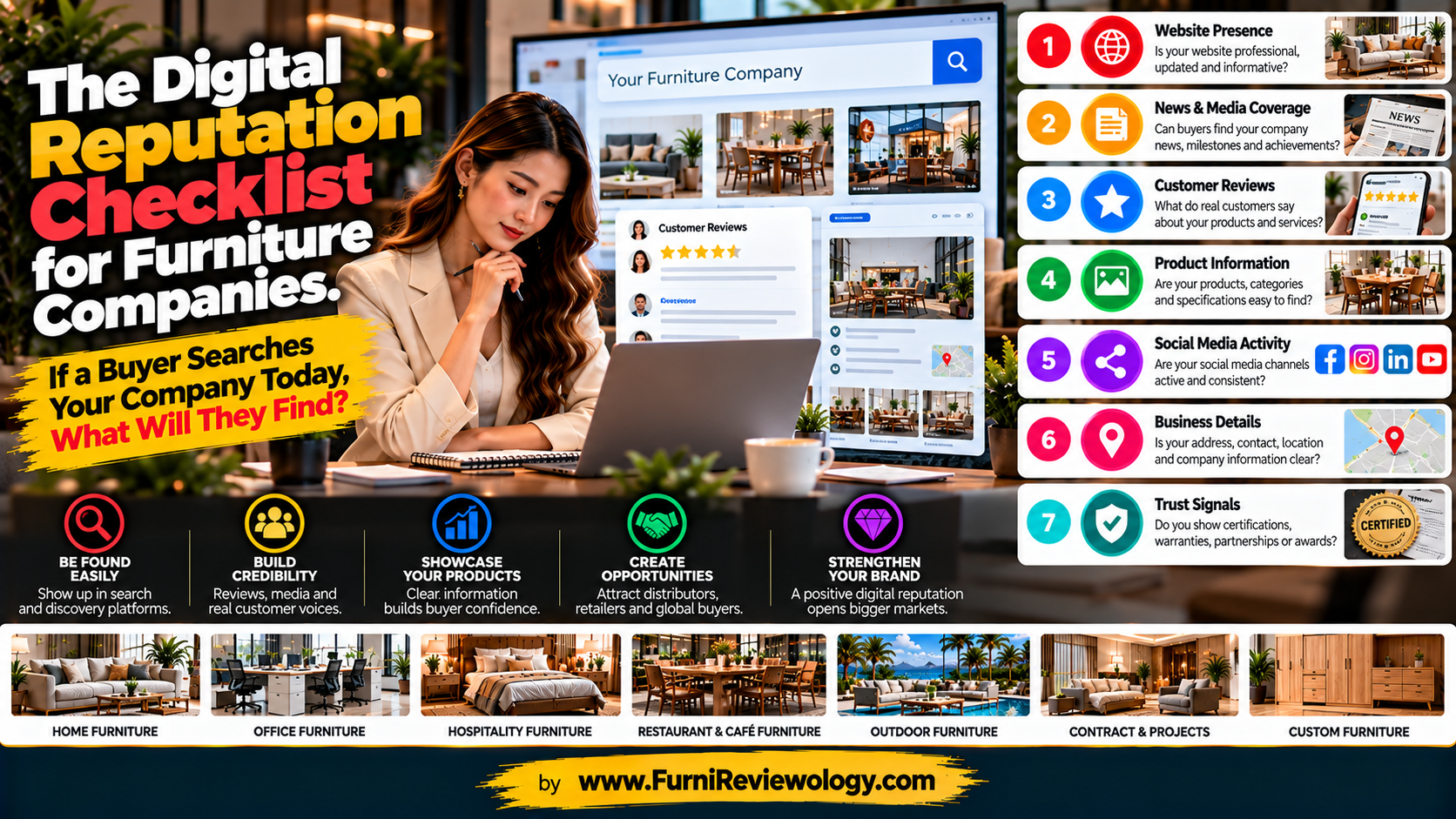
A furniture company's reputation used to be built largely through:
showrooms, trade fairs, referrals, catalogues, salespeople and word of mouth.
Those channels still matter.
But the first impression increasingly happens somewhere else:
online.
A potential buyer may search your company before sending an inquiry.
They may look at your website.
They may examine your products.
They may search for reviews.
They may check your social media.
They may look for projects you have completed.
They may investigate your company history.
They may compare you with other manufacturers or suppliers.
They may search your name together with words such as:
reviews
quality
manufacturer
supplier
complaints
hotel furniture
outdoor furniture
exporter
custom furniture
country
The question is therefore no longer simply:
“Do we have a website?”
The more important question is:
“What does the internet tell a potential buyer about us?”
That is your digital reputation.
The Digital Reputation Checklist
Use the following as a practical furniture-company audit.
You do not need to achieve perfection.
The objective is to identify what is missing, what is inaccurate, what is outdated and what needs attention.
CHECK 1 — COMPANY IDENTITY
Can a buyer immediately understand who you are?
Your basic digital identity should clearly communicate:
company name;
trading name, if different;
country;
city or operating location;
business type;
primary furniture categories;
website;
contact information;
years of operation where appropriate;
principal markets;
manufacturing or sourcing role.
Ask:
If someone discovers our company for the first time, can they understand what we actually do within 30 seconds?
If not, your reputation begins with confusion.
CHECK 2 — COMPANY INFORMATION CONSISTENCY
Search your company name across different platforms.
Compare:
website;
business listings;
social profiles;
industry directories;
trade-fair profiles;
marketplace pages;
association listings;
press coverage;
catalogue platforms.
Look for inconsistencies in:
company name;
address;
telephone;
email;
website;
founding date;
product descriptions;
business category;
factory location;
company history.
Reputation rule:
The same company should not appear to be five different companies across five different platforms.
Create a master company-information document.
Use it as the reference for future listings.
CHECK 3 — WEBSITE
Your website remains one of the most important places for buyers to investigate your company.
Ask:
Can visitors understand:
what you manufacture?
what you supply?
who you serve?
where you operate?
what materials you use?
what industries you serve?
whether you export?
what your capabilities are?
how to contact you?
Product pages
Do they include useful information such as:
dimensions;
materials;
finishes;
applications;
technical specifications;
available options;
care information;
photographs;
downloadable information where appropriate?
A beautiful website with very little useful information may create attention without creating confidence.
CHECK 4 — SEARCH YOUR OWN COMPANY
Open a private/incognito browser window if useful.
Search:
“Company Name”
Then search:
“Company Name” + furniture
“Company Name” + reviews
“Company Name” + quality
“Company Name” + supplier
“Company Name” + manufacturer
“Company Name” + complaints
“Company Name” + projects
“Company Name” + country
“Company Name” + product category
Now look at the results as a stranger.
Ask:
Would I understand this company?
Would I know whether it is legitimate?
Would I know what it manufactures?
Would I find evidence of its experience?
Would I know how to contact it?
Would I feel comfortable investigating further?
This is one of the simplest reputation audits a company can perform.
CHECK 5 — REVIEWS
Reviews can become an important part of a company's digital reputation.
But the goal should not be:
“Get as many five-star reviews as possible.”
The goal should be:
“Build a credible record of genuine customer experiences.”
The FTC advises businesses not to ask only customers expected to leave positive reviews and says companies should not discourage negative reviews. It also warns against fake or manipulated reviews.
Audit:
How many genuine reviews exist?
How recent are they?
Are they detailed?
Do they relate to actual products or services?
Are there reviews across more than one relevant platform?
Does the company respond?
Are recurring complaints visible?
Are customers describing specific experiences?
Remember:
A collection of authentic experiences is more useful than a manufactured perfect score.
CHECK 6 — NEVER BUY YOUR REPUTATION
This should be a red-line item.
Do not:
buy fake reviews;
create fake customer accounts;
pay for fabricated testimonials;
ask employees to pretend to be customers;
pay for guaranteed positive reviews;
offer incentives specifically for five-star reviews;
suppress legitimate negative experiences simply because they are negative;
publish fabricated customer stories.
The FTC's current Consumer Reviews and Testimonials Rule prohibits certain fake or false reviews, buying or selling reviews, incentives conditioned on particular sentiment, certain undisclosed insider testimonials, and certain review-suppression practices.
The precise legal obligations vary by jurisdiction, so furniture companies should also check the laws and platform rules applicable to their markets.
The principle is universal:
Do not manufacture trust. Earn it.
CHECK 7 — REVIEW RESPONSE
A review is not the end of the conversation.
It can be the beginning.
Check whether your company responds appropriately to:
positive reviews;
neutral reviews;
negative reviews;
questions;
complaints;
delivery issues;
product concerns.
A good response should generally be:
professional
calm
specific
respectful
solution-oriented
Avoid public arguments.
Avoid insulting customers.
Avoid revealing private customer information.
Avoid making claims you cannot substantiate.
If the issue needs investigation, move the detailed case discussion into an appropriate private channel while keeping the public response professional.
CHECK 8 — NEGATIVE REVIEWS
Do not automatically treat every negative review as a reputation disaster.
First ask:
Is the complaint genuine?
Is it factually accurate?
Is it an isolated event?
Is the same problem appearing repeatedly?
Did the company respond?
Was the issue resolved?
Does the complaint reveal an operational problem?
A negative review can sometimes reveal a weakness the company itself had not recognized.
The important question becomes:
What can we learn from this?
CHECK 9 — YOUR DIGITAL FOOTPRINT
List every place where your company appears online.
For example:
website;
Google;
LinkedIn;
Facebook;
Instagram;
YouTube;
Pinterest;
industry directories;
trade associations;
trade fairs;
marketplaces;
distributor websites;
supplier portals;
news websites;
review platforms;
business directories.
Then categorize each as:
Accurate
Needs updating
Incomplete
Duplicate
Incorrect
Inactive
Unknown
Create a quarterly review process.
CHECK 10 — SOCIAL MEDIA
Social media is not only a marketing channel.
For some buyers, it is evidence of whether the company is active.
Look at your last:
5 posts
10 posts
30 posts
Ask:
Is the information current?
Are products clearly identified?
Are photographs professional?
Are claims accurate?
Are comments being ignored?
Are customer questions answered?
Does the company look active?
Does the content reflect the company you are today?
An abandoned profile can create unnecessary uncertainty.
CHECK 11 — PRODUCT INFORMATION
Your reputation is not only about the company.
It is also about whether your products are properly represented.
Check whether product information is:
accurate;
consistent;
current;
sufficiently detailed;
easy to understand;
supported by photographs;
supported by specifications where appropriate.
Avoid promising features the product does not actually provide.
A mismatch between marketing language and the actual product experience can damage trust.
CHECK 12 — PHOTOGRAPHS
Furniture is highly visual.
Therefore photographs can become part of your reputation.
Check:
product photography;
factory photography;
project photography;
lifestyle photography;
close-ups;
material photographs;
detail shots;
installation photographs.
Ask:
Do our photographs accurately represent what customers receive?
Do not rely exclusively on heavily edited imagery.
The closer your digital presentation is to the real product experience, the less room there is for misunderstanding.
CHECK 13 — PROJECT EVIDENCE
If your company has supplied:
hotels;
resorts;
restaurants;
offices;
residential developments;
retail projects;
public projects;
international customers;
document appropriate examples.
Where permission allows, create project information covering:
Client/Project
Location
Furniture supplied
Quantity or scope where appropriate
Materials
Application
Challenges
Solution
Outcome
Project information can provide context that a product photograph alone cannot.
CHECK 14 — COMPANY HISTORY
A long operating history can be meaningful—but only if it is documented accurately.
Check:
founding year;
important milestones;
factory development;
market expansion;
export history;
product evolution;
leadership;
major achievements.
Do not exaggerate.
Do not claim:
“The world's leading...”
unless you can substantiate exactly what that means.
Specific facts are usually more useful than vague superlatives.
CHECK 15 — CERTIFICATIONS AND CREDENTIALS
If your company holds legitimate certifications, memberships or qualifications relevant to your business, make the information accessible.
Check:
certification name;
issuing organization;
certificate number where appropriate;
validity;
scope;
expiry;
applicable products or facilities.
Do not display expired certifications as though they are current.
Do not imply that a certification covers products, factories or activities outside its actual scope.
Accuracy is part of reputation.
CHECK 16 — TEAM AND LEADERSHIP
Buyers often want to know who is behind the company.
Where appropriate, provide:
leadership information;
design team;
technical team;
sales contacts;
factory expertise;
specialist capabilities.
For B2B furniture companies, human expertise can be an important part of understanding the business.
CHECK 17 — EXPORT IDENTITY
If you export, make it clear.
Consider documenting:
export markets;
product categories;
international experience;
packaging capability;
shipping experience;
documentation capability;
certifications relevant to target markets;
distributor relationships where appropriate.
A company should not simply say:
“We export worldwide.”
Explain what that means.
Which markets?
Which products?
What experience?
What capabilities?
Specific information is stronger than generic claims.
CHECK 18 — CUSTOMER SERVICE
Your digital reputation cannot be separated completely from the customer experience.
Check:
response time;
quotation process;
order communication;
delivery updates;
complaint handling;
warranty process;
after-sales service.
Then ask:
If a buyer has a problem tomorrow, do we have a clear process for resolving it?
A reputation strategy that ignores actual service will eventually run into reality.
CHECK 19 — RESPONSE TO PUBLIC QUESTIONS
Search your social media and public profiles for unanswered questions.
Examples:
“What is the price?”
“Do you ship to my country?”
“What material is this?”
“Can this be customized?”
“Do you have this in another size?”
“What is the lead time?”
You do not have to answer everything publicly.
But unanswered questions can represent missed opportunities and unnecessary uncertainty.
CHECK 20 — MEDIA AND INDUSTRY COVERAGE
Search your company name in:
furniture publications;
trade media;
local media;
business publications;
industry associations;
exhibition websites.
Have you:
launched a new product?
opened a factory?
entered a new market?
completed an important project?
introduced technology?
won an award?
appointed a new leader?
invested in production?
achieved an export milestone?
If yes, consider turning genuine developments into industry news.
This is where The Furniture Times — TFT can become part of a company's digital story.
CHECK 21 — PRESS RELEASES
Don't keep every important company development inside the company.
A legitimate press release can communicate:
product launches;
company milestones;
factory investments;
partnerships;
expansion;
appointments;
exports;
projects;
innovations;
awards;
events.
But a press release should communicate actual news—not simply repeat advertising language.
Ask:
What happened?
Why does it matter?
What evidence supports it?
Who can comment?
Where can the reader learn more?
CHECK 22 — BUSINESS LISTINGS
A furniture company should consider whether it has a structured presence in relevant business and industry directories.
The objective is not to list the company everywhere.
It is to establish accurate, useful industry information where buyers may reasonably search.
For a furniture-specific ecosystem, a company profile can include:
company name;
location;
category;
products;
materials;
capabilities;
industries served;
export markets;
experience;
photographs;
contact details.
This is where FISE — Furniture Industry Search Engine fits into the wider digital ecosystem.
FISE helps the world find them.
CHECK 23 — YOUR FISE PROFILE
If your company participates in FISE, review whether your profile actually represents the business.
Don't stop at:
Company Name + Phone Number.
A useful industry profile should help a buyer understand:
Who are you?
What do you make?
Where are you located?
What are you capable of producing?
Which industries do you serve?
Which materials do you work with?
Which markets do you serve?
How can buyers contact you?
The more accurately your capabilities are described, the more useful the profile can become for industry discovery.
No listing can guarantee search rankings, leads or sales.
Its purpose is to make relevant business information more structured and discoverable.
CHECK 24 — REVIEW YOUR FURNIREVIEWOLOGY PRESENCE
A furniture company's reputation should not exist only through promotional content.
It should also include customer experience.
Where appropriate, companies should encourage genuine, independent feedback about:
products;
quality;
service;
delivery;
communication;
projects;
after-sales experience.
FurniReviewology helps the world trust them.
The objective is not to create a perfect-looking reputation.
It is to create a more useful picture of the business.
CHECK 25 — SEARCH FOR COMPLAINTS
This is the uncomfortable part.
Search:
Company Name + complaint
Company Name + problem
Company Name + delayed
Company Name + damaged
Company Name + warranty
Do not panic if something appears.
Investigate it.
Ask:
Is it genuine?
Is it current?
Was it resolved?
Was the response appropriate?
Is there a recurring pattern?
You cannot responsibly improve what you refuse to look at.
CHECK 26 — SEARCH FOR POSITIVE EVIDENCE TOO
Reputation auditing should not become a hunt for criticism.
Search for:
Company Name + project
Company Name + hotel
Company Name + award
Company Name + interview
Company Name + export
Company Name + innovation
Company Name + product
You may discover valuable evidence that your own marketing team has forgotten about.
CHECK 27 — REMOVE OUTDATED INFORMATION
Digital reputation problems are not always caused by negative information.
Sometimes the problem is simply old information.
Check for:
old telephone numbers;
old addresses;
discontinued products;
former executives;
expired certifications;
outdated catalogues;
old prices;
old opening hours;
inactive social profiles;
obsolete company descriptions.
An outdated digital identity can make an active company appear inactive.
CHECK 28 — PROTECT YOUR BRAND NAME
Monitor your company name periodically.
Look for:
impersonation;
fake profiles;
fake websites;
fraudulent listings;
unauthorized use of photographs;
misleading claims;
fake reviews;
unauthorized seller accounts.
If something suspicious appears, document it before taking action.
Use the reporting process provided by the relevant platform, registrar, marketplace or authority.
CHECK 29 — CREATE A DIGITAL REPUTATION FILE
Every furniture company should maintain a central internal file containing:
Company
official company name;
registration information where appropriate;
approved company description;
addresses;
contacts.
Products
current catalogue;
specifications;
photographs;
approved descriptions.
Evidence
certifications;
awards;
projects;
testimonials;
media coverage.
Reputation
review links;
recurring feedback;
complaints;
responses;
resolution records.
Media
press releases;
interviews;
company news;
executive statements.
This becomes the company's digital reputation control centre.
CHECK 30 — APPOINT A REPUTATION OWNER
Someone should be responsible.
Not necessarily a full-time reputation manager.
It could be:
Marketing
Communications
Customer Service
Sales
Management
But someone needs ownership.
Their responsibilities can include:
monthly searches;
review monitoring;
response coordination;
information updates;
complaint escalation;
media monitoring;
listing maintenance;
company-profile accuracy.
If everyone owns reputation, sometimes nobody owns it.
THE 10-MINUTE FURNITURE REPUTATION TEST
Set a timer.
Search your company.
Then answer:
1.
Can I understand what the company does?
2.
Can I identify where it operates?
3.
Can I see its main products?
4.
Can I understand its capabilities?
5.
Can I find genuine customer experiences?
6.
Can I see how the company responds to customers?
7.
Can I find evidence of its experience?
8.
Can I identify how to contact it?
9.
Can I find recent company information?
10.
Would I investigate this company further if I were a new buyer?
If you cannot answer several of these questions, you have found your next digital-reputation project.
THE 30-DAY DIGITAL REPUTATION RESET
WEEK 1 — DISCOVER
Search the company everywhere.
Document what buyers can find.
Don't change anything yet.
First understand the situation.
WEEK 2 — CORRECT
Fix:
wrong information;
outdated profiles;
incomplete listings;
inconsistent company descriptions;
obsolete product information.
WEEK 3 — RESPOND
Review customer feedback.
Respond professionally.
Investigate recurring complaints.
Improve customer-service processes.
WEEK 4 — BUILD
Publish:
company news;
product information;
projects;
achievements;
capabilities;
interviews;
useful industry information.
Update your business listings.
Invite genuine customer feedback.
THE GOLDEN RULES OF DIGITAL REPUTATION
Rule 1
Tell the truth.
Rule 2
Keep information current.
Rule 3
Make your capabilities clear.
Rule 4
Invite genuine feedback.
Rule 5
Never manufacture reviews.
Rule 6
Do not silence legitimate criticism.
Rule 7
Respond professionally.
Rule 8
Document real achievements.
Rule 9
Correct misinformation with evidence.
Rule 10
Make the real company easier to discover.
THE DIGITAL REPUTATION EQUATION
A useful way to think about the process is:
DISCOVERABILITY + INFORMATION + EXPERIENCE + TRANSPARENCY + RESPONSE = STRONGER DIGITAL REPUTATION
It is not a mathematical score.
It is a management framework.
A company cannot control every statement made about it.
But it can control many of the foundations:
How clearly it presents itself.
How accurately it describes its products.
How it treats customers.
How it responds to problems.
How it documents achievements.
How it handles reviews.
How easy it is to find reliable information.
DON'T WAIT FOR A REPUTATION CRISIS
One of the worst times to start managing digital reputation is after a serious problem becomes public.
Start while the company is healthy.
Start while customers are satisfied.
Start while your achievements are fresh.
Start while your information is accurate.
Start before the next buyer searches your name.
Because digital reputation is not built in one campaign.
It is built through hundreds of small pieces of information and experience over time.
THE NEW FURNITURE COMPANY CHECKLIST
Every furniture business should be asking:
Can buyers find us?
Can buyers understand us?
Can buyers verify us?
Can buyers see our capabilities?
Can buyers find genuine customer experiences?
Can buyers see how we respond to problems?
Can buyers find our achievements?
Can buyers discover our products?
Can buyers contact us easily?
Can buyers trust the information they find?
If the answer is yes, you are building a stronger digital foundation.
If the answer is no, don't hide the problem.
Fix it.
THE FURNITURE INDUSTRY NEEDS BETTER DIGITAL IDENTITIES
The global furniture industry contains manufacturers, brands, suppliers, retailers, wholesalers, exporters, importers, designers, artisans, component companies, material suppliers, machinery companies, logistics providers, hospitality specialists and countless other businesses.
Many have valuable experience.
Many have excellent products.
Many have stories worth telling.
Many have customers who can describe their experiences.
But the information is fragmented.
That is the opportunity.
TFT — THE STORY LAYER
The Furniture Times tells their story.
News.
Press releases.
Interviews.
Company milestones.
Product launches.
Projects.
Industry analysis.
FISE — THE DISCOVERY LAYER
FISE helps the world find them.
Companies.
Categories.
Products.
Locations.
Capabilities.
Markets.
Industry participants.
FURNIREVIEWOLOGY — THE TRUST LAYER
FurniReviewology helps the world trust them.
Reviews.
Customer experience.
Reputation.
Evidence.
Trust.
Together:
STORY → SEARCH → TRUST
That is the digital journey a modern furniture company should be building.
YOUR ACTION STARTS TODAY
Don't wait until next year.
Don't wait until a buyer asks why your company has no information online.
Don't wait until an inaccurate listing damages your credibility.
Don't wait until a negative review becomes the first thing people discover.
Don't wait until your competitor has built the digital identity you should have built years ago.
Search your company today.
Audit your reputation.
Correct the information.
Document your achievements.
Invite genuine reviews.
Respond to customers.
List your business.
Publish your story.
Make your capabilities discoverable.
Build trust through evidence.
Your furniture company already has a real-world reputation.
Now make sure its digital reputation reflects the real company.
The Global Furniture Ecosystem
The Furniture Industry is a $1 Trillion USD Ecosystem in the world
FISE helps the world find them.
The Furniture Times tells their story.
FurniReviewology helps the world trust them.