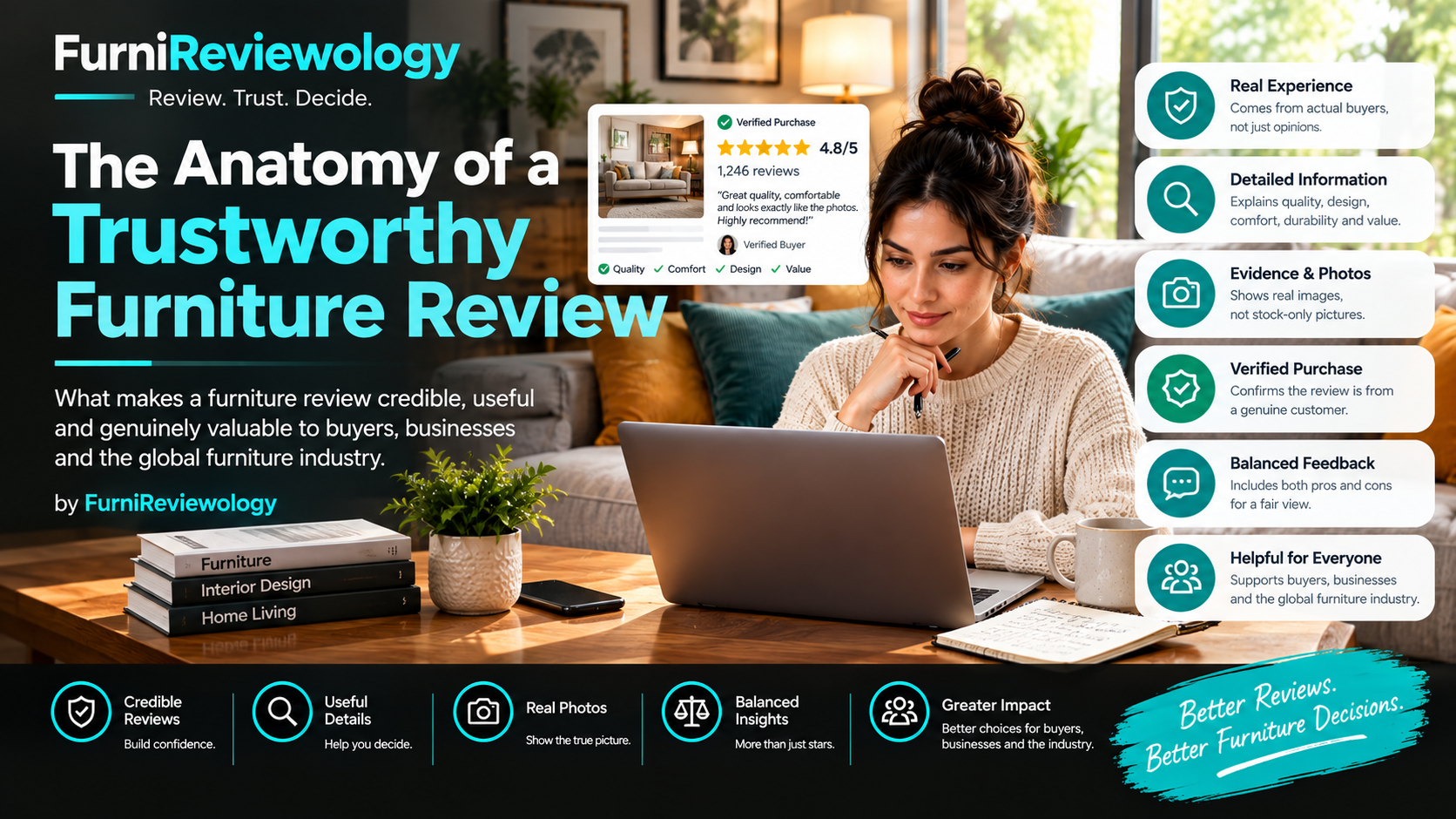
In the modern furniture marketplace, a review can influence a purchase in seconds.
A buyer searching for a sofa may read reviews before visiting a showroom. A hotel procurement manager may examine supplier feedback before placing a large order. An interior designer may investigate a manufacturer's reputation before recommending its products to a client. An Airbnb host may compare furniture experiences before furnishing a property.
But not every review has the same value.
A review can be long and still provide little useful information. A five-star review can be genuine but extremely vague. A negative review can raise an important concern—or simply reflect an individual expectation that does not apply to everyone.
This creates a fundamental question:
What does a trustworthy furniture review actually look like?
A trustworthy review is not necessarily a positive review.
It is not necessarily a five-star review.
It is not necessarily a lengthy review.
Instead, a trustworthy review is one that provides credible context, specific experience, useful evidence and enough information for another person to make a better-informed decision.
This is the anatomy of a strong furniture review.
1. A Trustworthy Review Begins With a Real Experience
The foundation of any meaningful review is experience.
The reviewer should have some legitimate connection to the furniture being discussed.
That could be:
- purchasing the furniture
- owning the furniture
- using the furniture
- installing the furniture
- specifying it for a project
- managing it in a commercial environment
- supplying or distributing it
- experiencing the retailer or manufacturer's service
The closer the reviewer is to the actual experience, the more useful the review can potentially become.
For example:
“The sofa looks excellent.”
provides little context.
But:
“We purchased this sofa for our family living room and have used it daily for approximately 10 months.”
immediately establishes a foundation for the review.
The reader now knows that the comment comes from an actual usage experience rather than a purely visual impression.
2. Reviewer Identity and Context Matter
A review becomes more useful when readers understand who is reviewing the furniture.
That does not necessarily mean revealing private personal information.
The important issue is context.
For example:
- Homeowner
- Interior designer
- Hotel operator
- Restaurant owner
- Airbnb host
- Office manager
- Retailer
- Architect
- Property developer
Different users have different expectations.
A homeowner may care primarily about:
- comfort
- aesthetics
- price
- family use
A hotel operator may prioritize:
- durability
- cleaning
- replacement parts
- supplier reliability
A restaurant owner may care about:
- commercial durability
- cleanability
- stackability
- maintenance
Knowing the reviewer's context helps readers interpret the experience.
3. The Exact Product Should Be Identified
A trustworthy review should make it reasonably clear what is being reviewed.
Furniture businesses often have multiple:
- sofa models
- chair designs
- dining tables
- collections
- finishes
- materials
- sizes
- configurations
A vague statement such as:
“Their chairs are very comfortable.”
may not be enough.
Which chair?
What material?
What configuration?
What size?
What upholstery?
A useful review should identify the product or service as specifically as possible.
This prevents one product's experience from being incorrectly generalized to an entire furniture brand.
4. The Purchase or Usage Date Adds Important Context
Furniture changes over time.
A review written immediately after delivery tells us something different from a review written after two years.
A strong review can indicate:
- when the furniture was purchased
- approximately how long it has been used
- whether it is still in use
- whether the product has changed during ownership
Consider these two statements:
“The sofa is comfortable.”
and:
“After approximately 18 months of daily use, the sofa remains comfortable, although the seat cushions have become slightly softer.”
The second statement provides substantially more useful information.
It introduces time.
5. Usage Conditions Are Part of the Evidence
Furniture does not exist in a laboratory.
It exists in real environments.
A trustworthy review should therefore explain, where relevant, the conditions under which the furniture was used.
For example:
Indoor furniture
- climate-controlled home
- family living room
- office
- hotel room
- restaurant
Outdoor furniture
- covered patio
- open garden
- poolside
- balcony
- beachfront environment
- commercial outdoor area
Usage intensity
- occasional
- daily
- heavy commercial use
- seasonal
- continuous hospitality use
These factors can dramatically affect performance.
A product used occasionally under a roof may perform very differently from the same product exposed to tropical weather every day.
6. Specificity Is One of the Strongest Signals of Review Quality
Trustworthy reviews tend to contain specific observations.
Compare:
“Excellent quality.”
with:
“The frame feels solid, the joints have remained tight after a year of daily use, and the powder-coated finish has shown only minor surface wear.”
The second review gives the reader something to evaluate.
Specificity can relate to:
- materials
- construction
- dimensions
- comfort
- finish
- hardware
- stitching
- stability
- packaging
- assembly
- durability
- maintenance
- delivery
- customer service
Specific information turns an opinion into useful knowledge.
7. A Trustworthy Review Separates Opinion From Observation
Not every statement in a review is an objective fact.
For example:
“This is the most beautiful dining table available.”
is primarily an opinion.
But:
“The table has a solid wood top with visible grain variation.”
is closer to an observable characteristic, assuming the reviewer has accurately identified the material.
Both types of information can be useful.
The key is understanding the difference.
A strong reviewer can distinguish:
What I observed
from
What I personally feel.
That makes the review easier to interpret.
8. Balanced Reviews Are Often More Informative
A trustworthy review does not have to criticize a product.
But balanced reviews can be particularly useful because they acknowledge both strengths and limitations.
For example:
“The chair is comfortable and remains stable after 12 months of daily use. The upholstery is easy to clean, but the lighter fabric requires more frequent maintenance.”
This is more informative than:
“Perfect chair. Five stars!”
The reviewer is not required to find a fault.
But when genuine limitations exist, mentioning them gives future buyers a more realistic understanding of the product.
9. The Review Should Explain Why
One of the most important characteristics of a useful review is the presence of reasons.
Instead of:
“I love this sofa.”
ask:
Why?
Perhaps:
- the seat depth is comfortable
- the cushions retain their shape
- the fabric is soft
- the frame feels stable
- the sofa fits the room well
- cleaning is easy
- delivery was efficient
Likewise, instead of:
“I don't recommend it.”
the reviewer should ideally explain why.
Reasons transform conclusions into information.
10. Durability Requires Time
Durability is one of the most frequently discussed characteristics in furniture reviews.
It is also one of the easiest to overstate.
A reviewer who received a chair yesterday cannot realistically provide evidence about five-year durability.
They can comment on:
- first impressions
- construction
- appearance
- assembly
- comfort
But not long-term performance.
A trustworthy review should therefore match the claim to the amount of experience.
For example:
After one week:
“The chair feels stable and comfortable.”
After two years:
“The chair has remained stable after two years of daily use.”
The second statement carries stronger evidence regarding long-term performance.
11. Material Information Makes Reviews More Valuable
Furniture materials have a major influence on performance.
A useful review can mention materials such as:
- solid wood
- engineered wood
- plywood
- metal
- aluminium
- steel
- rattan
- wicker
- plastic
- glass
- stone
- leather
- synthetic leather
- fabric
- outdoor-grade materials
But reviewers should avoid making technical claims they cannot verify.
For example, it is better to say:
“The frame appears to be aluminium according to the product specifications.”
than confidently claiming a material based only on appearance.
This distinction protects review credibility.
12. Comfort Is Personal—but Still Reviewable
Comfort is inherently subjective.
A chair that is comfortable for one person may feel uncomfortable to another.
That does not make comfort reviews useless.
It simply means the reviewer should provide context.
For example:
“I prefer a firmer seat, and this chair feels supportive for meals lasting one to two hours.”
is more useful than:
“This is the most comfortable chair ever.”
The first statement communicates both the experience and the reviewer's preference.
13. Delivery Is Part of the Furniture Experience
A furniture purchase does not end when the product leaves the factory.
The customer experience can include:
Ordering → Production → Packaging → Shipping → Delivery → Assembly → Installation → Usage → After-sales support
A trustworthy review can therefore discuss logistics.
For example:
- Was delivery on time?
- Was the furniture properly packaged?
- Did it arrive damaged?
- Was assembly straightforward?
- Were installation instructions clear?
- Did the company resolve delivery problems?
This is particularly important for large or expensive furniture.
14. Assembly and Installation Should Not Be Ignored
Some furniture requires:
- self-assembly
- professional installation
- wall mounting
- electrical installation
- project-site installation
- specialist adjustment
A product may be excellent once installed but frustrating to assemble.
A good review can explain this.
For example:
“The instructions were clear, but assembling the wardrobe required two people and took approximately three hours.”
That information can help another buyer prepare realistically.
15. After-Sales Service Is Part of Trust
Furniture can require assistance after purchase.
Customers may need:
- replacement components
- warranty support
- repairs
- adjustments
- maintenance guidance
- replacement cushions
- hardware
- technical assistance
A review that discusses the company's response to an actual problem can be particularly valuable.
For example:
“One hinge failed after several months. Customer service responded within two days and supplied a replacement.”
This provides information about the business beyond the product itself.
16. Photographs Can Strengthen a Review
Where appropriate, photographs can provide additional evidence.
Customer photographs can show:
- actual color
- scale
- installation
- wear
- outdoor exposure
- surface condition
- assembly
- room context
- damage
- long-term use
Professional marketing photography shows what the furniture can look like under controlled conditions.
Customer photography can show what it looks like in real life.
Both have value—but they serve different purposes.
17. Verification Strengthens the Foundation
A review platform can introduce verification mechanisms to establish stronger connections between reviewers and the experiences they describe.
Possible indicators include:
- verified purchase
- verified ownership
- verified business transaction
- verified project
- authenticated account
- supporting documentation
Again, verification should not be presented as proof that every statement is objectively true.
Instead, it can provide additional confidence about the reviewer's relationship to the experience.
That distinction is essential for responsible review platforms.
18. A Trustworthy Review Does Not Need to Be Perfectly Written
Real customers do not always write like professional journalists.
They may:
- make grammatical mistakes
- use simple language
- write briefly
- describe emotions
- mix positive and negative points
That does not automatically make a review unreliable.
In fact, overly polished language can sometimes make readers question whether the content sounds more like advertising than personal experience.
The priority should therefore be:
authentic experience—not literary perfection.
19. Generic Marketing Language Provides Limited Evidence
Reviews can become less useful when they rely heavily on promotional phrases such as:
- world-class
- amazing quality
- premium product
- best ever
- exceptional
- unbeatable
- highly recommended
These words are not necessarily false.
But they do not explain the experience.
A stronger review replaces broad praise with evidence.
Instead of:
“Premium quality.”
Explain:
“After one year of daily use, the frame remains stable and the upholstery has retained its shape.”
That is much more informative.
20. Repetition Can Reveal Patterns
One review may be an isolated experience.
Ten reviews describing the same issue may reveal a pattern.
For example, if multiple independent customers mention:
- delayed delivery
- difficult assembly
- fading
- cushion sagging
- excellent customer service
- strong packaging
the repeated observations deserve attention.
However, repetition should not automatically be treated as proof.
The quality and independence of the reviews still matter.
The objective is to identify meaningful patterns, not simply count comments.
21. A Trustworthy Review Allows Room for Differences
Furniture performance is influenced by many variables.
These include:
- climate
- maintenance
- usage intensity
- installation
- cleaning products
- location
- user preferences
- household composition
- commercial environment
Therefore, two genuine reviews can disagree.
One customer might write:
“The fabric is very durable.”
Another might say:
“The fabric showed visible wear after a year.”
Both experiences could potentially be genuine if the usage conditions were different.
Trustworthy review systems should therefore allow different experiences to coexist rather than forcing every product into a simplistic good/bad category.
22. Reviewers Should Avoid Claims They Cannot Prove
A responsible reviewer should be cautious about making serious claims.
There is an important difference between:
“My chair developed a crack after six months.”
and:
“This company always sells defective furniture.”
The first describes personal experience.
The second makes a broad claim that requires much stronger evidence.
A trustworthy review stays close to what the reviewer actually knows.
This principle protects both buyers and businesses.
23. The Difference Between a Complaint and a Useful Review
A complaint may say:
“Terrible company. Never buy from them.”
A useful review might say:
“The dining table arrived seven days later than the promised delivery date. The packaging was damaged, although the table itself was not. Customer service responded after two days and offered a delivery refund.”
The second review is more useful because it provides:
- what happened
- when it happened
- what impact it had
- how the company responded
- what the final outcome was
It converts frustration into information.
24. The Best Reviews Answer Future Buyers' Questions
A truly useful furniture review anticipates what another buyer wants to know.
For example:
Sofa
- Is it comfortable?
- Does it retain its shape?
- Is the fabric easy to clean?
- Is the frame stable?
- How long have you owned it?
Outdoor furniture
- Has it been exposed to rain?
- How does it perform in sunlight?
- Does the finish fade?
- How easy is maintenance?
Dining table
- Is it stable?
- Does the surface scratch easily?
- How difficult is cleaning?
- Is assembly straightforward?
Hotel furniture
- How does it perform under heavy use?
- Was delivery reliable?
- Were replacement components available?
- Did the supplier meet project deadlines?
A review becomes more valuable when it answers these practical questions.
25. A Furniture Review Can Be Viewed as an Evidence Structure
A useful way to understand the anatomy of a trustworthy furniture review is to divide it into layers.
Layer 1 — Identity
Who is reviewing?
Layer 2 — Connection
Did they purchase, own or use the furniture?
Layer 3 — Product
What exactly are they reviewing?
Layer 4 — Context
Where and how was it used?
Layer 5 — Time
How long was it used?
Layer 6 — Observation
What actually happened?
Layer 7 — Evaluation
What did the reviewer think about it?
Layer 8 — Evidence
Are there photographs, specifications or other supporting details?
Layer 9 — Service
How did the company perform before and after purchase?
Layer 10 — Conclusion
Would the reviewer recommend it, and under what circumstances?
Together, these layers create a much stronger review.
26. A Simple Anatomy of a High-Quality Furniture Review
A strong review could follow this structure:
1. What I Bought
Identify the furniture.
2. Why I Bought It
Explain the original need.
3. Where I Use It
Describe the environment.
4. How Long I've Used It
Provide the ownership period.
5. What I Like
Explain specific strengths.
6. What Could Be Better
Describe genuine limitations.
7. How It Has Performed
Discuss actual experience.
8. Delivery and Installation
Explain the purchasing process.
9. Customer Service
Describe communication and support.
10. Would I Buy It Again?
Provide a final recommendation with context.
This structure is simple enough for ordinary consumers but powerful enough to generate useful information.
27. What Businesses Can Learn From Trustworthy Reviews
Furniture companies should not see reviews only as a reputation-management exercise.
Reviews can become a source of product intelligence.
Repeated feedback can reveal:
- design weaknesses
- manufacturing problems
- packaging issues
- delivery challenges
- customer expectations
- material performance
- service gaps
- opportunities for innovation
A furniture company that systematically studies customer feedback can potentially improve its products and operations.
Therefore:
Reviews are not just feedback after the sale.
They can become input for the next product.
28. Reviews Can Become a Competitive Intelligence Tool
Furniture buyers are not the only ones who benefit.
Manufacturers can study reviews to understand market expectations.
Retailers can identify common customer complaints.
Designers can understand material preferences.
Hotels can compare supplier performance.
Investors and industry analysts can observe emerging reputation trends.
This turns the review ecosystem into something larger than consumer commentary.
It becomes a source of furniture market intelligence.
29. From Review to Trust Score
The future of furniture reviews may involve more sophisticated systems than a simple five-star rating.
A furniture trust profile could potentially examine:
- verified experiences
- review depth
- ownership duration
- reviewer diversity
- product performance
- complaint resolution
- service quality
- repeat customer feedback
- review recency
- evidence quality
The objective would not necessarily be to produce another mysterious number.
Instead, it could provide buyers with a transparent picture of why a business or product is considered trustworthy.
30. AI Will Make Review Quality Even More Important
Artificial intelligence is changing how people discover products and businesses.
AI systems can summarize thousands of reviews.
They can identify common complaints.
They can compare products.
They can answer questions.
They can generate recommendations.
But this creates a critical dependency:
AI needs reliable information.
If the underlying review ecosystem is weak, the resulting intelligence can also be weak.
This makes review quality increasingly important.
The future may therefore depend not simply on having more reviews, but on having better review data.
31. FurniReviewology: Building a Trust Layer for Furniture
This is where FurniReviewology has a larger role to play.
The concept goes beyond collecting stars.
It is about creating a furniture-focused environment where experiences can become searchable, comparable and useful.
Furniture reviews can potentially connect:
Buyer Experience → Product Information → Business Reputation → Search Discovery → Trust → Furniture Intelligence
This creates a bridge between discovery and decision-making.
A buyer may first discover a manufacturer through a furniture search ecosystem.
Then the buyer can investigate its reviews.
Then compare customer experiences.
Then evaluate the business.
Then make a decision with greater confidence.
That is a much richer journey than simply seeing an advertisement.
32. The Future of Furniture Trust Is Evidence-Based
The furniture industry is entering an environment where consumers and businesses have access to more information than ever.
But more information does not automatically mean better information.
The real challenge is determining:
Which information deserves trust?
That requires:
- verification
- context
- transparency
- specificity
- evidence
- balanced experiences
- long-term feedback
- responsible business responses
The furniture review of the future should therefore be more than:
★★★★★
It should become a compact record of experience.
Conclusion: A Trustworthy Review Tells the Story Behind the Stars
The anatomy of a trustworthy furniture review is not complicated.
At its heart, it requires a genuine experience and enough context for someone else to understand that experience.
A strong furniture review tells us:
Who experienced it.
What they experienced.
Which product they used.
Where they used it.
How long they used it.
What worked.
What did not work.
How the business responded.
And why they reached their conclusion.
That is what transforms a rating into useful knowledge.
The goal should not be to create a world where every furniture company has five stars.
The goal should be to create a world where buyers can understand why those stars exist.
Because furniture is ultimately experienced in real homes, hotels, restaurants, offices, resorts and commercial spaces—not in advertisements.
And the most valuable review is the one that helps the next buyer make a better decision.
A star tells you the score. A trustworthy review tells you the story. Evidence makes the story more useful.
As the global furniture ecosystem becomes increasingly digital, searchable and AI-driven, trustworthy reviews can become one of its most important forms of knowledge.
Visibility gets a furniture business discovered.
Credible reviews help it get trusted.
Trust helps turn discovery into decisions.
The Global Furniture Ecosystem
FISE - Furniture Industry Search Engine helps the world find them.
TFT - The Furniture Times tells their story.
FurniReviewology helps the world trust them.