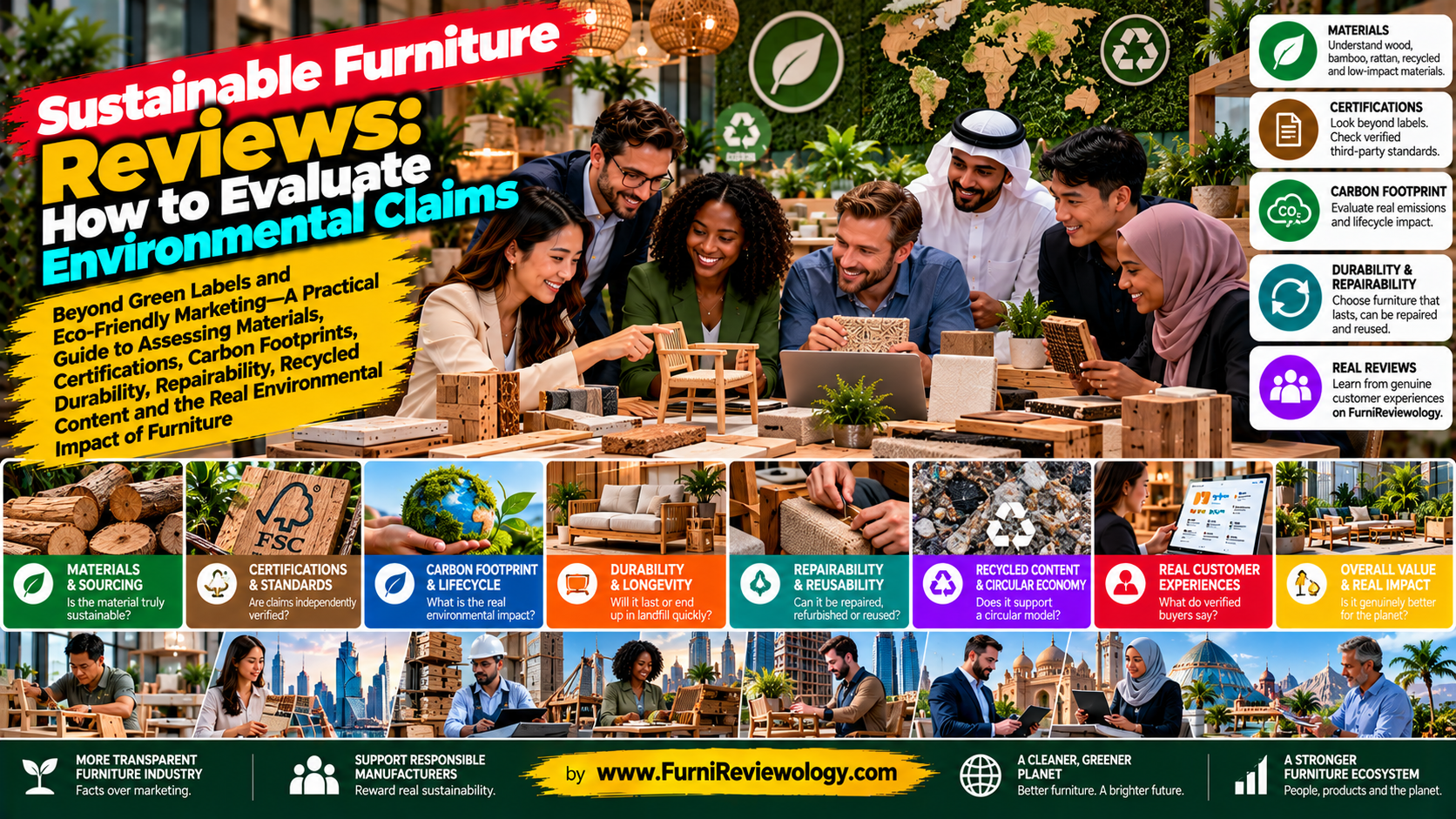
By The Furniture Times (TFT) Editorial Desk | FurniReviewology | Sustainable Furniture | Green Furniture | Environmental Claims | Furniture Reviews | Circular Economy | Responsible Manufacturing | Consumer Trust | Global Furniture Ecosystem
Is Your Furniture Really Sustainable—or Is It Just Marketed That Way?
A sofa is advertised as eco-friendly.
A dining table is described as sustainably sourced.
An office chair carries a green product label.
A bed frame is promoted as environmentally responsible.
A furniture manufacturer claims its products are carbon neutral.
A retailer introduces a collection described as 100% sustainable.
These statements sound reassuring.
But what do they actually mean?
Does the manufacturer use responsibly sourced materials?
Is the recycled content independently verified?
Are the adhesives and finishes tested for relevant emissions?
Can the furniture be repaired?
How long is the product expected to last?
Does the company provide evidence supporting its environmental claims?
And perhaps the most important question:
Is the product genuinely designed to reduce environmental harm, or is sustainability being used primarily as a marketing message?
As environmental awareness influences furniture purchasing, buyers are encountering an expanding vocabulary of green claims.
Sustainable.
Eco-friendly.
Natural.
Recycled.
Renewable.
Carbon neutral.
Zero waste.
Non-toxic.
Biodegradable.
Circular.
Responsible.
Yet these words do not all mean the same thing, and some have little value without clear definitions and supporting evidence.
That is why sustainable furniture reviews must go beyond appearance, price and promotional descriptions.
They must examine what a company claims, what evidence exists, what the product actually delivers and what remains uncertain.
A credible sustainable furniture review does not simply repeat a manufacturer's environmental promises. It evaluates them.
1. Sustainability Is Not a Color, a Label or a Marketing Style
A green-colored logo does not make furniture sustainable.
A photograph of a forest does not establish responsible sourcing.
A wooden product is not automatically environmentally preferable to every alternative.
A recycled material does not guarantee low environmental impact.
And a high-priced product is not necessarily more sustainable than an affordable one.
Sustainability involves multiple dimensions of a product's lifecycle.
These may include:
Raw material sourcing
Manufacturing processes
Energy and water use
Chemical emissions
Packaging
Transportation
Product durability
Repairability
Replacement parts
Reuse and refurbishment
Recycling and end-of-life management
A product may perform well in one area and poorly in another.
For example, a chair may contain recycled plastic but be difficult to repair.
A solid-wood table may be durable but have poorly documented timber sourcing.
An upholstered sofa may use certified wood but contain cushions that cannot be replaced.
Environmental performance is multidimensional. A single green claim rarely tells the complete story.
2. The First Rule of Sustainable Furniture Reviews: Ask for Evidence
The most important question is not:
“Does the company say its furniture is sustainable?”
It is:
“What evidence supports the specific environmental claim?”
Consider the difference.
Claim A
“Our furniture is environmentally friendly.”
This is broad and difficult to evaluate.
Claim B
“This table uses FSC-certified timber, with certification details available for the applicable material supply chain.”
This is more specific and potentially verifiable.
Claim C
“This chair contains 60% recycled plastic by weight, supported by documented material records.”
This provides a measurable claim, although the supporting documentation still needs examination.
Claim D
“Our factory reduced electricity consumption per unit produced by 18% over a defined reporting period.”
This can be evaluated if the baseline, measurement method and supporting data are disclosed.
The stronger claims identify:
What is being measured.
Which product or component is covered.
The relevant percentage or performance.
The measurement period.
The evidence available.
Any important limitations.
Specific, measurable and verifiable claims deserve more confidence than vague environmental language.
3. Understanding Greenwashing in the Furniture Industry
Greenwashing occurs when environmental communications mislead consumers about the environmental benefits of a product, service or business.
It can involve outright false statements.
But it can also involve exaggeration, selective disclosure or claims that omit important context.
Common warning signs
Vague language: Terms such as “green” or “planet-friendly” without explanation.
Unclear certification: A logo that resembles a certification mark but cannot be traced to a recognized scheme.
Selective claims: Promoting recycled packaging while ignoring significant environmental impacts elsewhere.
Unsubstantiated carbon claims: Declaring a product carbon neutral without explaining emissions calculations and the role of offsets.
Misleading comparisons: Claiming a product is “50% greener” without identifying the comparison and methodology.
Irrelevant claims: Highlighting the absence of a substance that is already prohibited or not normally used in the product.
Unrealistic absolutes: Statements such as “zero environmental impact” without rigorous evidence.
A sustainable furniture review should identify these warning signs without automatically accusing a company of deliberate deception.
Some businesses may simply lack clear documentation or use imprecise marketing language.
A missing explanation is a reason to ask questions. It is not, by itself, proof of dishonesty.
4. Furniture Materials: Natural Does Not Automatically Mean Sustainable
Material selection is one of the most visible aspects of furniture sustainability.
But the environmental impact of a material depends on sourcing, processing, manufacturing, product design and disposal.
Solid Wood
Wood can be renewable when sourced from responsibly managed forests.
It can also support long-lasting furniture.
However, buyers should consider timber origin, legality, forest-management practices, processing and product durability.
Engineered Wood
Plywood, MDF and particleboard can make efficient use of wood fibers and residues.
Environmental considerations include raw material sourcing, adhesives, emissions, manufacturing processes and product lifespan.
Bamboo
Bamboo grows relatively quickly and can be useful in furniture production.
But rapid growth alone does not establish a finished product's environmental performance.
Processing, adhesives, transportation and durability also matter.
Metal
Steel and aluminum can be durable and recyclable.
However, primary metal production can be energy-intensive.
Recycled content, production methods and product longevity influence environmental performance.
Plastic
Recycled plastics may reduce demand for virgin feedstock.
But buyers should also consider durability, material identification, potential additives and whether the finished product can be recycled in practice.
Upholstery Fabrics
Natural, synthetic and recycled textiles each have environmental trade-offs.
Fiber sourcing, chemical treatments, durability, cleaning requirements and recyclability all deserve attention.
Foam and Cushioning
Foam performance influences furniture lifespan.
Reviewers should consider durability, emissions information, material composition and replacement options rather than rely only on marketing claims.
There is no universally sustainable material independent of its application and lifecycle.
5. Sustainable Furniture Certifications: What Do They Actually Verify?
Certifications can provide useful evidence, but buyers must understand what each certification covers.
A certificate may apply to a material, factory, supply chain, chemical emissions or finished product.
It may not certify the entire furniture product as sustainable.
| Certification or Standard | What It Can Help Evaluate | Important Limitation |
|---|---|---|
| FSC | Responsible forest management and chain-of-custody claims | Check product scope and certification validity |
| PEFC | Forest certification and chain-of-custody claims | Does not automatically assess every environmental impact |
| GREENGUARD Gold | Chemical emissions under specified criteria | Not a complete lifecycle sustainability assessment |
| OEKO-TEX STANDARD 100 | Testing of textiles and certain components for harmful substances | Does not certify the entire furniture product's environmental footprint |
| Global Recycled Standard (GRS) | Recycled content and applicable processing requirements | Verify certified scope and product claims |
| Cradle to Cradle Certified | Multiple product sustainability attributes under the relevant program | Certification level, version and scope matter |
| BIFMA LEVEL | Sustainability assessment for applicable furniture products | Confirm the exact product and certification details |
| ISO 14001 | An organization's environmental management system | Does not mean every product is environmentally superior |
| Environmental Product Declaration (EPD) | Documented lifecycle environmental information | Not automatically proof that a product is better than alternatives |
A legitimate certificate should be checked through the relevant certification body or registry where available.
Important distinction
Certified material is not the same as a certified finished product.
For example, a sofa containing certified timber should not automatically be described as an entirely certified sustainable sofa unless the applicable certification supports that claim.
Reviews should state exactly what has been verified.
6. Carbon Footprint Claims: What Buyers Should Understand
Furniture production can generate greenhouse gas emissions through:
Material extraction.
Manufacturing.
Energy consumption.
Transportation.
Packaging.
Distribution.
Use and maintenance.
End-of-life treatment.
A product carbon footprint attempts to quantify greenhouse gas emissions associated with a defined product system.
But the result depends on the methodology and boundaries used.
For example:
Does the calculation include raw materials?
Does it include manufacturing?
Does it include transportation?
Does it include use?
Does it include disposal?
Are assumptions disclosed?
Has the calculation been independently reviewed?
Why boundaries matter
A cradle-to-gate assessment covers impacts up to the factory gate.
A cradle-to-grave assessment generally considers a broader lifecycle, including use and end-of-life stages.
These are not equivalent.
A company should not present a limited assessment as though it measures every stage of the product's life.
Carbon-neutral claims
Buyers should distinguish between actual emissions reductions and claims based partly or substantially on carbon offsets.
Offsets do not necessarily eliminate emissions generated by manufacturing the product.
A credible review should explain the scope, assumptions and evidence behind carbon claims—not simply repeat the phrase “carbon neutral.”
7. Durability May Be One of the Most Important Sustainability Factors
A product's lifespan can significantly influence its long-term environmental performance.
Consider two hypothetical dining chairs.
Chair A is inexpensive but requires frequent replacement.
Chair B costs more but remains functional for many years.
If Chair B genuinely lasts longer, it may reduce the frequency of replacement and associated production and disposal impacts.
However, actual environmental comparisons depend on materials, manufacturing, maintenance and lifecycle assumptions.
The general principle remains important:
Furniture designed for long service can help reduce the need for repeated production and replacement.
A sustainability review should therefore examine:
Frame strength.
Joint quality.
Surface durability.
Upholstery performance.
Cushion resilience.
Hardware reliability.
Finish resistance.
Repair options.
Warranty terms.
Long-term customer experiences.
A product advertised as sustainable but designed for a short lifespan deserves closer scrutiny.
8. Repairability: Can the Furniture Be Fixed Instead of Replaced?
Repairability is increasingly relevant to furniture sustainability.
A sofa may have a strong frame but worn cushions.
A dining chair may need new upholstery.
A cabinet may require replacement hinges.
An office chair may need a new gas lift.
A table may need refinishing.
If the product can be repaired economically, its useful life may be extended.
Questions for reviewers
Are replacement parts available?
Can upholstery be changed?
Can cushions be replaced?
Are fittings standardized?
Can damaged components be removed?
Does the manufacturer offer repair services?
Are assembly instructions available?
Does the design allow disassembly without destruction?
A furniture product should not be considered sustainable solely because it contains recycled materials.
A repairable product may offer significant long-term value even when its initial material composition is less heavily promoted.
9. Recycled Content: Understand the Percentage and the Proof
Recycled content is a common environmental claim.
A manufacturer may state that a chair contains 30%, 50% or 80% recycled material.
But the claim needs context.
Does the percentage apply to the entire product?
Only the plastic shell?
Only the upholstery?
Is the percentage calculated by weight?
Does it include pre-consumer or post-consumer recycled material?
How is the claim verified?
For example:
“Contains 70% recycled material” is ambiguous without a defined scope.
“Seat shell contains 70% post-consumer recycled polypropylene by weight” is more specific.
A reviewer should also consider product performance.
Recycled content is useful information, but it does not automatically guarantee durability, safety or recyclability.
The best environmental claims combine measurable material information with evidence of actual product performance.
10. Low-VOC and Non-Toxic Claims: Avoid Misleading Absolutes
Furniture products may release volatile organic compounds (VOCs) from materials, adhesives, coatings and other components.
Some products undergo emissions testing under recognized programs.
However, claims such as “chemical-free” or “completely non-toxic” can be misleading.
All furniture is made of chemical substances.
The relevant questions concern specific substances, exposure, emissions and applicable safety criteria.
A credible review should ask:
Has the product undergone relevant emissions testing?
What substances or emissions were assessed?
Does the test cover the finished product or only a component?
Which standard or certification applies?
Is the documentation current?
Does the claim apply to the actual product being sold?
Environmental and health-related claims should be precise, evidence-based and appropriately limited.
11. Packaging and Transportation: Important, but Not the Whole Story
Furniture can require substantial packaging because products are large, heavy and vulnerable to damage.
Manufacturers may use:
Cardboard.
Plastic film.
Foam.
Protective corners.
Wooden pallets.
Crates.
Reusable packaging.
Packaging design involves trade-offs.
Reducing packaging may save materials.
But inadequate protection can increase damage, returns and replacement shipments.
Similarly, transportation distance is relevant, but distance alone does not determine total environmental impact.
Freight mode, shipment efficiency, product weight, packaging and production methods also matter.
A local product is not automatically environmentally preferable in every circumstance.
What reviewers should examine
Packaging materials.
Excessive packaging.
Product damage.
Recyclability where local facilities exist.
Assembly efficiency.
Transport-related claims.
Disposal instructions.
Sustainable logistics should be assessed through real operational outcomes—not simplistic assumptions.
12. Circular Furniture: Can the Product Have a Second Life?
Circular-economy approaches aim to keep products and materials in use for longer.
In furniture, this may involve:
Repair.
Resale.
Refurbishment.
Reupholstery.
Remanufacturing.
Component reuse.
Product take-back.
Material recovery.
Recycling.
A manufacturer may design furniture for disassembly.
A retailer may offer refurbished products.
A commercial supplier may provide replacement components.
A hospitality business may refurbish furniture instead of replacing it entirely.
These approaches can create environmental and economic benefits when implemented effectively.
But claims should be evaluated.
Does a take-back program actually operate?
Which locations are covered?
What happens to returned furniture?
Are components reused or recycled?
Is participation practical for customers?
A circularity claim should describe a functioning system—not merely an aspiration.
13. A Sustainable Furniture Review Must Consider the Entire Product
One of the most common mistakes is focusing on a single attractive environmental feature.
For example:
A sofa may contain recycled fabric.
But what about its frame?
Its foam?
Its adhesives?
Its durability?
Its packaging?
Its repairability?
A table may use responsibly sourced wood.
But what about the coating?
Its construction?
Its expected lifespan?
Its ability to be refinished?
A more complete review evaluates multiple dimensions.
Sustainable Furniture Review Framework
| Evaluation Area | Key Question |
|---|---|
| Materials | Are sourcing and composition claims supported? |
| Certifications | Are relevant certificates valid and correctly represented? |
| Manufacturing | Are environmental performance claims measurable? |
| Chemical Emissions | Is relevant testing documented? |
| Durability | Is the product designed for long-term use? |
| Repairability | Can components be repaired or replaced? |
| Energy & Carbon | Are calculations and boundaries explained? |
| Packaging | Is packaging appropriate and reasonably efficient? |
| Circularity | Are reuse, take-back or recycling claims practical? |
| Transparency | Does the company disclose limitations and evidence? |
This framework can help buyers identify strengths, weaknesses and unanswered questions.
14. Sustainable Furniture Review Scorecard
A structured scorecard can help organize a review.
It should not be confused with independent certification or a formal lifecycle assessment.
{@body const criteria = [{name:"Material sourcing and evidence",weight:20},{name:"Durability and product quality",weight:20},{name:"Repairability and lifespan",weight:20},{name:"Manufacturing and emissions transparency",weight:15},{name:"Packaging and end-of-life options",weight:10},{name:"Certification and claim credibility",weight:15}]}
{@body const [scores,setScores] = DIL.useState([3,3,3,3,3,3])}
{@body const result = criteria.reduce((a,c,i)=>a+c.weight*scores[i]/100,0)}
<box border radius="xl" padding={3} gap={3}>
<row justify="between" align="center">
Interactive sustainability review scorecard
<badge color="secondary">Illustrative framework</badge>
</row>
<text color="secondary" size="sm">Score each category from 1 (poor or unsupported) to 5 (strong evidence and performance). The weighted result updates as you adjust your ratings.</text>
{#each criteria as c,i}
<box key={c.name} gap={1}>
<row justify="between" align="center">
<text weight="medium" size="sm">{c.name}</text>
<text color="secondary" size="xs" tabularNums>{c.weight}% · {scores[i]}/5</text>
</row>
<slider min={1} max={5} step={1} value={scores[i]} onChange={v=>setScores(prev=>prev.map((x,j)=>j===i?v))}/>
</box>
{/each}
<divider/>
<row justify="between" align="center">
<box gap={1}>
<text color="secondary" size="xs">Weighted assessment</text>
<title size="2xl" tabularNums>{result.toFixed(2)} / 5</title>
</box>
<button color="secondary" variant="outline" size="sm" onClick={()=>setScores([3,3,3,3,3,3])}>Reset scores</button>
</row>
<caption>This is an educational review aid, not an official FurniReviewology rating system, third-party certification or verified environmental impact calculation. Missing evidence should be described separately rather than automatically treated as proof of poor performance.</caption> </box>
The scorecard should be accompanied by written explanations and evidence.
A numerical score cannot fully capture every environmental trade-off.
For example, a product may score highly on durability but lack documented material sourcing.
Another may have strong recycled-content evidence but limited repair options.
The value of the review lies in making these distinctions visible.
15. How to Write a Credible Sustainable Furniture Review
A helpful review should explain the product and the evidence available.
Consider the following example.
Weak Review
“This sofa is very eco-friendly. Excellent sustainable product. Five stars.”
This provides little useful information.
Stronger Review
“I purchased this sofa eight months ago. The manufacturer states that the frame uses certified wood and provides documentation for the relevant material claim. The cushions have maintained their shape so far, and the covers are removable. However, I could not find information about the foam composition or replacement cushion availability. The packaging was mainly cardboard with some plastic protection. I would like the company to provide more information about repair services and the product's expected lifespan.”
This review is more useful because it:
Describes actual ownership experience.
Distinguishes company claims from observed performance.
Identifies available evidence.
Explains what remains unknown.
Avoids unsupported conclusions.
The strongest sustainable furniture reviews combine firsthand experience with careful examination of documented claims.
16. Questions Every Buyer Should Ask Before Purchasing Sustainable Furniture
Before accepting an environmental claim, consider the following checklist.
What exactly is being claimed?
Does the claim apply to the entire product or only one component?
Is supporting documentation available?
Can certifications be independently checked?
Is recycled content clearly quantified?
Are relevant emissions tests documented?
Is the product durable?
Can it be repaired?
Are replacement parts available?
Is the furniture designed for disassembly?
Does the company explain environmental limitations?
Are carbon claims based on clear calculations?
Is the warranty meaningful?
Are there credible long-term customer reviews?
Does the product offer reasonable lifetime value?
A buyer does not need to become an environmental scientist to ask useful questions.
Transparency should be part of the buying experience.
17. Furniture Manufacturers: Sustainability Claims Must Be Supported by Documentation
Manufacturers have an important responsibility.
If a company advertises furniture as sustainable, it should be prepared to explain the claim.
This may involve:
Material sourcing records.
Relevant certifications.
Product composition information.
Emissions testing.
Manufacturing process data.
Environmental management documentation.
Durability testing.
Repair instructions.
Replacement part availability.
Packaging information.
Applicable lifecycle assessments.
The exact evidence depends on the claim.
A company should not imply that one certificate establishes environmental superiority across every dimension.
An important commercial opportunity
Transparent sustainability information can help businesses respond to buyer questionnaires, procurement requirements and customer concerns.
It can also reduce the risk of misleading marketing.
Credible sustainability communication is not about making the biggest claim. It is about making the strongest claim the evidence can support.
18. Retailers and E-Commerce Platforms: Stop Treating Green Claims as Decorative Labels
Retailers influence how environmental information reaches consumers.
A product may be presented under an “eco-friendly” category without explaining why it qualifies.
This can create confusion.
A more useful product page should identify the actual attributes.
For example:
“Contains recycled aluminum.”
“Removable and replaceable cushion covers.”
“FSC-certified wood components, within the stated certification scope.”
“Manufacturer offers replacement hardware.”
“Product emissions tested under a specified program.”
These statements are more informative than simply displaying a green leaf symbol.
Retailers should request appropriate supporting documentation from suppliers and avoid overstating what certifications mean.
Sustainability categories should be based on defined criteria—not vague promotional language.
19. Hospitality and Commercial Furniture: Sustainability at Scale
Hotels, offices, educational institutions and commercial developments often purchase furniture in significant quantities.
Their procurement decisions can affect large volumes of materials and products.
For these buyers, sustainable furniture evaluation should consider:
Product lifespan.
Repair and refurbishment.
Maintenance costs.
Replacement parts.
Material documentation.
Durability.
Relevant emissions requirements.
Packaging and logistics.
End-of-life options.
Supplier transparency.
A hotel purchasing hundreds of chairs may find that repairability and replacement components have significant long-term value.
An office procuring workstations may prioritize modularity and reconfiguration.
A university may need furniture that can withstand intensive use.
Commercial sustainability should be evaluated through performance over time—not simply the environmental language used in a tender submission.
20. Why Sustainability Reviews Matter for SMEs and MSMEs
Small furniture manufacturers may not have the resources to conduct extensive lifecycle assessments for every product.
But they can still improve transparency.
They can document material sources.
Explain their manufacturing methods.
Offer repair services.
Improve durability.
Reduce production waste.
Use appropriate certifications where feasible.
Provide accurate product information.
Avoid exaggerated claims.
A small manufacturer should not be considered environmentally superior merely because it is small.
Likewise, a company should not automatically be dismissed because it lacks an expensive certification.
The appropriate evaluation depends on the evidence available and the claims being made.
Responsible sustainability begins with measurable actions and accurate communication—not company size.
21. FurniReviewology: Helping Buyers Look Beyond Green Marketing
The furniture industry needs a review environment where buyers can discuss more than appearance, price and delivery.
Environmental claims deserve examination too.
FurniReviewology's broader mission is to support meaningful furniture reviews and a more transparent industry reputation ecosystem.
Sustainable furniture reviews can encourage buyers to share information about:
Durability.
Repairability.
Material quality.
Packaging.
Replacement parts.
Long-term product performance.
Manufacturer responsiveness.
Documented environmental claims.
A customer review is not a substitute for a laboratory test or lifecycle assessment.
But firsthand experience can reveal whether a product performs consistently with the expectations created by its marketing.
For example, a company may promote a product as long-lasting.
Customer reviews after several years may offer useful evidence about actual durability.
A manufacturer may advertise replaceable parts.
Reviews may help reveal whether customers can obtain those parts in practice.
Environmental credibility becomes stronger when documented claims and real-world experiences can be examined together.
22. The Future of Sustainable Furniture Reviews: Evidence, Not Advertising
The furniture industry's sustainability conversation is likely to become more demanding.
Buyers may increasingly expect clear information about:
Material origins.
Recycled content.
Chemical emissions.
Durability.
Repairability.
Carbon calculations.
Certifications.
Environmental management.
Circular-economy services.
However, the future should not be built around more labels alone.
It should be built around better evidence.
A sustainability claim should be understandable.
A certification should be traceable.
A product should perform as expected.
A review should distinguish observation from marketing.
A manufacturer should acknowledge limitations.
A retailer should communicate accurately.
And buyers should be able to compare relevant information without being misled by vague environmental language.
The next stage of sustainable furniture buying is not simply choosing products labeled green. It is learning to evaluate what those labels actually mean.
Furniture Companies: Make Your Environmental Claims Searchable, Specific and Credible
If you manufacture sustainable furniture, communicate what makes your product environmentally relevant.
If you use certified materials, identify the certification and its scope.
If you use recycled content, state the percentage and component involved.
If your furniture is repairable, explain how.
If your products are designed for durability, provide relevant evidence.
If you have conducted environmental assessments, describe their methodology and limitations.
If you operate take-back or refurbishment programs, explain how customers can use them.
And if customers have genuine experiences to share, encourage honest reviews.
Don't ask buyers to trust a green label. Give them reasons to evaluate your claims with confidence.
Explore:
FurniReviewology: https://furnireviewology.com/
Furniture Industry Search Engine — FISE: https://furnitureindustrysearchengine.com/
The Furniture Times — TFT: https://thefurnituretimes.com/
Conclusion: Sustainable Furniture Must Be Judged by Evidence and Performance
The furniture industry has an opportunity to reduce environmental harm through better materials, longer-lasting products, responsible manufacturing, repairability and circular business models.
But meaningful progress requires credible information.
Consumers should question vague claims.
Manufacturers should document environmental attributes.
Retailers should communicate accurately.
Reviewers should distinguish evidence from assumptions.
And the industry should recognize that sustainability is not a single feature.
It is a collection of decisions across the product lifecycle.
A furniture product may have strengths and weaknesses.
A company may be improving without being perfect.
A certification may verify one important attribute without addressing every environmental impact.
The purpose of a credible review is not to demand impossible perfection.
It is to help buyers understand what is known, what is supported and what remains uncertain.
Don't Just Ask Whether Furniture Is Sustainable.
Ask How the Claim Is Measured, Verified and Demonstrated Over Time.
Because the future of sustainable furniture should be built on evidence—not greenwashing.
The Global Furniture Ecosystem
The Furniture Industry is a $1 Trillion USD Ecosystem in the world.
Furniture Industry Search Engine — FISE helps the world find them.
The Furniture Times — TFT tells their story.
FurniReviewology helps the world trust them.