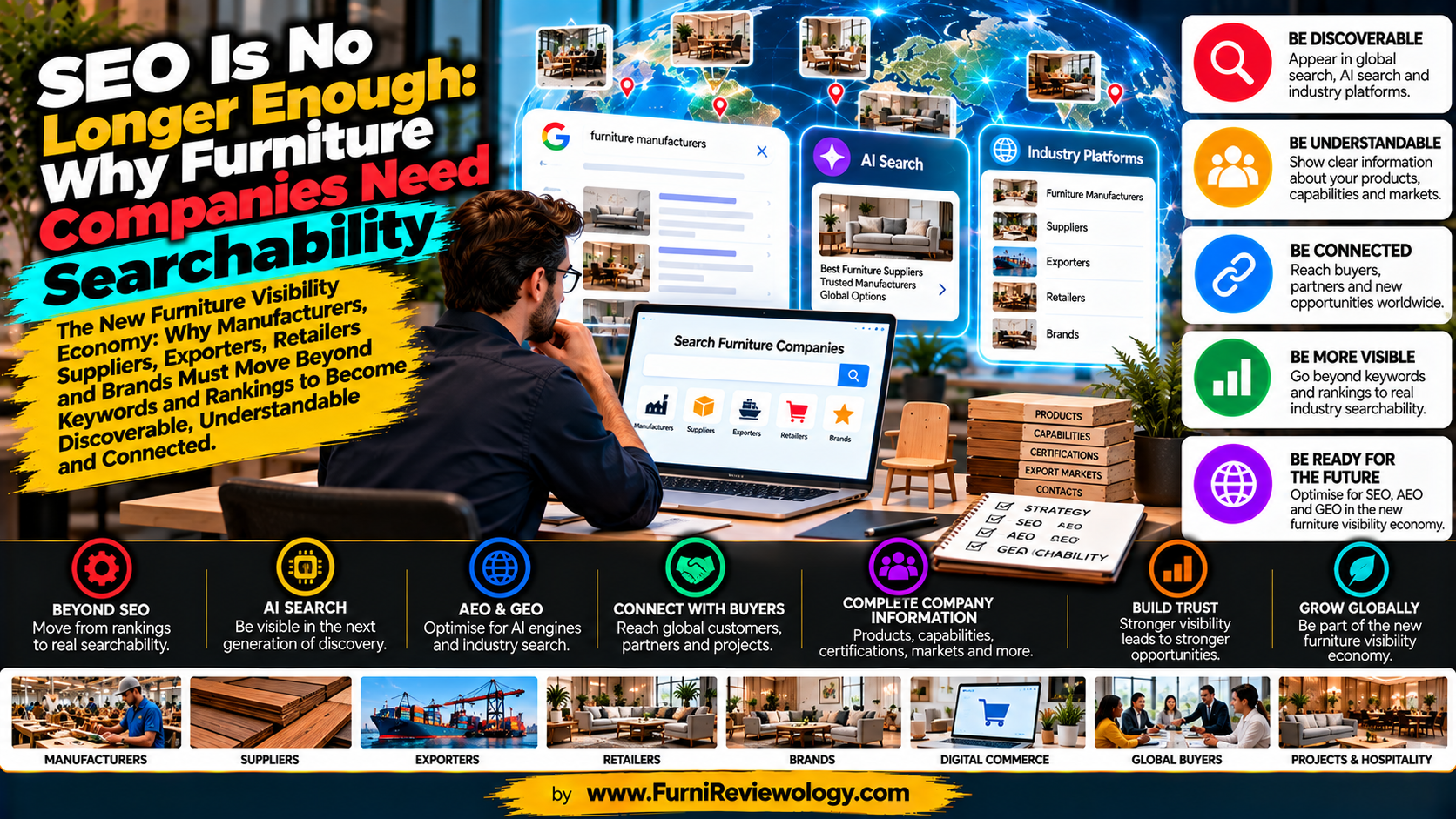
By The Furniture Times (TFT) Editorial Desk | FISE | Searchology | Furniture SEO | AI Search | Digital Visibility | AEO | GEO | Furniture Marketing | Global Furniture Industry Intelligence
Your Furniture Company May Have a Website. But Can the World Actually Find You?
You invested in a website.
You hired an SEO agency.
You optimized your pages.
You added keywords.
You published blogs.
You uploaded product photographs.
You created social media accounts.
You monitored Google rankings.
Perhaps you even reached the first page for several important keywords.
But here is the question that matters most:
When a potential buyer searches for a furniture manufacturer with your capabilities, does your company become a relevant option?
Not only when someone searches your company name.
Not only when someone knows your website address.
Not only when someone has already met you at a trade fair.
But when an unfamiliar buyer searches for what you actually manufacture, supply, design or sell.
Can they find you?
Can they understand your capabilities?
Can they identify your products?
Can they determine which markets you serve?
Can they distinguish your business from competitors?
Can they contact you?
And can AI-assisted discovery systems interpret the information you publish?
This is where the furniture industry's digital marketing conversation must evolve.
SEO Is Important. Searchability Is Bigger.
The future is not about abandoning search engine optimization.
It is about recognizing that a furniture company needs more than a website optimized for search engines. It needs a business identity that can be discovered and understood across relevant digital channels.
That is the thinking behind the Furniture Industry Search Engine (FISE) and its Searchology approach.
1. SEO Is Not Dead. But SEO Alone Is Not a Complete Visibility Strategy.
Search engine optimization remains essential.
A well-optimized website can help search engines understand a company's content and make it more accessible to potential customers.
Technical performance matters.
Website structure matters.
Useful content matters.
Relevant keywords matter.
Internal links matter.
Product information matters.
Google's own guidance confirms that established SEO best practices remain relevant to AI-powered search experiences, including AI Overviews and AI Mode.
But a furniture company must look beyond one question:
How does my website rank?
It must also ask:
How easily can buyers discover and evaluate my business across the digital furniture ecosystem?
These are related questions, but they are not identical.
SEO helps improve a website's presence in search.
Searchability, as used in this article, is the broader commercial ability of a business to be found and understood through its company identity, products, capabilities, location, industry information and relevant digital presence.
The distinction is especially important for furniture businesses serving multiple markets and customer categories.
2. The Furniture Industry Has a Searchability Problem
The global furniture industry is enormous, diverse and highly fragmented.
A furniture manufacturer may specialize in solid-wood dining furniture.
Another may produce upholstered sofas.
Another may manufacture aluminum outdoor furniture.
Another may focus on hotel casegoods.
Another may supply hinges, mechanisms or furniture frames.
Another may provide CNC cutting services.
Yet their online descriptions may be surprisingly similar:
“Leading furniture manufacturer.”
“Premium quality furniture.”
“Best furniture supplier.”
“High-quality products at competitive prices.”
These phrases do not tell buyers enough.
A procurement manager searching for commercial outdoor furniture needs different information from a retailer searching for bedroom furniture.
A hotel developer sourcing 500 customized beds has different requirements from a homeowner purchasing one bed.
Generic marketing language cannot substitute for a clear description of manufacturing capabilities.
The furniture industry needs more specific, structured and commercially useful business information.
3. The Difference Between SEO and Searchability
| SEO | Searchability |
|---|---|
| Improves website visibility in search engines | Makes a business easier to discover and understand across relevant channels |
| Focuses on webpages and search performance | Focuses on company identity, products and capabilities |
| Uses technical optimization and content | Combines SEO with accurate business and industry information |
| Measures rankings, impressions and clicks | Also considers relevant discovery, enquiries and buyer understanding |
| Helps people find website content | Helps people identify whether a business meets their requirements |
| Primarily operates through search engines | Can extend to industry platforms, catalogues, directories and AI-assisted discovery |
Searchability does not replace SEO.
SEO is one of the foundations of searchability.
A company needs both.
4. Buyers Search for Capabilities, Not Just Company Names
Consider a buyer in Europe looking for a Malaysian outdoor furniture manufacturer.
They may search:
“Outdoor furniture manufacturers in Malaysia.”
But they could also search:
“Aluminum outdoor furniture factory with OEM capabilities.”
“Commercial resort furniture manufacturer.”
“Custom outdoor dining furniture supplier.”
“Outdoor furniture exporter for hospitality projects.”
“Manufacturer of synthetic rattan furniture.”
Each query expresses a different requirement.
A company that simply describes itself as a furniture manufacturer may fail to communicate its relevance to those searches.
The solution is not to stuff every possible keyword into a webpage.
The solution is to publish genuinely useful information.
What do you manufacture?
Which materials do you use?
What customization do you offer?
Which customer segments do you serve?
What is your production specialization?
Which countries do you supply?
What evidence supports your capabilities?
The more accurately you describe your business, the easier it becomes for relevant buyers to assess whether you meet their needs.
5. AI Search Is Making Business Information More Important
Traditional search often begins with a short phrase.
AI-assisted search can support more detailed questions.
For example:
“Find furniture manufacturers in Southeast Asia producing commercial outdoor seating for hotel projects.”
Or:
“Which companies manufacture custom solid-wood dining tables for international buyers?”
Or:
“Identify furniture suppliers specializing in office workstations and contract furnishing.”
These requests involve multiple conditions.
Product category.
Location.
Business type.
Capability.
Application.
Market.
AI-assisted systems may use multiple searches and information sources to address complex questions.
Google describes this approach in its documentation on AI-powered Search.
However, companies should not assume that AI will discover or recommend them simply because they publish structured information.
AI responses can omit relevant businesses or contain inaccuracies.
The practical lesson is straightforward:
Make your company information accurate, accessible, specific and useful to both people and digital systems.
Don't try to manipulate AI.
Make your actual capabilities easier to understand.
6. Your Website Is Your Digital Headquarters. It Should Not Be Your Only Digital Address.
Imagine a manufacturer operating a modern factory.
The company has a website.
But it does not maintain consistent business information elsewhere.
Its product catalogue is outdated.
Its company description is vague.
Its trade-fair listing is incomplete.
Its business profiles contain conflicting information.
Its capabilities are not clearly documented.
Its contact details vary across platforms.
The company may be operationally strong but digitally difficult to evaluate.
A more complete digital presence can include:
An authoritative company website
Accurate company and contact information
Structured product pages
Current product catalogues
Relevant industry business listings
Company news and announcements
Professional interviews and case studies
Appropriate third-party reviews
Updated business profiles
Useful technical and manufacturing information
The objective is not to create hundreds of low-quality listings.
It is to build a consistent, trustworthy and useful digital business identity.
7. FISE: Making the Furniture Industry Searchable
The Furniture Industry Search Engine (FISE) approaches the problem from an industry-specific perspective.
Its mission is to help make furniture businesses more searchable, discoverable and connected.
Unlike a general search engine serving every industry, FISE is focused on the structure of the furniture ecosystem.
The relevant discovery dimensions include:
Company
Who is the business?
Category
What type of furniture or related product does it offer?
Country
Where is it located?
Business Type
Is it a manufacturer, supplier, exporter, retailer, wholesaler or designer?
Capability
What can it manufacture, customize or supply?
Material
Which materials does it work with?
Industry
Does it serve residential, hospitality, office, healthcare or another market?
Product
What does it actually offer?
Connection
How can an interested buyer contact the company?
This is the broader opportunity behind furniture-specific search infrastructure.
FISE is not a substitute for Google.
It is an additional industry-focused discovery environment.
8. The New Furniture Searchability Equation
A useful way to understand the challenge is through a proposed editorial framework:
Searchability = Identity + Information + Structure + Visibility + Trust
Each element serves a purpose.
Identity
A clear company name, location, business type and contact information.
Information
Accurate descriptions of products, materials, capabilities and markets.
Structure
Information organized into understandable categories, product pages and business profiles.
Visibility
Relevant presence across the company's website and appropriate industry channels.
Trust
Supporting evidence, genuine customer experiences, accurate claims and professional business practices.
This is not a search-engine ranking formula.
It is a practical framework for building a more discoverable business.
9. Why Furniture SMEs Need Searchability More Than Ever
Large furniture companies often have substantial marketing resources.
They may have dedicated teams for SEO, advertising, export sales, digital commerce and public relations.
Smaller companies may have none of these advantages.
Yet SMEs can possess valuable manufacturing capabilities.
A small workshop may specialize in intricate wood carving.
A regional manufacturer may offer highly flexible customization.
A component supplier may produce a specialized mechanism.
An artisan may create furniture unavailable through mass production.
A small hospitality furniture manufacturer may have extensive project experience.
These businesses deserve the opportunity to be discovered on the strength of their actual capabilities.
Your company does not need to be the largest manufacturer to be relevant to a buyer.
But buyers need sufficient information to recognize that relevance.
That is why structured company profiles and industry-specific discovery can be useful for SMEs.
10. Stop Measuring Visibility Only by Google Rankings
Rankings matter, but they do not tell the whole commercial story.
A furniture company should also evaluate whether its digital presence supports relevant business enquiries.
Consider the following indicators.
| Metric | What It Helps Evaluate |
|---|---|
| Organic search impressions | Whether website pages appear in searches |
| Relevant organic traffic | Whether appropriate audiences visit the website |
| Branded searches | Interest in the company name |
| Non-branded discovery | Whether people find the company through products or requirements |
| Product-page engagement | Whether buyers explore relevant offerings |
| Catalogue enquiries | Interest in products and collections |
| Qualified supplier enquiries | Whether relevant buyers initiate contact |
| Industry profile completeness | Whether essential company information is available |
| Information consistency | Whether business details agree across channels |
| Enquiry-to-quotation conversion | Whether discovery progresses toward commercial evaluation |
A high ranking for an irrelevant keyword may deliver little business value.
A lower-volume search from a serious procurement manager may be commercially more important.
The objective is not simply more visitors. It is better discovery by relevant audiences.
11. The Furniture Searchability Audit: Can Buyers Find Your Company?
Test your business without using its name.
Search as a buyer would.
Try questions such as:
Can I find my company by product category and country?
Can I find it by manufacturing capability?
Can I identify its business type?
Can I understand the materials it works with?
Can I locate its current product catalogue?
Can I determine whether it offers customization?
Can I identify the industries it serves?
Can I find accurate contact information?
Can I locate credible company news or project information?
Can I distinguish it from similarly named businesses?
Now try natural-language questions in relevant AI-assisted search tools.
Review the results critically.
Do not assume that one search test represents every buyer, geography or search environment.
The purpose is to identify gaps in your published information.
If a buyer must already know your company name to discover your capabilities, your digital presence may be missing important opportunities.
12. Your 30-Day Furniture Searchability Action Plan
Furniture companies do not need to rebuild their entire digital presence overnight.
They need a practical sequence.
Week 1 — Fix Your Business Identity
Audit your company website and profiles.
Confirm your company name, location, business type and contact details.
Write a clear description of what you manufacture or supply.
Remove outdated information.
Week 2 — Organize Products and Capabilities
Create clear product categories.
Update catalogues.
Publish accurate material and specification information.
Explain customization, OEM, ODM or contract capabilities where applicable.
Week 3 — Strengthen Industry Visibility
Review relevant industry directories and platforms.
Create or update your FISE company profile where available.
Submit genuine company news or developments to suitable industry publications.
Ensure your company information is consistent.
Week 4 — Test and Measure
Search for your company by category, location and capability.
Review relevant Search Console data.
Examine enquiries and referral sources.
Identify missing information.
Prioritize improvements based on buyer needs.
Then repeat the process periodically.
Searchability is not a one-time campaign.
It is an ongoing part of business development.
13. TFT + FISE + FurniReviewology: Three Layers of Digital Industry Identity
A company needs more than one type of visibility.
The Furniture Times, FISE and FurniReviewology address different parts of the information journey.
The Furniture Times — The Story Layer
TFT tells their story.
News, interviews, product launches, company developments, industry analysis and editorial coverage can help people understand the business behind the products.
Furniture Industry Search Engine — The Discovery Layer
FISE helps the world find them.
Industry-specific company information can help buyers discover manufacturers, suppliers, products, capabilities and relevant markets.
FurniReviewology — The Trust Layer
FurniReviewology helps the world trust them.
Genuine reviews and experience-based information can contribute additional context to supplier and product evaluation.
Together:
STORY → SEARCH → TRUST → CONNECTION
A news story is not a substitute for a company profile.
A company profile is not proof of quality.
A review is not a complete supplier audit.
But these information layers can complement one another.
14. Manufacturers: Stop Hiding Your Capabilities Behind Generic Marketing
The furniture industry needs to stop relying on descriptions that say very little.
“Quality furniture manufacturer.”
“Professional furniture supplier.”
“Leading furniture company.”
“Excellent service.”
These phrases may sound attractive, but they are not enough.
Instead, explain what buyers actually need to know.
For example:
“We manufacture aluminum outdoor dining furniture for hospitality and commercial projects, with configurable finishes and project-based production.”
Or:
“We specialize in upholstered restaurant seating, custom dimensions and contract furniture manufacturing.”
Or:
“We supply furniture hardware and components to manufacturers serving residential and commercial markets.”
Specific descriptions create a clearer picture of the business.
Clarity is a competitive asset.
15. SEO, AEO and GEO: What Should Furniture Companies Actually Do?
The digital marketing industry increasingly uses terms such as:
SEO — Search Engine Optimization
AEO — Answer Engine Optimization
GEO — Generative Engine Optimization
These labels can describe different areas of search visibility, but they should not distract companies from fundamentals.
Google's 2026 guidance emphasizes that its generative AI search experiences continue to rely on established SEO principles, including accessible pages, technical clarity, useful content and reliable information.
Furniture companies should therefore avoid expensive promises of guaranteed AI recommendations or secret optimization techniques.
Prioritize:
Strong technical SEO
Helpful, original website content
Clear company information
Accurate product data
Relevant structured data where appropriate
Genuine expertise and evidence
Consistent business information
Useful industry visibility
Ongoing measurement
The objective is not to chase every new acronym. It is to become a business that buyers can genuinely find, understand and evaluate.
16. The Cost of Being Unsearchable
The most difficult missed opportunity to measure is the enquiry that never happens.
A buyer searches for a supplier.
The buyer finds several companies.
A shortlist is prepared.
Quotations are requested.
A purchasing decision follows.
A manufacturer that was not discovered may never know the opportunity existed.
This does not mean every missed order is caused by poor digital visibility.
Pricing, quality, capacity, geography and buyer relationships all matter.
But discovery is an important early stage.
You cannot submit a quotation to a buyer who never finds your company.
That is why searchability deserves attention from business owners, not only marketing departments.
17. The New Responsibility of Furniture Industry Leadership
Searchability should not be delegated entirely to an SEO agency.
An external agency can help optimize webpages.
But the agency may not know every detail of your factory.
It may not understand your production capacity.
It may not know which materials you specialize in.
It may not understand your export markets.
It may not know which products can be customized.
That information comes from the business itself.
Manufacturing teams, sales departments, product managers, export teams and leadership must contribute.
The strongest digital identity begins with accurate operational knowledge.
Searchability is not only a marketing project. It is a company-information project.
18. Furniture Companies: Your Now-or-Never Searchability Moment
The urgency is not that SEO has stopped working.
It has not.
The urgency is that furniture companies can no longer afford to think about digital visibility only as website rankings.
Buyers may discover businesses through multiple channels.
AI-assisted search is changing how information is explored.
Industry-specific discovery can introduce additional ways to find suppliers.
Product information is becoming increasingly important.
And businesses with vague, outdated or inaccessible information risk being harder to evaluate.
There is no universal deadline.
But there is a practical reason to act now:
Building a clear digital business identity takes time.
Start before your next major sourcing opportunity.
Start before your next trade fair.
Start before launching your next collection.
Start before expanding into another market.
LIST YOUR FURNITURE BUSINESS ON FISE
Your Factory Exists. Your Products Exist. Your Capabilities Exist. Make Them Searchable.
The Furniture Industry Search Engine invites businesses across the furniture ecosystem to strengthen their industry discovery presence.
Manufacturers.
Suppliers.
Exporters.
Importers.
Wholesalers.
Retailers.
Designers.
Artisans.
Component manufacturers.
Material suppliers.
Machinery companies.
Hospitality furniture specialists.
Outdoor furniture companies.
Office furniture manufacturers.
Technology companies.
Furniture startups.
Industry service providers.
List your company. Describe your capabilities. Organize your products. Keep your information current.
Explore FISE:
https://furnitureindustrysearchengine.com/
And explore The Furniture Times for industry news, company stories and editorial visibility:
https://thefurnituretimes.com/
Listings, search rankings, AI mentions, enquiries and commercial outcomes are not guaranteed. Accurate information and ongoing participation are the starting point.
The Future Belongs to Furniture Companies That Can Be Found and Understood
The global furniture industry does not lack manufacturing capability.
It does not lack products.
It does not lack creativity.
It does not lack experienced suppliers.
But many businesses still need a clearer, more structured and more connected digital presence.
The industry must move from simply having websites to building searchable business identities.
From generic descriptions to specific capabilities.
From isolated catalogues to organized product information.
From disconnected profiles to consistent company data.
From visibility alone to discovery and understanding.
SEO helps the world find your website. Searchability helps the world understand what your furniture business can offer.
Both matter.
And the companies that invest in both will be better prepared for the changing digital discovery environment.
Don't Just Rank. Be Relevant.
Don't Just Publish. Be Discoverable.
Don't Just Exist Online. Become Searchable.
The Global Furniture Ecosystem
The Furniture Industry is a $1 Trillion USD Ecosystem in the world.
Furniture Industry Search Engine — FISE helps the world find them.
The Furniture Times — TFT tells their story.
FurniReviewology helps the world trust them.
Search. Connect. Discuss. Deal.