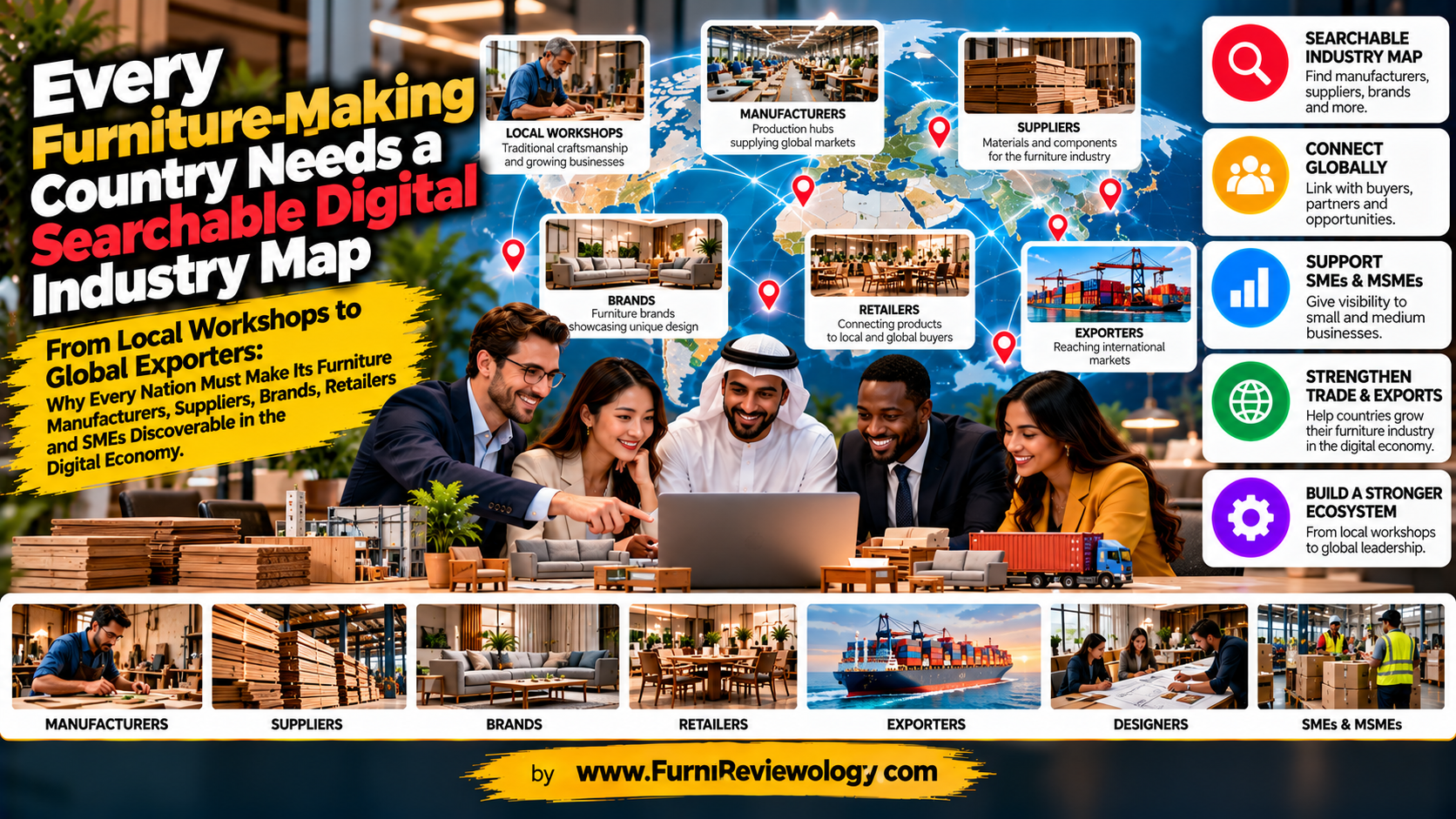
By The Furniture Times (TFT) Editorial Desk | Global Furniture Industry | FISE | FurniReviewology | Furniture Industry Mapping | Digital Economy | Manufacturing | SMEs & MSMEs | Trade Intelligence | Global Furniture Ecosystem
A Country May Have Thousands of Furniture Companies — But Can the World Find Them?
Every furniture-producing country has an industry story.
Some countries are internationally recognized for furniture manufacturing.
Others have strong domestic furniture markets.
Some specialize in solid wood furniture.
Others lead in upholstery, mattresses, metal furniture, outdoor furniture, office furniture, contract furnishings, rattan, bamboo, components or furniture machinery.
Some countries have large export-oriented factories.
Others depend heavily on family-owned businesses, regional workshops, artisans, retailers and small manufacturers.
But almost every furniture-producing nation faces a common digital challenge.
Its furniture industry is often much easier to find physically than digitally.
A country may have thousands of manufacturers, yet no comprehensive, regularly maintained digital map showing what those manufacturers actually produce.
An industrial district may contain hundreds of specialized suppliers, yet an overseas buyer may struggle to identify them.
A regional workshop may have decades of expertise but no structured online profile.
A growing furniture brand may be known domestically but remain invisible internationally.
The problem is not necessarily a shortage of businesses.
It is a shortage of organized, searchable and accessible industry information.
Every Furniture-Making Country Needs a Searchable Digital Industry Map.
Not merely a PDF directory.
Not simply a list of association members.
Not only an exhibition catalogue.
Not another outdated database.
But a living digital representation of its furniture ecosystem.
A map that helps the world answer:
Who makes furniture here?
What do they manufacture?
Where are they located?
Which categories do they specialize in?
How can buyers discover and contact them?
What information is available about their capabilities and reputation?
This is no longer just a marketing question.
It is an economic development opportunity.
Furniture Industry Mapping Is a Form of Economic Infrastructure
Countries invest heavily in physical infrastructure.
Industrial parks.
Roads.
Ports.
Warehouses.
Export-processing zones.
Exhibition centers.
Manufacturing facilities.
Logistics networks.
These investments help businesses produce and move goods.
But digital infrastructure performs a different function.
It helps buyers discover those businesses.
A factory that cannot be found by a potential customer may be commercially disadvantaged even when its production capabilities are excellent.
A searchable national furniture map can help connect manufacturing capacity with market demand.
It can make industry clusters more visible.
It can help smaller companies participate in international discovery.
It can also provide a foundation for better industry research.
Physical infrastructure helps furniture move. Digital discovery infrastructure helps furniture businesses become visible to the markets they want to serve.
Both matter.
The Missing Digital Map of the Furniture Economy
Consider what a complete furniture-industry map would need to represent.
It would not be limited to finished furniture manufacturers.
It would include the businesses and services supporting the entire value chain.
| Industry segment | Examples of searchable businesses |
|---|---|
| Residential furniture | Sofa, bed, dining, storage and living-room manufacturers |
| Commercial furniture | Office, education, healthcare and public-space furniture |
| Hospitality furniture | Hotel, resort, restaurant and contract furniture suppliers |
| Outdoor furniture | Patio, garden, poolside and commercial outdoor furniture |
| Components | Hardware, hinges, slides, frames, mechanisms and accessories |
| Materials | Timber, panels, fabric, leather, foam, metal, glass and coatings |
| Machinery | Woodworking, cutting, finishing, upholstery and automation equipment |
| Distribution | Wholesalers, importers, exporters, distributors and retailers |
| Professional services | Designers, installers, testing providers, logistics and repair specialists |
| Circular economy | Restoration, refurbishment, recycling and second-hand furniture businesses |
Without this broader perspective, a national furniture directory risks presenting only part of the real industry.
The furniture economy is an ecosystem.
Its digital map should reflect that.
A Searchable Map Is More Than Pins on a Screen
The term digital industry map may sound geographical.
Geography is important.
But the deeper value comes from connecting locations with structured business information.
Imagine a buyer searching for:
“Outdoor furniture manufacturers in Malaysia.”
The buyer should ideally be able to narrow the research by:
Manufacturer or distributor.
Product category.
Material specialization.
Geographic region.
Residential or commercial application.
Export-market experience.
Customization capability.
Relevant certifications where documented.
Company profile and contact information.
A geographical pin alone cannot provide all of this.
A useful digital industry map needs a searchable data structure behind it.
Location tells buyers where a company is. Structured information helps them understand why it may be relevant.
One Country. Many Furniture Clusters. One Discoverable Ecosystem.
Furniture production is often concentrated in regional clusters.
These clusters develop around raw materials, labor skills, manufacturing traditions, logistics access, established companies and supporting suppliers.
Consider several examples.
Malaysia: Making Manufacturing Capabilities Easier to Discover
Malaysia has an established furniture manufacturing and export ecosystem, with important activity across different states and industrial areas.
A searchable industry map could help buyers identify:
wood furniture manufacturers,
outdoor furniture suppliers,
upholstery producers,
contract furniture businesses,
component manufacturers,
export-oriented companies,
and supporting service providers.
It could also make smaller businesses easier to find alongside established exporters.
India: Connecting Diverse Manufacturing Traditions
India's furniture economy includes industrial manufacturing, regional furniture clusters, woodcraft traditions, upholstery, metal furniture, modular systems and a large domestic retail sector.
A searchable digital map could connect:
large manufacturers,
regional SMEs,
artisans,
design-led brands,
contract suppliers,
material companies,
and emerging furniture businesses.
The objective should be to make India's diversity discoverable without reducing the entire industry to a handful of major cities.
China: Improving Category-Specific Supplier Research
China's furniture ecosystem includes large manufacturing clusters, export suppliers, domestic brands, component businesses, machinery companies and highly specialized production capabilities.
A structured digital map could support more precise discovery by product, material, region and business capability.
Vietnam: Connecting Export Manufacturing With Global Discovery
Vietnam is an important furniture manufacturing and export location.
A searchable industry map could help buyers research manufacturers, supporting suppliers, production specializations and relevant industrial regions.
It could also help smaller businesses become more visible within the wider manufacturing ecosystem.
Italy: Connecting Design, Craftsmanship and Manufacturing
Italy's furniture industry includes internationally recognized design brands, specialist manufacturers, material expertise, craftsmanship and production clusters.
A searchable map could help buyers explore both established names and less visible specialist businesses.
Indonesia: Connecting Natural Materials and Manufacturing
Indonesia's furniture ecosystem includes wood, rattan and other material-based manufacturing traditions alongside modern industrial production.
A searchable digital map could help make regional capabilities, suppliers and manufacturers easier to discover.
These examples illustrate a broader principle.
Every furniture-producing country has its own industrial strengths. The digital map should reveal those strengths rather than force every country into the same narrow category structure.
The Biggest Beneficiaries May Be the Smallest Companies
Large furniture manufacturers often already have established international visibility.
They attend trade exhibitions.
Maintain professional websites.
Work with distributors.
Advertise.
Publish catalogues.
Employ export teams.
Develop media relationships.
But smaller manufacturers may not have these resources.
Consider a 15-person furniture workshop producing specialized wooden tables.
Its products may be excellent.
Its craftsmanship may be respected.
Its customers may be loyal.
But an overseas buyer searching for that type of product may never discover the business.
A searchable digital industry map can help reduce this information gap.
It gives smaller companies an opportunity to establish a basic digital identity.
That does not guarantee sales.
But it can make participation in buyer research more accessible.
Digital Inclusion Must Extend Beyond Large Furniture Brands.
Why National Furniture Associations Should Care
Furniture associations and trade bodies play important roles in industry development.
They connect members.
Represent business interests.
Organize events.
Provide information.
Support policy discussions.
Promote exports.
But many associations have an opportunity to expand their digital contribution.
A modern furniture association could help its members maintain accurate, searchable company information.
It could support:
industry categorization,
company-profile completeness,
digital literacy,
product-data standards,
regional cluster visibility,
and member participation in wider industry discovery.
Association directories can remain valuable while becoming more structured, current and accessible.
The objective should not be to replace existing institutions.
It should be to connect their industry knowledge with the broader digital economy.
Governments Should See Furniture Mapping as an SME Development Opportunity
For governments and economic development agencies, searchable industry mapping can support several policy objectives.
SME Digitalization
Help smaller businesses establish an online identity.
Export Promotion
Make potential exporters easier for international buyers to research.
Regional Development
Increase visibility for manufacturing activity outside major commercial centers.
Industrial Intelligence
Develop a clearer picture of the businesses and categories participating in the sector.
Investment Promotion
Help investors understand industrial capabilities and clusters.
Workforce Development
Identify relevant manufacturing concentrations and skills requirements.
Supply-Chain Development
Help companies discover potential domestic suppliers.
However, a digital map should not be mistaken for an official industrial census unless its coverage, verification methods and data limitations support that use.
An industry map can support better economic decisions, but its usefulness depends on the accuracy and completeness of its information.
FISE: The Opportunity for a Global Furniture Industry Map
This is where FISE — Furniture Industry Search Engine becomes strategically relevant.
The long-term opportunity is not only to help a buyer find an individual furniture company.
It is to make furniture industries searchable across countries, regions and categories.
Imagine a global discovery structure where buyers can explore:
Afghanistan furniture companies.
Australia furniture companies.
Brazil furniture companies.
China furniture companies.
Germany furniture companies.
India furniture companies.
Indonesia furniture companies.
Italy furniture companies.
Malaysia furniture companies.
Mexico furniture companies.
Poland furniture companies.
Türkiye furniture companies.
United States furniture companies.
Vietnam furniture companies.
And every other furniture-producing market.
Each country becomes a discoverable part of the wider furniture ecosystem.
Within each country, businesses can be organized by relevant categories and locations.
This is the broader opportunity behind furniture-specific search infrastructure.
From National Furniture Industries to One Searchable Global Furniture Ecosystem.
The Country-to-Company Discovery Model
A practical digital mapping structure could follow this hierarchy:
Global Furniture Ecosystem
↓
Country
↓
State / Province / Region
↓
City / Manufacturing Cluster
↓
Industry Category
↓
Company Profile
↓
Products / Services / Capabilities
↓
Reviews / Reputation / Relevant Industry Information
↓
Buyer Enquiry / Business Connection
This model provides a logical path from broad industry discovery to specific company research.
It also makes room for local, regional and international businesses within the same broader structure.
FurniReviewology Adds the Reputation Dimension
A map can show where furniture businesses are located.
A directory can show their names.
A search engine can help buyers discover them.
But another question remains:
What customer-experience information is available about these businesses?
This is where FurniReviewology adds a complementary dimension.
Its furniture-focused company profiles and review orientation can help support the reputation layer of the ecosystem.
A buyer researching a manufacturer may want to examine:
product quality,
communication,
delivery,
durability,
after-sales service,
and problem resolution.
A professional buyer may need additional information about manufacturing performance and commercial reliability.
Reviews provide context, but they do not replace independent verification.
The value of a connected ecosystem lies in making discovery and reputation research easier to navigate.
FISE helps the world find them. FurniReviewology helps the world trust them.
TFT Adds the Industry Intelligence Dimension
A country-level furniture map should also be supported by meaningful industry context.
What is happening in that country's furniture sector?
Which manufacturing categories are developing?
What trade challenges are emerging?
Which companies are investing?
What innovations are being introduced?
How are materials, technology, sustainability and buyer demand changing?
This is where The Furniture Times — TFT contributes through industry news, market intelligence, company developments and editorial coverage.
For example, a buyer researching furniture companies in a country may also want to understand:
export-market conditions,
trade policies,
manufacturing developments,
sustainability requirements,
technology adoption,
and relevant industry events.
This information helps buyers interpret the market rather than merely browse company names.
A searchable company map tells buyers who is there. Industry intelligence helps explain the environment in which those companies operate.
The Digital Industry Map Must Be Built on Reliable Information
An ambitious global map cannot succeed through company names alone.
Data quality matters.
At minimum, useful company records should distinguish between:
Official company identity and brand names.
Business type and industry categories.
Location and markets served.
Products and services.
Official website and contact information.
Self-declared capabilities and independently verified information.
Active and outdated records.
Genuine reviews and other reputation signals.
Companies should have ways to correct outdated information.
Duplicate records should be addressed.
Businesses should not be labeled as verified without an appropriate verification process.
Personal data should be handled responsibly.
And the system should distinguish clearly between paid promotion and organic or editorial information.
A large database with unreliable information is not automatically a valuable industry map.
Trustworthy infrastructure requires ongoing maintenance.
A Digital Map Must Remain Alive
One of the biggest weaknesses of traditional industry directories is that they become outdated.
Companies relocate.
Factories close.
Brands change ownership.
Phone numbers change.
Product categories evolve.
Export markets expand.
New businesses enter.
Others disappear.
A searchable digital map must therefore be treated as a living information system.
That means regular updates.
Company participation.
Data correction.
Profile maintenance.
Duplicate management.
And transparent handling of uncertain information.
The objective is not simply to collect as many listings as possible.
It is to build a resource that becomes more useful over time.
The AI Opportunity: From Static Directory to Intelligent Industry Discovery
Artificial intelligence creates another reason to structure furniture-industry information.
A buyer may eventually ask:
“Find manufacturers in Malaysia specializing in commercial outdoor furniture.”
“Identify potential suppliers of wooden hospitality furniture in Southeast Asia.”
“Which furniture-producing regions should I investigate for upholstered seating?”
“Help me prepare a shortlist of manufacturers and identify what needs verification.”
AI-assisted tools can help interpret structured company and product information.
But useful answers depend on the quality of the underlying data.
An AI system cannot reliably infer capabilities that a company has never documented.
A global furniture-industry map built on accurate, structured information could become a useful foundation for more sophisticated discovery.
This is a strategic opportunity, not a guarantee that any particular listing will appear in AI-generated answers.
Every Country Needs to Know Its Furniture Industry Better
A digital industry map is not only about helping foreign buyers.
It can also help countries understand their own manufacturing ecosystems.
For example:
Which regions have strong upholstery manufacturing?
Where are outdoor furniture producers concentrated?
Which locations have specialist hardware suppliers?
Where are furniture machinery services available?
Which industrial clusters support hospitality projects?
Where might supply-chain gaps exist?
Which smaller businesses need digitalization support?
These questions matter for businesses, associations, researchers and policymakers.
A well-maintained map can make such questions easier to investigate.
The Hidden Domestic Opportunity
Furniture-industry mapping is often discussed in terms of exports.
But domestic opportunities may be just as important.
A furniture manufacturer may be importing a component that another local company produces.
A hotel developer may be unaware of capable manufacturers within the same country.
A retailer may not know that a regional supplier offers a suitable product.
A startup may struggle to identify local material suppliers.
A digital map can help reduce these discovery gaps.
It can encourage domestic business connections alongside international trade.
A country should make its furniture industry discoverable to its own businesses as well as to the rest of the world.
A Practical Roadmap for Building a National Furniture Digital Map
The opportunity is large, but implementation can begin in stages.
Phase 1 — Establish the Industry Categories
Define the major furniture segments, supporting industries and business types.
Use categories that reflect how buyers actually search.
Phase 2 — Map Geographic Clusters
Identify states, provinces, cities and industrial regions with furniture-related activity.
Avoid assuming that only established export clusters matter.
Phase 3 — Invite Company Participation
Encourage manufacturers, suppliers, brands, retailers, designers, artisans and service providers to establish accurate profiles.
Make participation accessible to SMEs and MSMEs.
Phase 4 — Improve Information Quality
Standardize essential company details, categories and product information.
Create processes for corrections and updates.
Phase 5 — Connect Discovery and Reputation
Where appropriate, connect company profiles with genuine customer feedback and reputation information.
Phase 6 — Add Industry Intelligence
Provide relevant country, category and company developments through industry media and research.
Phase 7 — Maintain and Expand
Measure coverage gaps, improve data accuracy and continue inviting businesses into the ecosystem.
The objective is continuous improvement rather than an unrealistic claim of immediate completeness.
What Every Furniture Company Should Do Today
A national digital map cannot be built without company participation.
Every furniture business has a role.
Start with a simple question:
If someone searched for our company, category and location today, what would they discover?
Then take action.
First: Make your official company information accurate.
Second: Clearly describe your products, services and capabilities.
Third: Establish your company presence in relevant furniture-industry discovery environments.
Fourth: Create or complete your free FurniReviewology listing.
Fifth: Encourage genuine customer reviews and maintain your reputation information.
Sixth: Explore FISE as part of your furniture-specific discovery strategy.
Seventh: Share meaningful company developments and industry stories through appropriate media channels, including TFT.
Eighth: Update your information as the business evolves.
Do not wait for a government, association or industry body to map your company before you begin building your digital identity.
A Call to Furniture Associations, Chambers and Industry Leaders
This initiative should not be seen as the responsibility of individual companies alone.
Furniture associations can mobilize members.
Chambers of commerce can support industry participation.
Export-promotion organizations can help companies prepare for international discovery.
Manufacturing clusters can contribute local knowledge.
Industry media can document developments.
Technology companies can develop search and data tools.
Educational institutions can support research and digital skills.
Governments can encourage SME digitalization and appropriate data standards.
A stronger furniture-industry map requires collaboration.
The more accurate and inclusive the participation, the more valuable the map can become.
No Furniture-Making Country Should Remain Digitally Invisible
The global furniture economy includes established manufacturing powers and emerging producers.
Some have sophisticated export industries.
Others have smaller but culturally and economically important furniture sectors.
Some specialize in mass production.
Others in craftsmanship, natural materials or custom work.
Every country has a different story.
But every furniture-producing country deserves the opportunity to make its industry easier to discover.
A global furniture search ecosystem should not be limited to the countries that already dominate international exhibitions and trade publications.
It should create room for less visible markets too.
From major industrial manufacturers to small regional workshops, the furniture economy needs a more inclusive digital identity.
The Future of Furniture Trade Begins With Knowing Who Exists
A buyer cannot evaluate a supplier they have never discovered.
A manufacturer cannot connect with a distributor it cannot identify.
An investor cannot investigate an industrial cluster without useful information.
An association cannot fully support its members if large portions of the sector remain digitally invisible.
A country cannot easily promote the full diversity of its furniture capabilities if those capabilities are scattered across disconnected sources.
This is why searchable digital industry mapping matters.
It is not merely a technology project.
It is about economic participation.
Visibility.
Market access.
Industry intelligence.
Digital inclusion.
And creating more opportunities for businesses to connect.
One Global Furniture Ecosystem. Every Country. Every Category. Every Company.
Imagine a future in which buyers can explore the world's furniture ecosystem country by country.
From large manufacturers to emerging brands.
From furniture factories to component suppliers.
From industrial clusters to independent workshops.
From domestic retailers to international exporters.
From company profiles to customer reviews.
From search results to relevant industry intelligence.
That is the opportunity.
FISE provides the furniture-industry discovery vision.
FurniReviewology contributes the review and reputation layer.
The Furniture Times contributes industry stories and intelligence.
Together, these functions can support a more connected global furniture-information ecosystem.
The journey will require accurate data, sustained participation, responsible governance and continuous development.
But the direction is clear.
Every Furniture-Making Country Needs a Searchable Digital Industry Map.
And every furniture business should begin preparing to be part of it.
Get listed. Become searchable. Build your reputation. Tell your story. Help put your country's furniture industry on the global digital map.
The Global Furniture Ecosystem
The Furniture Industry is a $1 Trillion USD Ecosystem in the world
Furniture Industry Search Engine - FISE helps the world find them.
The Furniture Times - TFT tells their story.
FurniReviewology helps the world trust them.