By The Furniture Times (TFT) Editorial Desk | Furniture Industry Search Engine (FISE) | Global Furniture Ecosystem | Furniture Manufacturing | Industry Searchability | Business Discovery | SMEs & MSMEs | Supply Chain | Global Trade | Digital Industry Intelligence
If Your Business Is Connected to Furniture, You Belong in the Furniture Ecosystem
The furniture industry does not begin with a sofa.
It does not end with a dining table.
And it certainly does not consist only of factories manufacturing finished furniture.
Behind every sofa is an entire network of businesses.
Someone supplies the timber.
Someone manufactures the foam.
Someone produces the fabric.
Someone makes the springs.
Someone supplies the mechanisms.
Someone designs the product.
Someone manufactures the frame.
Someone provides the machinery.
Someone packages the finished furniture.
Someone transports it.
Someone exports it.
Someone imports it.
Someone sells it.
Someone delivers it.
Someone installs it.
Someone maintains it.
And eventually, someone may repair, refurbish, resell or recycle it.
Every one of these businesses contributes to the furniture industry.
Yet when people discuss furniture business directories, supplier discovery or industry search engines, the conversation often focuses primarily on finished-furniture manufacturers.
That is too narrow.
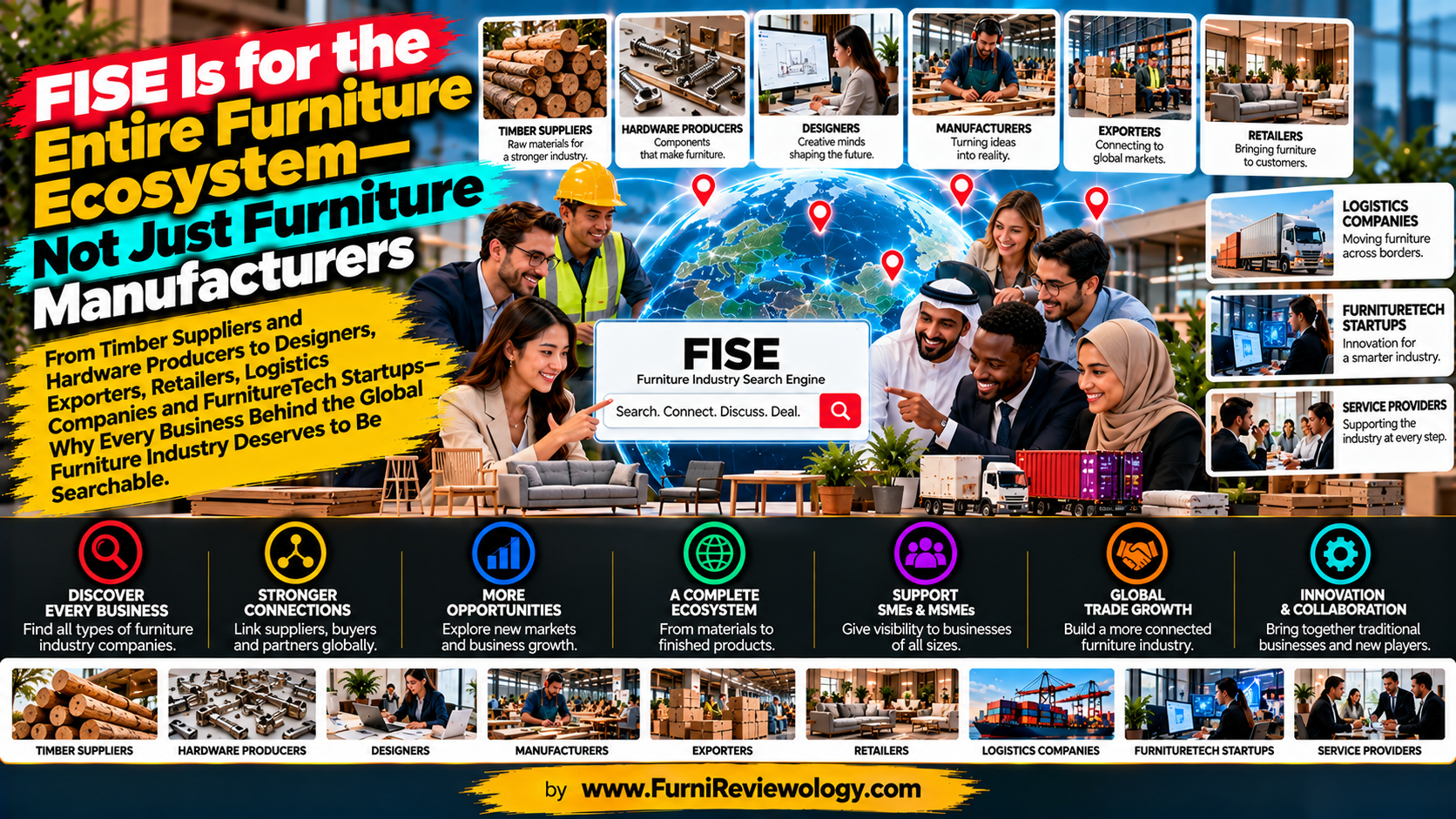
The global furniture industry is an interconnected ecosystem of products, materials, people, companies, technologies, services and markets.
The Furniture Industry Search Engine (FISE) is built around a broader idea:
ONE FURNITURE INDUSTRY. ONE CONNECTED ECOSYSTEM. EVERY BUSINESS DESERVES TO BE DISCOVERABLE.
If your company manufactures, supplies, designs, distributes, transports, services, repairs, promotes or supports furniture, you have a place in this industry.
And your business should have an opportunity to become searchable within it.
The Furniture Industry Is Much Bigger Than Finished Furniture
A finished furniture product may be the most visible part of the industry.
But it represents only one stage of a much larger commercial process.
Consider a single upholstered chair.
The chair may involve:
Timber or metal suppliers
Frame manufacturers
Foam producers
Fabric manufacturers
Spring and webbing suppliers
Furniture hardware companies
Adhesive suppliers
Finishing material producers
Industrial machinery providers
Product designers
Furniture manufacturers
Quality testing laboratories
Packaging companies
Logistics providers
Exporters and importers
Wholesalers and distributors
Retailers
Installation and after-sales service providers
That is an extensive commercial network supporting one product.
Now multiply that across residential furniture, office furniture, hospitality furniture, outdoor furniture, institutional furniture, custom furniture, mattresses, cabinets, components and accessories.
The result is an industry far more diverse than a conventional manufacturer directory can adequately represent.
FISE recognizes the need to make the businesses behind furniture discoverable—not only the finished products.
Who Belongs on FISE?
The answer is broader than many companies may expect.
1. Furniture Manufacturers
Manufacturers remain a central part of the ecosystem.
Residential furniture factories.
Office furniture manufacturers.
Outdoor furniture producers.
Hospitality furniture manufacturers.
Contract furniture specialists.
Mattress manufacturers.
Cabinet makers.
Custom furniture workshops.
OEM and ODM manufacturers.
Every manufacturing specialization deserves clear representation.
But manufacturing is only the beginning.
2. Furniture Component Manufacturers
The furniture industry depends on thousands of components that buyers rarely see in finished products.
Hinges.
Drawer slides.
Handles.
Furniture legs.
Frames.
Recliner mechanisms.
Gas lifts.
Casters.
Springs.
Connectors.
Fasteners.
Furniture locks.
Electrical components.
Adjustable systems.
These companies are essential to furniture production.
Your component may be hidden inside someone else's furniture. Your company should not be hidden from the industry.
List your component manufacturing business.
Describe what you produce.
Identify the manufacturers and industries you serve.
3. Raw Material Suppliers
Furniture production begins with materials.
Timber.
Plywood.
MDF.
Particleboard.
Veneer.
Laminates.
Metal.
Aluminum.
Stainless steel.
Glass.
Stone.
Foam.
Fabric.
Leather.
Synthetic fibers.
Rattan.
Bamboo.
Plastic and composite materials.
Material suppliers need visibility because manufacturers regularly search for alternative sources, specialized specifications and new materials.
If your company supplies materials used in furniture production, your business belongs in the searchable furniture ecosystem.
4. Furniture Hardware and Accessories Companies
Hardware businesses support furniture functionality, durability, assembly and user experience.
They may serve kitchen cabinet manufacturers, wardrobe manufacturers, office furniture producers, upholstered furniture companies and many other categories.
These businesses should be discoverable by product, application, material and technical capability.
A manufacturer searching for a specialized mechanism should not have to depend entirely on personal referrals.
5. Furniture Machinery and Equipment Suppliers
Furniture manufacturing relies on industrial technology.
CNC machinery.
Panel saws.
Edge banders.
Woodworking equipment.
Upholstery machinery.
Sanding equipment.
Finishing systems.
Metal fabrication machinery.
Robotics.
Automation.
Material handling.
Production software.
Machinery suppliers and technical service companies are important members of the furniture ecosystem.
FISE's broader industry vision includes the businesses that help factories manufacture furniture more efficiently.
6. Furniture Designers and Design Studios
Designers contribute creativity, functionality, aesthetics, ergonomics and innovation.
Furniture designers.
Industrial designers.
Interior designers.
Product development studios.
Furniture design consultants.
CAD specialists.
3D visualization professionals.
Design-led businesses should be discoverable by their specializations, capabilities and industries served.
A manufacturer may be looking for a designer.
A hotel developer may be looking for a furniture design studio.
A brand may need product development support.
Search should help these relationships begin.
7. Furniture Exporters and Importers
International furniture trade connects manufacturing regions with consumer and commercial markets.
Exporters need to communicate what they supply and where they operate.
Importers need to identify product categories, distribution capabilities and market coverage.
Both belong in the ecosystem.
A searchable furniture industry should support international discovery beyond existing trade networks.
8. Furniture Wholesalers and Distributors
Wholesalers and distributors connect products with retailers, commercial buyers and regional markets.
Their business information may include:
Product categories.
Brands represented.
Markets served.
Distribution regions.
Commercial capabilities.
Warehouse locations.
Business contact information.
These companies are not simply intermediaries.
They are part of the industry's commercial infrastructure.
9. Furniture Retailers and Showrooms
Retailers are among the most visible businesses to consumers, but they also belong in the broader industry network.
Furniture stores.
Specialist showrooms.
Online furniture retailers.
Multi-brand outlets.
Office furniture dealers.
Outdoor furniture specialists.
Hospitality furniture suppliers.
A retailer may be looking for manufacturers.
A manufacturer may be looking for distributors.
A customer may be searching for a particular furniture category.
Industry-specific discovery can help connect these different needs.
10. Furniture Logistics and Supply Chain Companies
Furniture requires specialized handling.
Bulky products.
Fragile finishes.
Large-volume shipments.
Container loading.
Warehousing.
Last-mile delivery.
Installation.
Reverse logistics.
Furniture logistics providers support the movement of products across factories, warehouses, retailers, projects and homes.
They are an important part of the industry and should not be excluded from its digital identity.
11. Furniture Installation, Repair and Maintenance Companies
The furniture industry does not end when a product is delivered.
Installation companies.
Furniture repair specialists.
Upholstery restoration businesses.
Office furniture maintenance providers.
Commercial furniture servicing companies.
Refurbishment specialists.
Furniture cleaning services.
These businesses contribute to product usability, longevity and customer experience.
A connected furniture ecosystem should recognize the complete furniture lifecycle.
12. Furniture Technology Companies and Startups
Technology is becoming increasingly relevant across furniture manufacturing, sourcing, retail and customer experience.
FurnitureTech.
AI-powered product discovery.
Manufacturing software.
Digital catalogues.
3D visualization.
AR product previews.
ERP systems.
Inventory management.
Digital procurement.
Supply chain software.
Smart furniture.
Circular-economy platforms.
Technology companies supporting furniture businesses deserve industry-specific visibility.
A startup solving a furniture-industry problem should have a place alongside the manufacturers and suppliers it hopes to serve.
The Furniture Ecosystem Also Includes Professional Services
Many businesses supporting the furniture industry do not manufacture or sell physical furniture.
Yet their contribution is commercially important.
These include:
Testing and certification laboratories
Quality inspection companies
Furniture industry consultants
Product photographers
Furniture marketing agencies
Digital commerce specialists
Trade consultants
Customs and freight service providers
Furniture training organizations
Recruitment and workforce companies
Industry media organizations
Furniture associations and councils
Trade fair organizers
Research and market intelligence providers
Sustainability consultants
Product development specialists
Packaging designers
Furniture-related educational institutions
The appropriate connection to furniture should be clear.
FISE is not intended to become an unrestricted directory of unrelated businesses.
The principle is inclusion across the furniture value chain, with relevance to the industry.
Why This Matters to Furniture Buyers
Consider a company developing a new outdoor furniture collection.
It may need more than a finished-product manufacturer.
It may need:
An aluminum extrusion supplier.
A powder-coating specialist.
An outdoor fabric manufacturer.
A cushion foam supplier.
A furniture hardware producer.
A packaging company.
A testing laboratory.
A logistics provider.
A product photographer.
A distributor.
Finding these businesses through separate, unrelated channels can take significant effort.
A furniture-specific search environment creates the possibility of exploring a broader range of relevant companies from a common industry perspective.
The buyer may search by:
What is needed.
Who provides it.
Where the company operates.
What capabilities it offers.
How to contact it.
This is why FISE's ecosystem approach matters.
It reflects how furniture businesses actually operate.
The Furniture Industry Needs to Search Its Supply Chain
A major weakness in furniture discovery is the limited visibility of upstream businesses.
Finished products receive attention.
Brands receive attention.
Retail stores receive attention.
But the supply chain behind them is often less visible.
That creates an opportunity.
Imagine a manufacturer searching for a supplier of specialized upholstery foam.
Or a cabinet factory looking for a new hardware producer.
Or an outdoor furniture company seeking an alternative aluminum supplier.
Or a hotel furniture manufacturer looking for a specialist finishing service.
These are furniture-industry searches.
They deserve to be part of the furniture industry's discovery infrastructure.
FISE should help the industry search not only for furniture, but also for everything required to create, distribute and support furniture.
One Searchable Ecosystem Does Not Mean Every Company Is the Same
The furniture industry contains many different business models.
A factory is not a retailer.
A retailer is not a designer.
A designer is not a logistics company.
A logistics company is not a hardware manufacturer.
A hardware manufacturer is not a testing laboratory.
A testing laboratory is not a furniture startup.
Each business needs information appropriate to its role.
A manufacturer profile may emphasize production capabilities, materials, product categories and export markets.
A designer profile may emphasize design specializations, projects and services.
A logistics company may emphasize regions served, handling capabilities and service types.
A component supplier may emphasize technical specifications and applications.
A retailer may emphasize brands, categories, locations and customer services.
The objective is not to force every furniture business into one generic listing format.
The objective is to make different business types discoverable through relevant information.
Searchability Can Help Smaller Businesses Compete for Attention
The global furniture ecosystem includes multinational corporations, established regional manufacturers, family businesses, workshops, artisans, startups and microenterprises.
Not all have equal marketing resources.
A large company may have international sales teams, exhibition budgets and dedicated digital marketing departments.
A smaller company may have strong capabilities but limited exposure.
An industry-specific discovery environment can offer another route for smaller businesses to present accurate information about what they do.
That does not guarantee equal commercial outcomes.
Buyers will still evaluate price, quality, reliability, capacity and suitability.
But a company should have the opportunity to be considered based on its capabilities—not only its marketing budget.
A small furniture business can have a highly specialized capability. That capability deserves to be searchable.
The FISE Ecosystem Participation Map
| Industry Segment | Examples of Businesses That Can Participate |
|---|---|
| Finished Furniture | Manufacturers, OEM/ODM factories, brands |
| Components | Hardware, mechanisms, frames, fittings |
| Raw Materials | Timber, panels, fabrics, foam, metal, glass |
| Machinery | Woodworking, CNC, automation, production equipment |
| Design | Furniture designers, product studios, interior specialists |
| Trade | Exporters, importers, wholesalers, distributors |
| Retail | Furniture stores, showrooms, online retailers |
| Hospitality & Contract | Hotel, resort, restaurant and commercial furniture suppliers |
| Logistics | Freight, warehousing, delivery and installation |
| After-Sales | Repair, maintenance, restoration, refurbishment |
| Technology | FurnitureTech, AI, software, visualization, digital platforms |
| Professional Services | Testing, certification, consultancy, marketing, training |
| Industry Organizations | Associations, councils, chambers, trade bodies |
| Startups | Emerging products, materials, technology and business models |
This map is an editorial framework for understanding the breadth of the ecosystem, not a claim that every category or feature is already fully implemented on FISE.
Your Company May Be Part of the Furniture Industry Even If You Never Sell a Chair
This is an important message for the global business community.
You may be a foam manufacturer.
You may be a timber supplier.
You may produce furniture handles.
You may manufacture machinery.
You may develop software for furniture factories.
You may provide logistics services.
You may operate a testing laboratory.
You may train furniture workers.
You may design hospitality interiors.
You may produce furniture packaging.
You may supply commercial upholstery.
You may provide restoration services.
If your business meaningfully serves the furniture industry, it has a place in the broader furniture ecosystem.
Do not exclude your company from furniture-industry visibility simply because you do not manufacture finished furniture.
The New Furniture Business Identity
Every company participating in the furniture ecosystem should be able to answer five basic questions.
Who are we?
What do we provide?
Which part of the furniture industry do we serve?
Where do we operate?
How can relevant buyers or partners contact us?
A strong business profile should communicate these answers clearly.
Depending on the business type, it can also include:
Company background.
Product categories.
Technical capabilities.
Materials.
Markets.
Certifications.
Services.
Project experience.
Product catalogues.
Photographs.
Contact information.
Relevant supporting evidence.
The objective is simple:
Make it easier for the right people to understand your business.
Manufacturers: Invite Your Supply Chain Into the Searchable Ecosystem
Furniture manufacturers can play an important role in strengthening industry discovery.
You already know the businesses supporting your production.
Your material suppliers.
Your component suppliers.
Your machinery providers.
Your packaging companies.
Your logistics partners.
Your technical service providers.
Encourage relevant companies to build clear digital industry profiles.
Why?
Because stronger supply-chain visibility can benefit the entire industry.
When businesses are easier to identify and understand, manufacturers have more opportunities to explore alternative suppliers, specialized capabilities and new partnerships.
A connected ecosystem becomes more useful when participation extends beyond the finished-product manufacturer.
Associations and Councils: Help Make Your Members Discoverable
Furniture associations, councils, federations and chambers can also contribute.
They represent manufacturers, suppliers, retailers, exporters, professionals and other industry participants.
Their member networks contain valuable business information.
Associations can encourage members to maintain accurate digital identities, publish clear capability information and participate in appropriate industry discovery platforms.
They can also help explain the importance of searchable company information to SMEs.
Industry representation and industry discoverability should support one another.
The 24-Hour FISE Ecosystem Challenge
If your company serves the furniture industry, begin with a simple exercise.
First: Identify Your Role
Are you a manufacturer, supplier, designer, exporter, retailer, logistics provider, technology company or another industry participant?
Second: Define Your Specialization
Avoid vague descriptions.
Explain exactly what you provide.
Third: Identify Your Customers
Which furniture businesses or market segments do you serve?
Fourth: Prepare Your Business Information
Collect your company name, location, website, contact details, products, services and relevant evidence.
Fifth: Build Your Industry Presence
Explore FISE and the available business-listing process.
Sixth: Keep Your Information Updated
A business profile is most useful when its information remains accurate.
Seventh: Encourage Your Industry Network
Invite relevant suppliers, manufacturers, partners and professional service providers to participate.
One business can become searchable. An industry becomes more useful when many relevant businesses participate.
TFT + FISE + FurniReviewology: One Connected Furniture Ecosystem
The global furniture industry needs different types of information.
It needs stories.
It needs discovery.
It needs trust.
These functions are connected but distinct.
The Furniture Times — TFT
TFT tells their story.
News, interviews, company developments, product launches, market intelligence and industry analysis help explain what is happening across the furniture ecosystem.
Furniture Industry Search Engine — FISE
FISE helps the world find them.
Company profiles, categories, locations, products and capabilities support industry-specific business discovery.
FurniReviewology
FurniReviewology helps the world trust them.
Relevant reviews and customer experiences can provide additional context when evaluating furniture businesses and products.
Together:
STORY → SEARCH → TRUST → CONNECTION
A manufacturer can tell its story.
A supplier can describe its capabilities.
A designer can showcase expertise.
A retailer can present its business.
A technology startup can introduce its solution.
A logistics provider can explain its services.
A buyer can explore relevant companies.
This is the wider vision of a connected furniture-industry information ecosystem.
FISE Is Not Only for the Companies Making Furniture
It is for the companies making furniture possible.
The businesses producing materials.
The companies developing machinery.
The suppliers manufacturing components.
The designers creating products.
The exporters opening markets.
The logistics providers moving goods.
The retailers connecting products with customers.
The technicians installing and maintaining furniture.
The educators developing industry skills.
The startups introducing new technologies.
The associations representing businesses.
The professional service providers supporting growth.
The furniture industry is not one product category. It is an entire economy of interconnected capabilities.
And those capabilities deserve to be discoverable.
LIST YOUR FURNITURE ECOSYSTEM BUSINESS ON FISE
Your Business Is Part of the Furniture Industry. Make Sure the Industry Can Find You.
The Furniture Industry Search Engine invites relevant businesses across the global furniture ecosystem to explore participation.
Manufacturers — List your factory.
Suppliers — List your products and capabilities.
Component Companies — Make your technical products discoverable.
Material Suppliers — Show what you supply.
Machinery Companies — Present your equipment and solutions.
Designers — Showcase your professional expertise.
Exporters — Build your international business identity.
Importers — Make your sourcing and distribution role clear.
Retailers — Present your business and product categories.
Logistics Providers — Explain your furniture-related services.
Technology Companies — Introduce your solutions.
Startups — Show the industry what you are building.
Associations — Encourage your members to become searchable.
SMEs and MSMEs — Don't wait for global buyers to discover you by accident.
Explore FISE:
https://furnitureindustrysearchengine.com/
Describe your company accurately.
Identify your role in the industry.
Publish relevant product and service information.
Maintain current contact details.
Make your capabilities easier to understand.
Listing availability, publication, rankings, enquiries and commercial outcomes depend on the platform and individual circumstances; participation does not guarantee business results.
One Industry. Thousands of Categories. Millions of Connections to Be Made.
The furniture industry is already interconnected through manufacturing, materials, services, trade and people.
What remains fragmented is much of the information that helps companies discover one another.
FISE aims to address that discovery challenge through an industry-specific search environment.
The opportunity becomes more meaningful when the whole value chain participates.
Not just manufacturers.
Not just retailers.
Not just brands.
Everyone who meaningfully contributes to the furniture industry.
The next furniture buyer may be searching for your company.
The next manufacturer may need your component.
The next designer may need your material.
The next exporter may need your logistics service.
The next factory may need your machinery.
The next startup may need your expertise.
Make sure they have a better opportunity to find you.
FISE Is for the Entire Furniture Ecosystem.
List. Describe. Discover. Connect.
The Global Furniture Ecosystem
The Furniture Industry is a $1 Trillion USD Ecosystem in the world.
Furniture Industry Search Engine — FISE helps the world find them.
The Furniture Times — TFT tells their story.
FurniReviewology helps the world trust them.
Search. Connect. Discuss. Deal.