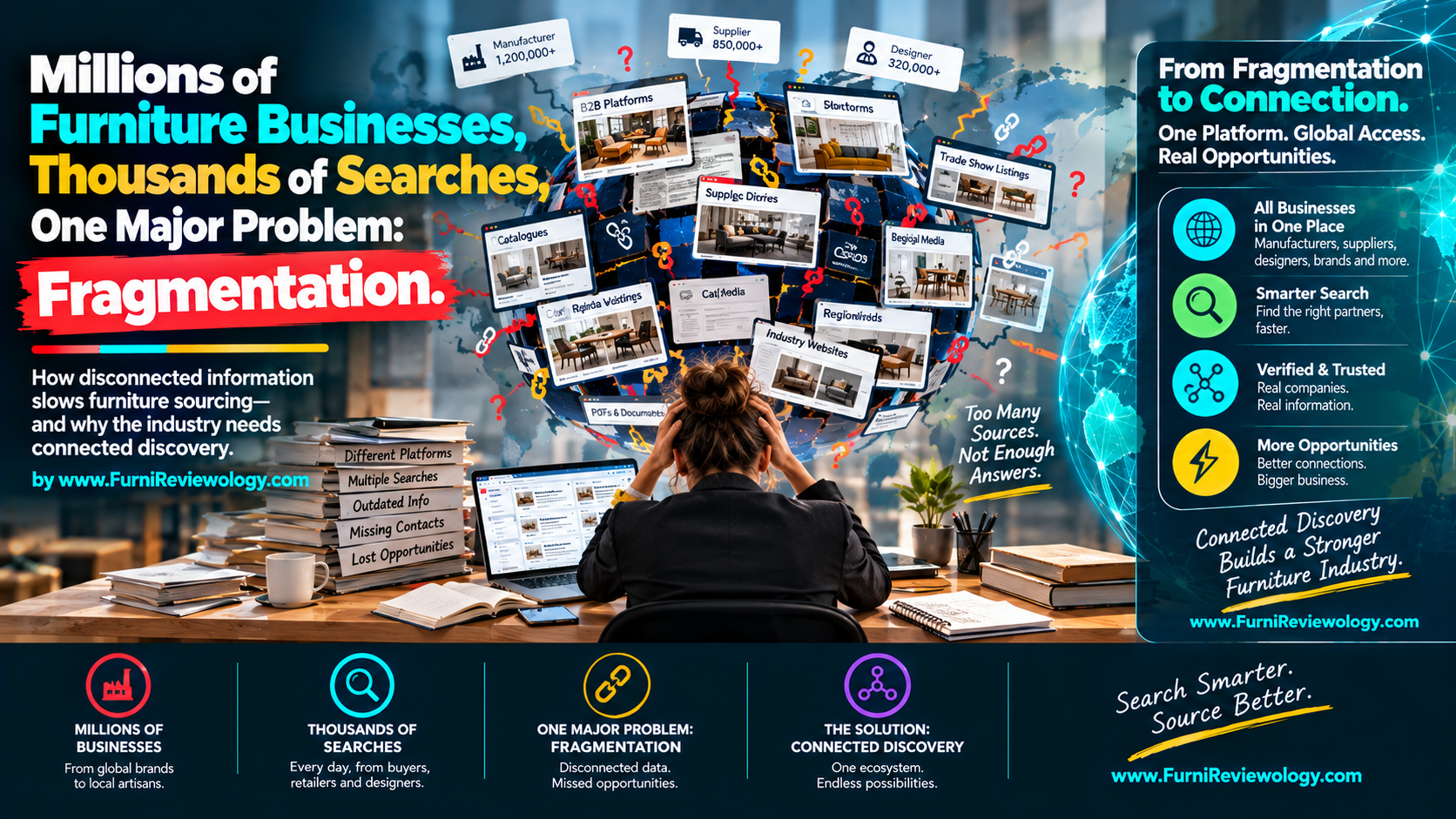
By Furniture Industry Search Engine (FISE) | Furniture Sourcing | Global Discovery | Supply Chain | Searchability | Furniture Ecosystem
The global furniture industry has a strange problem.
There are enormous numbers of companies.
There are enormous numbers of products.
There are enormous numbers of suppliers.
There are enormous numbers of buyers.
There are thousands of searches every day.
Yet finding the right company can still be unnecessarily difficult.
A buyer may know exactly what they want.
A manufacturer may already be producing exactly what the buyer needs.
A supplier may have the required material.
A designer may know the right specification.
A logistics company may already serve the destination market.
A component manufacturer may have the solution.
And still—
they may never find each other.
The problem is not necessarily a lack of supply.
It is not necessarily a lack of demand.
It is not necessarily a lack of technology.
It is often a problem of fragmentation.
The Global Furniture Industry Is Connected Physically—but Fragmented Digitally
Furniture supply chains are highly interconnected.
A single finished product can involve multiple businesses:
Raw material → Component → Manufacturer → Finishing → Packaging → Logistics → Distributor → Retailer → Customer
A hotel project can involve even more:
Developer → Architect → Designer → Procurement → Manufacturer → Supplier → Logistics → Installer → Hotel
The physical relationships can be extremely sophisticated.
But the information about those businesses is often scattered.
One company has a website.
Another has Instagram.
Another has a trade-show catalogue.
Another is listed in a marketplace.
Another appears only on a social-media page.
Another has an old directory listing.
Another relies almost entirely on referrals.
Another may have excellent capabilities but very little searchable information.
The physical supply chain may be connected.
The information supply chain is not.
The Furniture Times' 2026 analysis describes furniture's digital environment as growing but fragmented, with businesses spread across websites, social media, marketplaces, directories, trade shows and offline networks.
That fragmentation has consequences.
Imagine You Are the Buyer
Let's make the problem practical.
You are responsible for sourcing furniture for a new resort.
You need:
500 outdoor dining chairs
200 tables
custom finishes
commercial-grade construction
tropical-weather suitability
reliable production
international shipping
a supplier capable of meeting project deadlines
You begin searching.
Search #1
“Outdoor furniture manufacturer.”
Hundreds of results.
Search #2
“Outdoor furniture manufacturer Southeast Asia.”
More results.
Search #3
“Hotel outdoor furniture supplier.”
Different results.
Search #4
“Custom resort furniture manufacturer.”
Different results again.
Search #5
“Commercial aluminium outdoor furniture.”
Another collection of companies.
Now the real work begins.
You have to determine:
Who actually manufactures?
Who only resells?
Who exports?
Who works with hotels?
Who handles custom production?
Who works with the required materials?
Who has the required capacity?
Who is in the right country?
Who is legitimate?
Who has relevant experience?
Who can actually deliver?
You are no longer simply searching.
You are manually reconstructing the furniture industry.
This Is the Hidden Cost of Fragmentation
Fragmentation creates friction at every stage.
1. Search takes longer
Buyers must search multiple channels.
2. Shortlisting becomes harder
Relevant companies are mixed with companies that are not relevant.
3. Information must be verified manually
Product information may exist in one place and company information somewhere else.
4. Supplier comparison becomes difficult
Different companies present their information in completely different formats.
5. Smaller suppliers can disappear
Companies with limited digital visibility may never enter the buyer's shortlist.
6. International sourcing becomes more complicated
A buyer unfamiliar with a country may not know where to begin.
7. Relationships remain unnecessarily dependent on networks
Referrals, trade fairs and personal contacts remain important—but they cannot provide a complete global map of supply.
The Real Problem: Information Exists, But It Is Not Connected
This distinction is critical.
The furniture industry does not necessarily suffer from an information shortage.
Search engines contain information.
Company websites contain information.
Social media contains information.
Marketplaces contain information.
Trade publications contain information.
Trade-show databases contain information.
Business directories contain information.
Reviews contain information.
Product catalogues contain information.
The problem is that the information is often distributed across disconnected systems.
Think of it like having a giant library in which:
books have no consistent categories
shelves are in different buildings
some books have no titles
some have outdated labels
some are accessible only by personal invitation
some are stored in another country
and there is no furniture-industry-wide catalogue
The information exists.
Finding the right information is the problem.
Fragmentation Is Not Just an Inconvenience
It can affect commercial opportunity.
A buyer who cannot quickly identify relevant suppliers may:
narrow the search to familiar companies
rely on existing relationships
choose a supplier already known to the procurement team
spend additional time researching
delay a sourcing decision
miss specialist manufacturers
overlook smaller businesses
struggle to compare international options
At the same time, suppliers may:
miss international inquiries
remain dependent on local networks
struggle to enter new markets
have difficulty communicating specialist capabilities
lose opportunities to more visible competitors
The result is a strange inefficiency:
The right supply may exist, while the right discovery does not.
Furniture Sourcing Is Becoming More Complex
This problem becomes more important as sourcing strategies become more international.
Companies are increasingly considering:
alternative manufacturing countries
regional suppliers
diversified supply chains
specialist manufacturers
new materials
new production partners
different logistics routes
multiple sourcing options
The global furniture supply chain itself is undergoing changes driven by tariffs, geopolitical tensions, logistics disruption, labor costs and regional sourcing strategies.
When sourcing becomes more geographically diverse, discovery becomes more important.
A buyer cannot diversify supply effectively if they cannot discover alternative suppliers.
The Supplier You Don't Know About Cannot Be Compared
This may be the most important point in the entire article.
Suppose a buyer knows three furniture manufacturers.
They compare those three.
They negotiate with those three.
They select from those three.
But what if the ideal specialist manufacturer was company number four thousand?
The buyer never knows.
The company never gets the opportunity.
The buyer never gets the alternative.
The market never creates the connection.
This is why discovery infrastructure matters.
The quality of a sourcing decision can be influenced by the quality of the discovery process that comes before it.
That does not mean the most discoverable company is necessarily the best company.
It means that a company cannot be evaluated if it never enters the consideration set.
The Fragmentation Problem Is Also an SME Problem
Large furniture businesses often have stronger resources for digital visibility.
They may have:
marketing departments
international websites
professional catalogues
advertising budgets
SEO teams
distributors
PR agencies
established brand recognition
Smaller companies may have extraordinary production capability but far less digital infrastructure.
A family-owned manufacturer might have 25 years of experience.
A small workshop might specialize in a rare craft.
A component producer might have a highly valuable technical capability.
An exporter might have excellent relationships in several markets.
But if their information is scattered or difficult to discover, the buyer may never encounter them.
That creates a visibility imbalance that has little to do with actual manufacturing capability.
The Furniture Ecosystem Is Bigger Than Furniture Brands
Another reason fragmentation is so serious is that the furniture industry is often understood too narrowly.
A buyer may be looking for a “furniture company.”
But the actual solution could come from:
a component manufacturer
a timber supplier
a metal fabricator
a foam producer
a fabric supplier
a hardware company
a machinery manufacturer
a specialist finisher
a logistics provider
a contract manufacturer
an artisan
an interior designer
an installation company
The furniture ecosystem extends far beyond finished furniture.
A meaningful search infrastructure therefore needs to reflect the whole ecosystem.
What If Furniture Search Worked Differently?
Imagine the same resort buyer.
Instead of beginning with dozens of disconnected searches, the buyer enters:
Outdoor Hospitality Furniture
Then narrows:
Country → Malaysia
Business Type → Manufacturer
Application → Resort
Material → Aluminium
Capability → Custom Production
Market → Export
Now the buyer has a structured group of potentially relevant businesses.
The next step is not necessarily to buy.
The next step is to:
Discover → Understand → Compare → Validate → Trust → Connect
That is a fundamentally different sourcing experience.
This Is the Idea Behind FISE
FISE — Furniture Industry Search Engine is built around this discovery problem.
The concept is straightforward:
Bring furniture businesses into a structured, searchable industry environment.
Instead of asking buyers to reconstruct the ecosystem manually, organize business information around the dimensions buyers actually use.
Search by company
Find a specific business.
Search by category
Find manufacturers and suppliers within a furniture category.
Search by country
Explore furniture businesses in different markets.
Search by city
Discover local and regional companies.
Search by capability
Find businesses that can actually perform the required work.
Search by material
Find companies working with particular materials.
Search by industry
Explore hospitality, office, residential, outdoor, healthcare and other segments.
Search by business type
Find manufacturers, suppliers, exporters, retailers, designers and service providers.
This is the difference between a generic directory and an industry-specific discovery layer.
FISE Is About Structure
Search becomes much more useful when information has structure.
Consider two company descriptions.
Profile A
“We are a leading furniture company offering quality products worldwide.”
Profile B
“Outdoor furniture manufacturer based in Malaysia, specializing in commercial hospitality projects, custom aluminium and timber products, serving resorts, hotels and international buyers.”
The second profile gives the buyer—and potentially search systems—far more useful context.
It answers:
What?
Where?
For whom?
How?
Which market?
That is structured discoverability.
Structure Makes Comparison Possible
Once businesses are described using meaningful categories, buyers can begin comparing relevant information.
Not necessarily ranking companies.
Not automatically deciding which company is “best.”
But understanding differences.
For example:
| Buyer requirement | Supplier information |
|---|---|
| Location | Country / city |
| Product | Category / product |
| Material | Timber / metal / fabric / etc. |
| Capability | Standard / custom production |
| Market | Residential / hospitality / commercial |
| Geography | Domestic / export |
| Experience | Years / projects |
| Evidence | Certifications / reviews / references |
| Contact | Direct business channel |
This is much closer to how real sourcing decisions are made.
Search Is the Beginning—Not the End
FISE should not be viewed as merely a place where someone searches for a company.
Search is the beginning of the journey.
The broader journey is:
Search
Find potentially relevant businesses.
Discover
Explore the company.
Understand
Learn what it actually does.
Compare
Look at relevant alternatives.
Validate
Examine available evidence.
Trust
Consider reviews, reputation and business information.
Connect
Contact the company.
Opportunity
Turn discovery into a commercial conversation.
The broader FISE ecosystem has been described in similar terms, connecting search and discovery with understanding, validation, trust and business connection.
Fragmentation Also Hurts the Buyer Who Thinks They Have Found Everything
This is an overlooked issue.
A buyer may conduct extensive research and still have incomplete visibility.
Why?
Because search results naturally reflect what is digitally accessible and indexed.
A company with weak online visibility may not appear.
A workshop with no structured profile may not appear.
A specialist supplier whose information is buried in a PDF may not appear.
A local manufacturer whose only presence is social media may be difficult to evaluate.
So a buyer may conclude:
“These are the available suppliers.”
When the reality may be:
“These are the suppliers I was able to discover.”
Those are very different statements.
The Internet Is Large. That Does Not Mean the Industry Is Organized.
This is an important distinction.
The furniture industry does not need another giant pile of disconnected information.
It needs organization.
It needs:
Categories.
Locations.
Capabilities.
Products.
Materials.
Business types.
Markets.
Services.
Evidence.
Connections.
The objective is not to make the internet bigger.
It is to make furniture information more usable.
AI Makes Structured Discovery Even More Important
The shift toward AI-assisted discovery adds another dimension.
Modern platforms are increasingly trying to interpret natural-language requests rather than simply match individual keywords.
Furniture.com, for example, launched an AI-powered platform in 2026 designed to help shoppers discover and compare furniture across multiple brands, illustrating the wider movement toward category-level digital discovery and decision support.
Other furniture technology work has also highlighted the challenge of inconsistent and unstructured product data when trying to match furniture products across multiple sources.
The lesson for the furniture industry is straightforward:
The more structured the information, the more useful discovery can become.
This applies to buyers.
It applies to search engines.
It applies to AI systems.
And it applies to the businesses themselves.
The Furniture Company Should Not Have to Explain Everything From Zero
When a buyer discovers a company, the basic information should already be available.
The buyer should be able to answer:
Who are they?
Where are they?
What do they manufacture?
What materials do they use?
What industries do they serve?
Can they customize?
Do they export?
What type of business are they?
What evidence is available?
How can I contact them?
The better this information is organized, the less friction exists between discovery and inquiry.
What Furniture Companies Should Do About Fragmentation
The solution is not simply to complain that buyers cannot find suppliers.
Companies can take practical steps.
1. Create one authoritative company profile
Keep the core facts consistent.
2. Define your categories
Be specific about what you manufacture or supply.
3. Document your capabilities
Don't simply say “custom furniture.”
Explain what you can actually customize.
4. Identify your markets
Residential?
Hospitality?
Office?
Healthcare?
Outdoor?
Contract?
Export?
5. Document your geography
Country, city, manufacturing location and markets served.
6. Add products
Give each major product or product category a clear identity.
7. Add visual evidence
Factory, workshop, products and completed projects.
8. Keep information updated
An outdated profile can be nearly as problematic as no profile.
9. Build discoverability beyond your own website
Participate in relevant industry platforms and professional networks.
10. Make your business searchable
This is where FISE can become part of the strategy.
The Call to Manufacturers: Don't Let Your Capability Disappear Inside the Fragmentation
If you manufacture furniture, list the company.
If you supply furniture materials, list the company.
If you manufacture components, list the company.
If you export, list the company.
If you are an artisan, list the company or workshop.
If you provide furniture machinery, list the company.
If you provide logistics, installation or maintenance, list the company.
If you design furniture, make your professional identity discoverable.
If you serve hospitality, make that capability explicit.
If you are a retailer, make your market visible.
The ecosystem cannot become searchable if the ecosystem does not participate.
That is why listing is not simply a marketing exercise.
It is a contribution to the industry's information infrastructure.
Don't Wait Until You Need a New Buyer
One of the biggest mistakes a company can make is to build visibility only when business slows down.
By then, the work is reactive.
A stronger approach is:
Build the profile before the opportunity arrives.
When a buyer eventually searches:
Your company is already there.
Your categories are already defined.
Your products are already uploaded.
Your capabilities are already documented.
Your location is already known.
Your contact information is already available.
Your company has already become part of the searchable ecosystem.
A New Way to Think About Furniture Sourcing
For decades, furniture sourcing often depended heavily on:
Trade fairs
Personal networks
Agents
Referrals
Distributors
Existing relationships
These remain valuable.
But digital discovery adds another dimension:
Searchable industry infrastructure.
The goal is not to eliminate relationships.
It is to help more of the right relationships become possible.
A buyer should have a better chance of discovering a supplier they would otherwise never encounter.
A supplier should have a better chance of being discovered by a buyer outside its traditional network.
That is the commercial opportunity created by connected discovery.
From Fragmentation to Connection
The problem can be summarized simply.
Today:
Millions of businesses
↓
Thousands of searches
↓
Thousands of disconnected information sources
↓
Manual research
↓
Limited discovery
↓
Missed possibilities
The opportunity:
Businesses
↓
Structured profiles
↓
Industry-specific search
↓
Discovery
↓
Understanding
↓
Validation
↓
Trust
↓
Connection
↓
Business opportunity
That is the transformation FISE is trying to enable.
One Global Furniture Ecosystem Should Not Require Thousands of Separate Searches
The furniture industry is too large to continue operating digitally as disconnected islands.
A buyer should not have to become an expert in another country's furniture industry before discovering its suppliers.
A manufacturer should not have to rely entirely on luck to reach an overseas buyer.
An artisan should not need a global marketing department to become discoverable.
A specialist component producer should not remain invisible because its products are hidden inside finished furniture.
A retailer should not have to search dozens of disconnected sources to discover new suppliers.
The industry needs a better starting point.
FISE: Connecting the Search Layer of Furniture
FISE is designed around that starting point.
Furniture Industry Search Engine
A dedicated discovery environment for the furniture ecosystem.
A place where businesses can become more discoverable through:
Company
Category
Country
City
Product
Material
Capability
Industry
Market
Service
Expertise
And where discovery can eventually connect naturally with:
Information
Reviews
Trust
Business inquiries
Commercial opportunities
The Furniture Times provides the storytelling and industry-intelligence layer.
FISE provides the discovery layer.
FurniReviewology provides the review and trust layer.
Together, they represent a broader attempt to connect an industry that has historically been fragmented across many digital and physical channels.
The Industry Has the Businesses. Now It Needs the Map.
Think of the global furniture ecosystem as a huge city.
The businesses are already there.
The factories are there.
The workshops are there.
The suppliers are there.
The designers are there.
The retailers are there.
The buyers are there.
The roads exist.
But the map is incomplete.
A buyer may know the destination exists without knowing how to get there.
A supplier may be operating successfully without being visible from another part of the world.
FISE is about building a better map of the furniture ecosystem.
Not replacing the businesses.
Not replacing their websites.
Not replacing relationships.
Making the businesses easier to discover.
The Urgency Is Real
The furniture industry is becoming increasingly digital.
Buyers are researching online.
Companies are expanding sourcing networks.
AI-assisted discovery is developing.
Product and supplier data are becoming increasingly important.
And the furniture market itself remains highly fragmented, with large numbers of regional specialists and smaller businesses competing alongside major players.
The longer information remains fragmented, the more effort buyers must spend reconstructing the market themselves.
And the longer companies remain disconnected from structured discovery, the greater the possibility that potential buyers will never encounter them.
Fragmentation does not disappear by itself.
It has to be addressed.
Your Next Buyer May Not Know Your Name
This should be printed on every furniture company's strategy board.
Your next buyer may not know your name.
They may know:
the product they want
the material they need
the country they want to source from
the industry they serve
the quantity they require
the application
the capability they need
But they may not know you.
Your job is not simply to wait for them to learn your name.
Your job is to make it possible for them to discover your company before they know your name.
That is what searchability can change.
The Furniture Industry Needs to Stop Thinking in Isolated Websites
One company website cannot map an entire industry.
One social platform cannot map an entire industry.
One trade fair cannot map an entire industry.
One marketplace cannot map an entire industry.
One search engine cannot necessarily organize the industry's business relationships in the way furniture professionals need.
The opportunity is to create a dedicated layer around the industry's own structure.
One ecosystem.
Many businesses.
Structured discovery.
The Action Is Simple
If you are part of the global furniture ecosystem:
List your company.
Upload your products.
Define your categories.
Document your capabilities.
Identify your markets.
Add your location.
Show your expertise.
Keep the information current.
Invite genuine reviews where appropriate.
Make yourself discoverable.
Do not wait for the ecosystem to become fully searchable before you participate.
Participation is how the ecosystem becomes searchable in the first place.
The Furniture Industry's Fragmentation Problem Has a Name
It is not simply a marketing problem.
It is not simply an SEO problem.
It is not simply a website problem.
It is a discovery infrastructure problem.
And infrastructure requires participation.
The global furniture industry already has extraordinary supply.
It already has extraordinary talent.
It already has extraordinary manufacturing capability.
It already has extraordinary demand.
What is missing is a stronger connection between those elements.
Search can become that connection.
From Thousands of Searches to One Connected Ecosystem
The future should not require a buyer to search endlessly across disconnected channels.
It should make it easier to move from:
Search
to
Discovery
to
Understanding
to
Comparison
to
Validation
to
Trust
to
Connection
to
Opportunity
That is the larger vision behind FISE.
The Global Furniture Ecosystem
The furniture industry is already connected by:
Products.
Materials.
Factories.
Supply chains.
People.
Trade.
Markets.
What remains fragmented is the way the world discovers all of them.
The industry does not need more disconnected information.
It needs connected discovery.
FISE — Furniture Industry Search Engine
Bringing the fragmented furniture ecosystem into a more searchable, discoverable and connected environment.
And the opportunity begins with every company that decides to participate.
List your company.
Upload your information.
Become part of the searchable furniture ecosystem.
Because somewhere in the world, a buyer is already searching for what you make.
The real question is not whether the demand exists.
The real question is whether your company—and the right supplier for that buyer—can find each other.
The Global Furniture Ecosystem
FISE helps the world find them.
The Furniture Times tells their story.
FurniReviewology helps the world trust them.