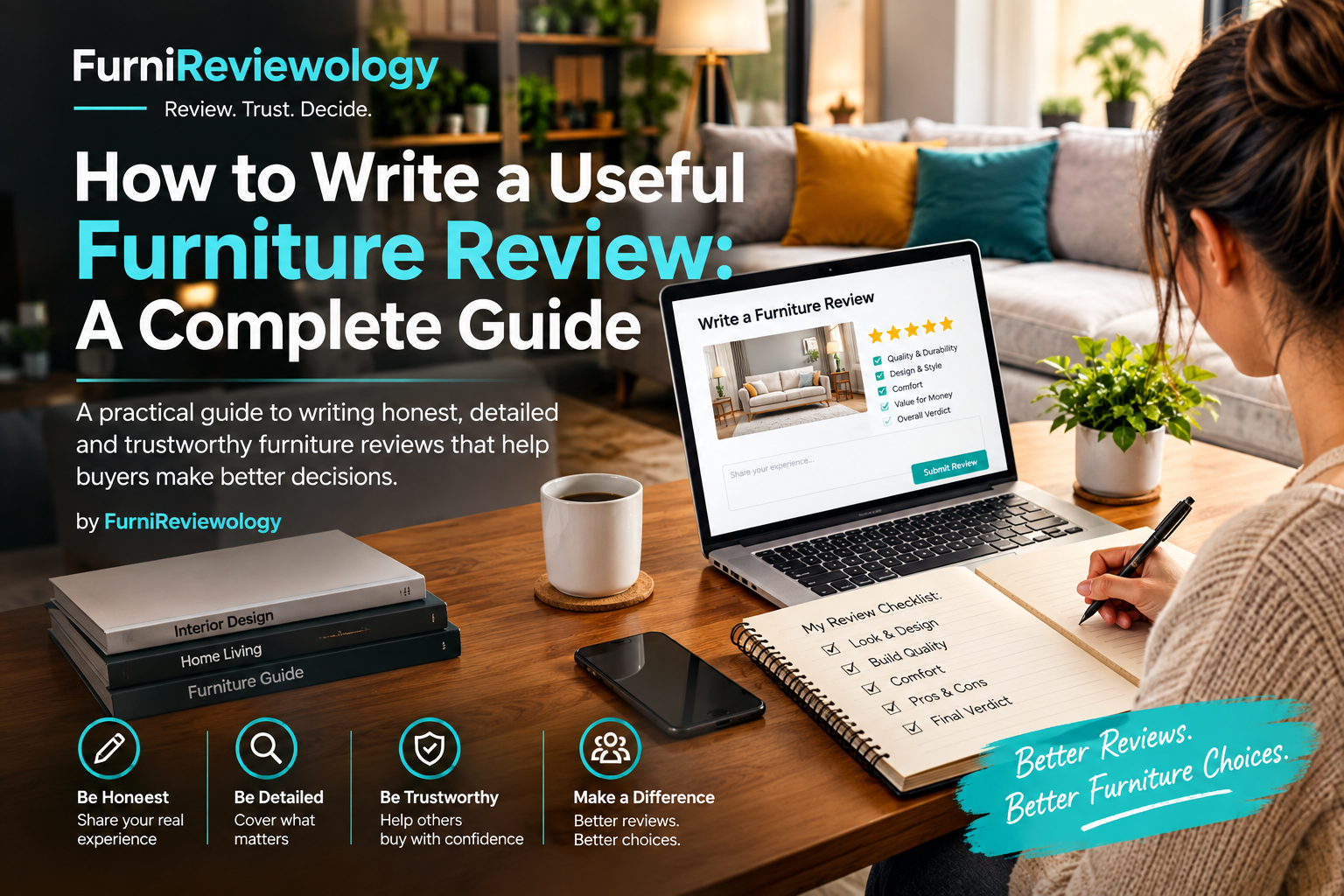
A furniture review should do more than say “I love it” or “Terrible product.”
A useful furniture review should help another person understand what it is actually like to buy, receive, use and live with a piece of furniture.
That distinction is becoming increasingly important.
Furniture is no longer purchased only after visiting a physical showroom. Consumers, interior designers, property developers, hotels, restaurants, offices, retailers and other buyers increasingly discover furniture through search engines, online marketplaces, social media, websites, digital directories, artificial intelligence platforms and industry publications.
Before making a purchase, they want answers.
Is the furniture comfortable?
Is it well made?
Are the materials genuine?
Does it look like the photographs?
Is it suitable for everyday use?
How does it perform after several months?
Was delivery reliable?
Was the company responsive?
Was the product worth the money?
A thoughtful furniture review can answer these questions in a way that advertising cannot.
This is why FurniReviewology believes that furniture reviews should be treated as more than ratings. They can become a valuable source of Furniture Trust and Furniture Intelligence.
What Is a Useful Furniture Review?
A useful furniture review is an honest and informative account of a buyer's experience with a furniture product, brand, manufacturer, retailer or service.
It should provide enough information for another person to understand:
What was purchased
Why it was purchased
How much or what type of use it received
What worked well
What did not work well
How the product performed
How the company handled the transaction
Whether expectations were met
Whether the reviewer would recommend it
Who the product may be suitable for
The goal is not necessarily to give the product five stars.
The goal is to provide useful information.
A three-star review can sometimes be more valuable than a five-star review if it explains the strengths, weaknesses and circumstances clearly.
Why Detailed Furniture Reviews Matter
Furniture is different from many everyday purchases.
A buyer may use a sofa for years.
A dining table may become part of a family's daily life.
A bed may affect comfort every night.
An office chair may be used for thousands of hours.
A hotel may purchase hundreds of chairs or tables.
An outdoor furniture set may be exposed to sun, rain, humidity and heavy use.
Consequently, furniture quality cannot always be judged from a photograph or a product description.
Real-world experience matters.
A useful review can provide information that potential buyers cannot easily obtain before purchase.
It can reduce uncertainty.
It can help buyers compare alternatives.
It can identify potential problems.
And it can help good furniture businesses demonstrate their strengths.
Before Writing Your Review, Gather the Facts
One of the biggest mistakes reviewers make is writing immediately based only on emotion.
Instead, take a moment to collect information.
Before starting, identify:
Product name
What exactly did you purchase?
Brand or manufacturer
Who made or supplied the furniture?
Purchase date
When did you buy it?
Usage period
How long have you actually used it?
Location
Where is it being used?
Usage level
Is it lightly used, moderately used or heavily used?
Price range
If relevant and comfortable to disclose, explain approximately what you paid.
Purpose
Why did you purchase it?
This background makes the review much more useful.
Step 1: Explain What You Bought
Start with the basics.
For example:
“I purchased a three-seater fabric sofa for our family living room and have been using it daily for approximately eight months.”
That single sentence provides valuable context.
The reader immediately knows:
What the product is
Where it is being used
Who is using it
How long it has been used
How frequently it is being used
Compare that with:
“Great sofa. Highly recommended.”
The second statement gives almost no useful information.
Step 2: Explain Why You Bought It
Your purchasing motivation can help readers with similar needs.
You might have purchased furniture because:
You moved into a new home
You renovated a room
You opened an office
You furnished a hotel
You needed outdoor furniture
You wanted better ergonomics
You needed more storage
You wanted a particular design
You were replacing damaged furniture
You needed commercial-grade furniture
You wanted custom dimensions
Explain the problem you were trying to solve.
For example:
“We needed an outdoor dining set for a covered restaurant terrace that would receive daily commercial use.”
That context makes the rest of the review much more meaningful.
Step 3: Describe the First Impression
Your first impression matters, but it should not become the entire review.
Consider:
Packaging
Appearance
Colour
Finish
Size
Materials
Construction
Hardware
Assembly
Whether the product matched the photographs
Be specific.
Instead of:
“It looks very nice.”
Consider:
“The finish looked consistent with the online photographs, although the fabric appeared slightly warmer in colour under our indoor lighting.”
That is much more useful.
Step 4: Review the Materials
Materials can have a major effect on furniture performance.
Where possible, identify what the product is made from.
For example:
Solid wood
Engineered wood
Metal
Aluminium
Steel
Rattan
Wicker
Fabric
Leather
Synthetic leather
Glass
Stone
Plastic
Composite materials
You can also discuss visible construction.
For example:
Wood furniture
Grain
Joints
Thickness
Finish
Stability
Metal furniture
Welding
Coating
Corrosion resistance
Structural stability
Upholstered furniture
Fabric
Stitching
Cushion support
Frame
Comfort
Outdoor furniture
Weather resistance
Drainage
UV exposure
Corrosion
Maintenance requirements
Do not make technical claims that you cannot verify.
If you are unsure whether a material is genuinely solid wood, for example, say that you are unsure rather than presenting an assumption as fact.
Step 5: Evaluate Comfort
Comfort is one of the most subjective elements of furniture.
That does not make it unimportant.
It means the reviewer should explain the circumstances.
Instead of:
“Very comfortable.”
Consider:
“The seat feels relatively firm rather than soft, which works well for dining but may not be ideal for someone looking for a deep lounge-style chair.”
That gives the reader something they can evaluate against their own preferences.
For sofas and chairs, consider:
Seat firmness
Back support
Seat depth
Armrest height
Cushion support
Sitting posture
Long-duration comfort
For beds and mattresses:
Firmness
Support
Sleeping position
Heat retention
Edge support
The more specific the observation, the more useful the review.
Step 6: Evaluate Design and Appearance
Furniture is both functional and visual.
Discuss:
Style
Colour
Shape
Proportion
Finish
Detailing
Visual quality
Compatibility with the room
But remember that design is subjective.
Instead of claiming:
“This is the most beautiful sofa available.”
write:
“The clean, contemporary design worked well with our minimalist interior.”
The second statement describes your experience without presenting personal taste as universal truth.
Step 7: Evaluate Construction and Workmanship
This is one of the most important sections of a furniture review.
Look carefully at:
Joints
Stitching
Screws
Hardware
Welds
Alignment
Surface finishing
Drawer movement
Door movement
Frame stability
Cushion construction
Structural support
For custom furniture, consider:
Accuracy of dimensions
Quality of craftsmanship
Attention to detail
Communication during production
Ability to accommodate changes
Avoid destructive testing unless you are specifically qualified and authorized to perform it.
A normal customer review should describe observed performance rather than attempt to scientifically certify structural strength.
Step 8: Talk About Assembly
Assembly can dramatically affect the buying experience.
A product may be excellent once assembled but frustrating to put together.
Consider:
Were instructions included?
Were all parts included?
Was the hardware complete?
Was assembly intuitive?
How long did it take?
Was professional installation required?
Did everything align correctly?
For commercial furniture, installation can be even more important.
A hotel, restaurant or office may have dozens or hundreds of units to assemble.
In such cases, installation efficiency can have a significant operational impact.
Step 9: Review Delivery
Furniture is large, heavy and often difficult to transport.
Therefore, delivery is part of the furniture experience.
Consider:
Delivery time
Communication
Packaging
Handling
Damage
Delivery personnel
Installation
Unpacking
Collection of packaging materials
A furniture review should distinguish between product quality and logistics quality.
For example:
“The dining table itself was excellent, but delivery was delayed by five days.”
That is more useful than simply saying:
“Bad experience.”
Step 10: Evaluate Customer Service
Customer service can become particularly important when something goes wrong.
Consider:
How quickly did the company respond?
Were questions answered clearly?
Was the company professional?
Did they take responsibility?
Was the problem resolved?
Did they follow up?
If there was no problem, you can still describe the communication experience.
For example:
“The company confirmed the delivery schedule promptly and provided updates throughout the process.”
That information can help future buyers.
Step 11: Discuss Durability
Durability is one of the most important areas of furniture reviewing.
But durability must be considered in context.
A product used occasionally in a guest room may experience very little stress.
The same product used every day in a restaurant may experience significantly more.
Explain:
How long you have owned it
How frequently it is used
Who uses it
Where it is located
What environmental conditions it experiences
Then describe what you have observed.
For example:
“After approximately one year of daily family use, the frame remains stable and the fabric has shown only minor signs of wear.”
This is much more useful than:
“Very durable.”
Step 12: Explain Maintenance Requirements
A beautiful piece of furniture that requires unreasonable maintenance may not be suitable for every buyer.
Discuss:
Cleaning
Polishing
Fabric care
Waterproofing
UV protection
Rust prevention
Cushion storage
Replacement parts
Periodic tightening
Professional maintenance
Outdoor furniture deserves particular attention.
For example, furniture exposed to tropical weather may require different care from furniture used indoors.
A good review explains the actual maintenance experience rather than simply saying:
“Easy to maintain.”
Step 13: Discuss Value for Money
Price alone does not determine value.
A better review asks:
What did I receive for what I paid?
Consider:
Quality
Design
Materials
Durability
Warranty
Service
Delivery
Expected lifespan
A higher-priced product can provide good value if it performs exceptionally well over many years.
Likewise, a low-priced product may be poor value if it requires frequent replacement.
A useful review should therefore separate:
Price
from
Value.
Step 14: Mention the Strengths
Every review should clearly identify what worked well.
For example:
What I liked
Comfortable seating
Strong frame
Attractive finish
Easy assembly
Good packaging
Responsive customer service
Suitable for everyday use
This allows readers to quickly understand the product's advantages.
Step 15: Be Honest About Weaknesses
A trustworthy review should also identify limitations.
For example:
What could be improved
Assembly instructions could be clearer
Delivery took longer than expected
Cushion is firmer than anticipated
Colour differs slightly from photographs
Replacement parts are difficult to obtain
A negative observation does not automatically make a review unfair.
In fact, balanced criticism often increases credibility.
Step 16: Avoid Exaggeration
Avoid statements such as:
“The best furniture in the world.”
“Absolutely perfect.”
“Nobody can make anything better.”
“Guaranteed to last forever.”
These statements are difficult to verify and provide little useful information.
Instead, describe what you experienced.
Observation is stronger than exaggeration.
Step 17: Use Evidence Where Possible
Evidence can strengthen a furniture review.
Consider including:
Your own photographs
Purchase date
Product specifications
Usage period
Dimensions
Material information
Warranty details
Delivery experience
Before-and-after photographs where relevant
Do not publish private personal information or confidential documents.
The objective is to provide useful evidence without compromising anyone's privacy.
Step 18: Separate Facts From Opinions
This is one of the most important principles of responsible reviewing.
Fact:
“The table is 180 cm long according to the manufacturer's specification.”
Opinion:
“I think the table is ideal for six people.”
These are not the same thing.
Another example:
Fact:
“The chair has an aluminium frame according to the product description.”
Observation:
“After six months outdoors, I have not noticed visible corrosion.”
Opinion:
“I consider it suitable for covered outdoor use.”
Keeping these categories separate makes reviews more credible.
Step 19: Be Fair to the Business
A furniture review should evaluate an experience—not become a personal attack.
Avoid:
Insults
Threats
Harassment
Unsupported allegations
Personal attacks against employees
Publishing private information
Claims you cannot substantiate
If something went wrong, explain what happened.
State what you expected.
Explain what actually happened.
Describe how the company responded.
That is far more useful than simply attacking the business.
Step 20: Give the Business an Opportunity to Respond
If you are reviewing a significant problem, particularly with a business transaction, consider contacting the company first.
Explain the issue.
Give the business a reasonable opportunity to respond.
If the company resolves the issue, update the review if appropriate.
This creates a more complete record.
A furniture review should ideally document the journey, not just the complaint.
A Simple Furniture Review Structure
If you are unsure where to begin, use this structure:
Product
What did you buy?
Purpose
Why did you buy it?
Usage
How long and how often have you used it?
First Impression
What did you think when it arrived?
Materials
What is it made from?
Design
How does it look and function?
Comfort
How comfortable is it?
Construction
How well is it built?
Assembly
Was installation easy?
Delivery
How was the delivery experience?
Customer Service
How did the company communicate?
Durability
How is it performing over time?
Maintenance
How much care does it require?
Strengths
What did you like?
Weaknesses
What could be improved?
Value
Was it worth the money?
Recommendation
Who would you recommend it to?
This structure can turn a short comment into a meaningful review.
Example of a Weak Furniture Review
“Amazing sofa. Very beautiful. Five stars. I love it.”
There is nothing inherently wrong with this review, but it gives potential buyers very little information.
They do not know:
How long the sofa has been used
Whether it is comfortable
What materials it uses
Whether it is durable
Whether delivery was good
Whether the product matched the description
Whether the reviewer would buy it again
Example of a More Useful Furniture Review
“We purchased this three-seater sofa for our family living room and have used it daily for approximately eight months. The design matches the photographs closely, and the fabric has been easy to maintain. The seating is on the firmer side, which we prefer, although someone looking for a very soft sofa may find it less suitable. The frame remains stable and there has been no noticeable sagging so far. Delivery was on schedule and the installation team completed the setup efficiently. Our main improvement would be to provide clearer cleaning instructions. Overall, we consider it good value for our needs and would consider buying from the same company again.”
This review is much more useful because it provides context, observations, strengths, limitations and a conclusion.
A Furniture Review Should Answer One Important Question
Before publishing your review, ask yourself:
“If I were about to spend my own money on this furniture, what would I want to know?”
That question can transform the quality of your review.
Think beyond:
“Do I like it?”
Ask:
“What would help another person decide?”
That is the essence of useful reviewing.
The Difference Between a Review and an Advertisement
A review should not simply repeat the company's marketing message.
If the product description says:
“Premium luxury craftsmanship.”
The reviewer should examine what that means in practice.
Does the furniture actually appear well made?
Are the joints properly finished?
Are the materials consistent with the description?
How does it perform?
The purpose of a review is to provide an independent perspective based on experience, not simply reproduce promotional language.
Reviews Should Also Recognize Context
There is rarely one furniture product that is perfect for everyone.
A chair may be excellent for:
Restaurants
but unsuitable for:
Long-duration office work.
A sofa may be excellent for:
Compact apartments
but unsuitable for:
Large hospitality environments.
Outdoor furniture may perform exceptionally well in:
Covered spaces
but require different care in:
Fully exposed environments.
Therefore, instead of asking:
“Is this furniture good?”
a better question is:
“Is this furniture good for this particular purpose?”
That is a much more intelligent approach to reviewing.
Furniture Reviews Can Help Create Better Industry Standards
When thousands of furniture experiences are documented responsibly, something bigger can happen.
Patterns begin to emerge.
Buyers can identify recurring strengths and weaknesses.
Businesses can identify areas for improvement.
Manufacturers can understand changing expectations.
Retailers can better evaluate suppliers.
Designers can make better specifications.
Hospitality companies can make better procurement decisions.
The review therefore becomes more than an individual opinion.
It becomes a piece of industry information.
The Future: From Furniture Reviews to Furniture Intelligence
The next generation of furniture review platforms can go beyond collecting comments.
Reviews can potentially be organized around measurable categories such as:
Quality
Comfort
Design
Durability
Materials
Delivery
Installation
Customer service
Value
Sustainability
Commercial performance
Over time, these categories can create structured furniture intelligence.
Instead of simply asking:
“Does this furniture have good reviews?”
buyers may eventually be able to ask:
“How does this furniture perform for customers with needs similar to mine?”
That is a much more powerful concept.
Why FurniReviewology Matters
The global furniture industry is incredibly diverse.
There are major manufacturers, international brands, retailers, distributors, small workshops, independent artisans, designers and countless specialized suppliers.
Many excellent businesses remain difficult to evaluate because their reputation is fragmented across different platforms.
FurniReviewology can help bring furniture reviews into a dedicated ecosystem where products, brands, suppliers and customer experiences can become easier to understand.
Its mission is not simply to collect stars.
It is to help build a culture of:
Review.
Transparency.
Evidence.
Comparison.
Trust.
Better decisions.
A furniture ecosystem becomes stronger when buyers can make informed decisions and responsible businesses can demonstrate their credibility.
Final Checklist: Before You Publish Your Furniture Review
Ask yourself:
Have I explained exactly what I bought?
Have I explained why I bought it?
Have I stated how long I have used it?
Have I described the actual conditions of use?
Have I discussed materials and construction?
Have I discussed comfort and functionality?
Have I mentioned what worked well?
Have I honestly identified weaknesses?
Have I discussed delivery and customer service?
Have I separated facts from opinions?
Have I avoided exaggeration?
Have I avoided unsupported allegations?
Have I provided evidence where appropriate?
Have I explained who the product may be suitable for?
Would this review genuinely help another buyer?
If the answer to these questions is yes, you are no longer simply leaving a rating.
You are contributing useful information to the furniture ecosystem.
Conclusion: A Good Furniture Review Helps Someone Make a Better Decision
A useful furniture review does not need to be complicated.
It needs to be honest, specific, balanced, contextual and useful.
You do not need to be a professional furniture designer or industry expert to describe your genuine experience.
You simply need to observe carefully and communicate clearly.
Tell readers what you bought.
Tell them why you bought it.
Tell them how it performed.
Tell them what you liked.
Tell them what disappointed you.
Tell them what you learned.
And most importantly, tell them what you would want to know if you were standing on the other side of the purchase decision.
Because the purpose of a furniture review is not simply to say:
“I liked it.”
Its purpose is to help someone else confidently answer:
“Is this furniture right for me?”
That is where a review becomes valuable.
That is where information becomes intelligence.
And that is where a furniture review becomes part of a stronger culture of trust across the global furniture industry.
The Global Furniture Ecosystem
FISE helps the world find them.
The Furniture Times tells their story.
FurniReviewology helps the world trust them.