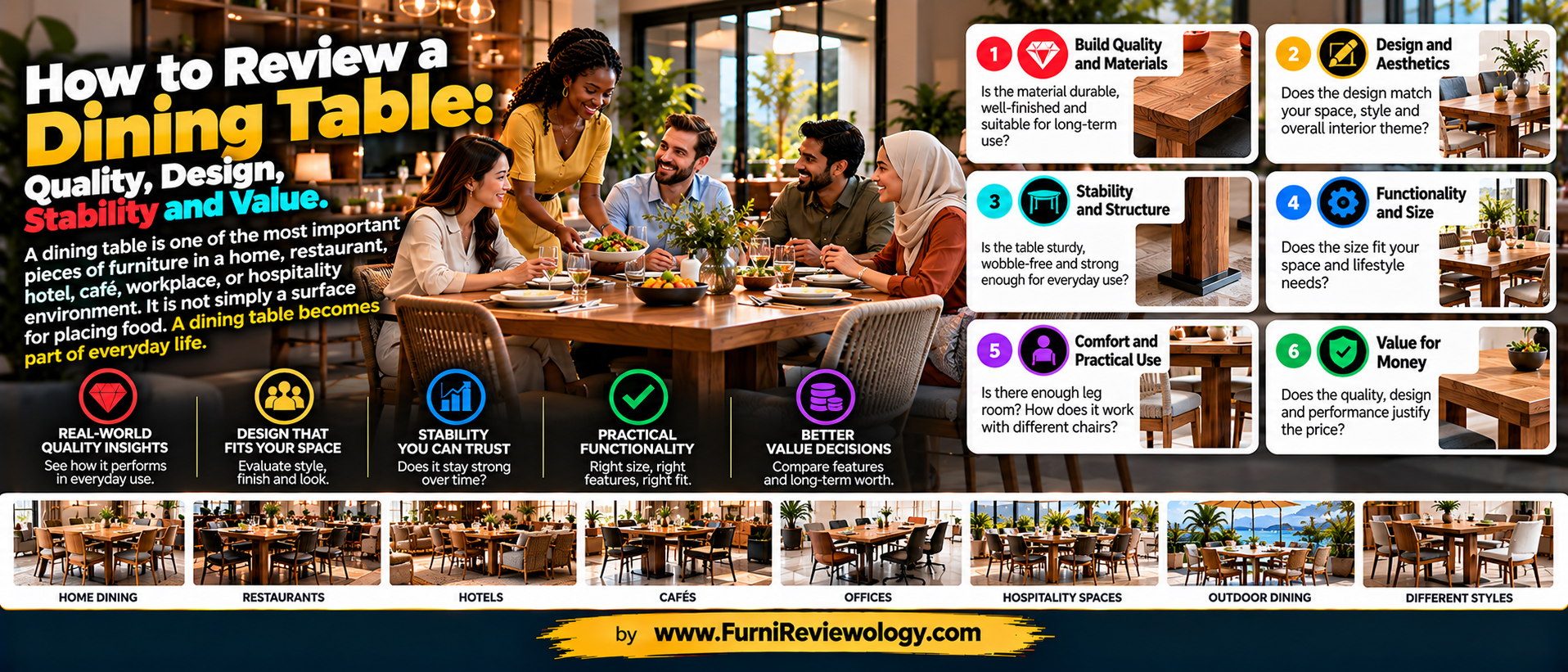
A useful dining table review should examine the complete ownership and usage experience—from materials and construction to stability, dimensions, finish, functionality, maintenance, durability, delivery, assembly, customer service, and value for money.
A beautiful table that wobbles, stains easily, has weak joints, or does not fit the room properly may not be a good purchase. Conversely, a simple-looking table made with appropriate materials, solid construction, excellent proportions, and durable finishing may provide outstanding value for many years.
This guide explains how buyers, furniture professionals, interior designers, hospitality operators, retailers, and reviewers can evaluate a dining table systematically and write a review that provides genuinely useful information.
Why Dining Table Reviews Matter
Dining tables are relatively high-involvement furniture purchases.
Unlike a small decorative object, a dining table can occupy a significant amount of space and may remain in use for many years. Its performance affects everyday comfort and functionality.
A good review can help answer questions such as:
- Is the table structurally sound?
- Is it stable?
- Does it feel durable?
- Is the material appropriate for its intended use?
- Is the tabletop resistant to normal wear?
- Is the finish practical?
- Is the table comfortable to sit around?
- Does its size match the advertised dimensions?
- Is assembly straightforward?
- Does it require unusual maintenance?
- Is the design likely to remain useful over time?
- Does the price make sense for the quality delivered?
- Would the reviewer buy it again?
These questions are considerably more useful than a simple star rating.
A star tells you the score. A detailed review tells you why.
1. Start With the Intended Use
Before reviewing the table itself, establish how the table is being used.
A dining table used by two adults in a low-traffic home faces very different demands from a table used every day by a family with children.
A restaurant table may experience:
- repeated daily use
- frequent cleaning
- food and beverage spills
- movement
- impact
- commercial cleaning chemicals
- high customer turnover
A hotel or resort table may face even greater demands.
An outdoor dining table has another set of requirements, including:
- moisture
- sunlight
- temperature changes
- humidity
- rain
- wind
- corrosion
- UV exposure
Therefore, a review should always provide context.
For example:
“We used this six-person dining table every day for approximately six months in a household of four.”
is much more useful than:
“Great table. Five stars.”
The first statement tells future buyers something about the conditions under which the reviewer formed an opinion.
2. Examine the Overall Design
Design is one of the first things buyers notice, but appearance should not be the only consideration.
When reviewing the design, consider:
- overall proportions
- shape
- visual balance
- tabletop thickness
- leg design
- base structure
- color
- texture
- finishing
- decorative details
- relationship between tabletop and base
- compatibility with surrounding furniture
A table can look impressive in photographs but feel visually different in a real room.
Reviewers should therefore consider the table in its actual environment.
Questions to ask
- Does it look like the photographs?
- Does the finish look premium or ordinary?
- Does the tabletop appear proportionate to the legs?
- Does the table dominate the room?
- Does it visually complement the chairs?
- Does the design work with the intended interior style?
- Does it look better in person than online?
- Does the design remain attractive after regular use?
A strong review separates personal taste from observable characteristics.
Instead of writing:
“This is the most beautiful dining table available.”
a more useful statement would be:
“The table has a minimalist rectangular design, a relatively thick tabletop, and a simple four-leg base. It worked well with contemporary dining chairs in our space.”
The second description gives readers information they can evaluate for themselves.
3. Review the Tabletop Material
The tabletop is usually the most important physical component of a dining table.
Different materials behave differently.
Common options include:
- solid wood
- engineered wood
- plywood
- MDF
- particleboard
- veneer
- laminate
- glass
- ceramic
- sintered stone
- natural stone
- marble
- metal
- combinations of multiple materials
A review should identify the material whenever possible.
Solid wood
Solid wood can offer:
- natural appearance
- tactile warmth
- repairability in some finishes
- long service potential
- distinctive grain patterns
However, wood can also respond to environmental changes through expansion and contraction.
Veneer
A quality veneer can provide the appearance of natural wood while using a different structural substrate.
A review should distinguish between:
“wood finish”
and
“solid wood construction.”
They are not necessarily the same thing.
Engineered materials
Engineered boards can perform very well when appropriately manufactured and finished.
Reviewers should avoid assuming that an engineered material automatically means poor quality.
The more useful question is:
Does the material, construction and finishing system perform appropriately for the intended use and price?
4. Examine the Construction
Material alone does not determine furniture quality.
Two tables made from similar materials can have dramatically different performance because of differences in construction.
Look closely at:
- joints
- supports
- brackets
- fasteners
- frame construction
- leg attachment
- underside reinforcement
- tabletop support
- connection points
- hardware quality
Ask whether the table feels engineered as a complete structure rather than simply assembled from individual components.
Important construction questions
- Are the legs securely attached?
- Are the joints tight?
- Does the tabletop flex excessively?
- Are support structures adequate?
- Are screws and fittings properly installed?
- Are there visible gaps?
- Are joints aligned?
- Does anything move when pressure is applied?
These observations can reveal much more than photographs.
5. Stability Is One of the Most Important Review Criteria
A dining table should normally feel stable during ordinary use.
A table that moves, rocks, or wobbles can quickly become frustrating.
Stability should be assessed on an appropriate floor surface and under normal conditions.
Check:
- leg alignment
- base geometry
- floor contact
- frame rigidity
- joint tightness
- tabletop movement
- lateral movement
Try normal activities:
- placing plates on the table
- cutting food
- leaning lightly against the table
- writing
- moving chairs around it
Do not deliberately abuse the table merely to create a dramatic review.
The objective is to assess normal-use performance.
6. Review the Dimensions Carefully
A dining table can be high quality and still be wrong for a particular room.
Dimensions are therefore critical.
Measure:
- length
- width
- height
- tabletop thickness
- leg clearance
- space underneath
- extension length, if applicable
Also consider the dimensions of the dining chairs.
The relationship between the table and chairs affects comfort significantly.
Room planning matters
A dining table should leave enough space for:
- pulling chairs out
- walking behind seated people
- opening nearby doors
- moving around the dining area
- serving food
- cleaning
A review should ideally mention the size of the room or available space when discussing whether the table feels appropriately sized.
7. Evaluate Seating Capacity
Manufacturers may advertise a table as suitable for four, six, eight, or more people.
But advertised seating capacity does not always tell the entire story.
Actual seating depends on:
- tabletop dimensions
- table shape
- leg placement
- base design
- chair width
- desired personal space
For example, a table might technically accommodate six chairs, but if the chairs are wide, the arrangement may feel cramped.
A useful review should distinguish between:
maximum physical capacity
and
comfortable everyday capacity.
8. Examine the Leg and Base Design
The base has both structural and functional importance.
Look at:
- leg thickness
- leg position
- material
- connection method
- spacing
- floor contact
- visual proportion
- clearance for feet and knees
A central pedestal base can create excellent legroom but may affect stability depending on its design.
A four-leg table can be very stable but may interfere with certain seating positions.
A trestle design may offer different advantages.
The review should explain how the base affects actual use.
9. Check Legroom and Knee Clearance
A dining table should allow users to sit comfortably.
Pay attention to:
- knee clearance
- foot positioning
- apron height
- underside supports
- crossbars
- pedestal placement
This becomes especially important for:
- taller users
- children
- people who sit for long periods
- work-from-home use
- restaurants
- hospitality settings
A table that looks elegant but restricts legroom may not perform well in everyday use.
10. Review the Table Finish
The finish affects both appearance and maintenance.
Examine:
- smoothness
- consistency
- sheen
- color
- grain visibility
- edge finishing
- resistance to everyday marks
- ease of cleaning
For wooden furniture, inspect whether the finish appears evenly applied.
For painted tables, look for:
- uneven coating
- visible brush or spray marks
- inconsistent color
- exposed substrate
- edge imperfections
For glass, stone, ceramic, or other hard surfaces, examine:
- edge quality
- surface consistency
- scratches
- chips
- stains
- installation quality
11. Pay Special Attention to the Edges
The tabletop edge is frequently touched and therefore deserves its own review category.
Consider:
- sharpness
- rounding
- smoothness
- consistency
- edge durability
This is particularly important in homes with young children.
A sharp or poorly finished edge can affect the usability of an otherwise attractive table.
12. Test Everyday Durability
Durability should be evaluated through realistic use.
A reviewer can observe how the table performs against:
- plates
- cutlery
- glasses
- food
- spills
- routine cleaning
- chair movement
- ordinary knocks
- repeated use
For longer-term reviews, document changes over time.
For example:
After one week
- initial appearance
- assembly
- stability
After three months
- scratches
- stains
- loosening
- finish changes
After one year
- structural condition
- surface wear
- color changes
- maintenance requirements
This is far more informative than judging durability immediately after opening the packaging.
13. Evaluate Scratch and Stain Resistance Carefully
Dining tables inevitably encounter spills and contact with everyday objects.
A review should describe actual experiences rather than make unsupported laboratory-style claims.
Consider:
- food stains
- beverage marks
- water rings
- scratches
- heat marks
- fingerprints
- cleaning marks
If a table is advertised as stain-resistant or heat-resistant, reviewers should distinguish between the manufacturer's stated specification and their own experience.
For example:
“The manufacturer describes the surface as stain-resistant. During three months of normal use, we did not observe permanent staining from routine food and beverage spills.”
This is stronger and more transparent than simply stating:
“The table is completely stain-proof.”
14. Examine Resistance to Heat and Moisture
Dining tables regularly encounter:
- hot plates
- coffee cups
- cold drinks
- condensation
- wet glasses
- food spills
A review should consider the manufacturer's care instructions.
Do not intentionally expose furniture to extreme conditions beyond its intended use merely to produce dramatic content.
Instead, assess whether ordinary use produces problems.
If the manufacturer specifically recommends coasters, placemats, or trivets, mention that information because it affects ownership.
15. Review Extendable Dining Tables Differently
Extendable tables require additional evaluation.
Review:
- extension mechanism
- leaf storage
- alignment
- locking mechanism
- opening effort
- closing effort
- surface alignment
- stability when extended
- appearance when extended
- appearance when closed
Ask:
Does the table remain equally stable in both configurations?
Also check whether the extension leaves match the main tabletop in:
- color
- grain
- texture
- finish
A poorly matched extension can be visually obvious.
16. Review Round, Oval, Rectangular and Square Tables Differently
Different shapes create different experiences.
Rectangular tables
Often provide:
- efficient use of wall-adjacent space
- straightforward seating arrangements
- strong surface area
Round tables
Can encourage:
- face-to-face conversation
- flexible seating
- easier social interaction
Oval tables
Can combine some characteristics of rectangular and round designs.
Square tables
Can work particularly well in certain compact dining spaces.
The review should explain how the shape worked in the reviewer's actual environment.
17. Review Assembly
Assembly is part of the furniture experience.
A product may be excellent once assembled but frustrating to install.
Evaluate:
- clarity of instructions
- number of components
- hardware labeling
- tools required
- assembly time
- alignment
- ease of attaching legs
- whether two people are required
- whether anything was missing
Do not automatically treat professional assembly as a negative.
Large or heavy dining tables may reasonably require more than one person.
The important question is whether the assembly process matches reasonable expectations for the product.
18. Examine Packaging and Delivery
The review should not necessarily stop once the table arrives.
Consider:
- packaging quality
- protection of corners
- protection of tabletop
- internal padding
- damage during transport
- delivery communication
- missing components
- delivery timing
For a large dining table, logistics are part of the customer experience.
A table arriving damaged can create significant inconvenience even when the product itself is well manufactured.
19. Evaluate the Customer Service Experience
If something goes wrong, customer service becomes part of the product experience.
Review:
- response speed
- communication
- replacement policy
- spare parts
- damage resolution
- warranty support
- clarity of instructions
A balanced review can explain both the original problem and how the company handled it.
This distinction matters.
A manufacturing problem and a poor after-sales response are two different issues, although together they affect the customer's overall experience.
20. Examine Maintenance Requirements
Some dining tables require more maintenance than others.
A review should explain:
- cleaning requirements
- recommended cleaning products
- need for periodic treatment
- sensitivity to moisture
- sensitivity to heat
- whether refinishing may eventually be required
For solid wood, for example, maintenance may differ significantly from glass, laminate, ceramic, or stone surfaces.
The important question is not whether maintenance exists.
It is:
Is the maintenance reasonable for the intended buyer and intended environment?
21. Consider Families With Children
Families should evaluate additional factors.
Reviewers can consider:
- edge safety
- surface cleaning
- stability
- tipping concerns
- exposed hardware
- stain resistance
- scratch visibility
- ease of cleaning underneath
Avoid making absolute safety claims unless supported by appropriate testing or certification.
Instead, describe observable characteristics and refer buyers to manufacturer safety information where relevant.
22. Consider Homes With Pets
Pets can affect furniture differently from people.
A review may mention:
- scratch visibility
- hair accumulation
- ease of cleaning
- food debris
- exposed corners
- surface durability
Again, distinguish personal experience from universal claims.
“After six months with two indoor pets, the finish showed little visible scratching”
is a useful experience report.
It does not imply that every household will obtain exactly the same result.
23. Evaluate the Table's Visual Longevity
Trendy furniture can look excellent initially but may become visually dated.
A useful review can ask:
- Is the design highly trend-dependent?
- Is the shape versatile?
- Can different chairs work with it?
- Would it fit future interior changes?
- Does the material age attractively?
This is particularly relevant when the table is expensive.
Furniture often remains in homes longer than expected.
24. Review Color and Finish Accuracy
Online furniture shopping creates another important issue: expectation versus reality.
Compare the delivered product with:
- product photographs
- descriptions
- finish names
- material descriptions
- dimensions
Lighting and photography can affect appearance, so a review should avoid treating minor color differences as automatically deceptive.
Instead, describe the difference objectively.
25. Review the Chairs and Table as a System
A dining table should not be evaluated completely in isolation.
The table interacts with the chairs.
Consider:
- chair height
- armrests
- seat width
- tabletop height
- apron clearance
- leg placement
- chair movement
A beautiful chair may not fit comfortably under the table.
A table review should therefore include the relationship between table and seating whenever possible.
26. Evaluate Value for Money
Value is one of the most important—but also most misunderstood—parts of a furniture review.
Price and value are not the same thing.
A lower-priced table may provide excellent value if it performs reliably for its intended use.
A high-priced table may justify its price through:
- superior materials
- craftsmanship
- durability
- design
- customization
- warranty
- service
- repairability
- manufacturing quality
But price alone does not establish quality.
27. Compare the Complete Cost of Ownership
The purchase price is only one part of furniture economics.
Consider:
Purchase price + delivery + assembly + maintenance + repairs + replacement risk
A cheaper table that needs replacement after a short period may have a higher long-term cost than a more expensive table that remains functional for many years.
However, reviewers should avoid pretending to calculate lifetime value without sufficient evidence.
Long-term value should be based on actual ownership experience or clearly stated assumptions.
28. Consider Repairability
Furniture sustainability and long-term value increasingly depend on repairability.
Ask:
- Can legs be replaced?
- Can hardware be replaced?
- Can damaged components be repaired?
- Are spare parts available?
- Can the tabletop be refinished?
- Can the product be disassembled for relocation?
A table designed for repair can potentially remain useful longer than one that must be completely replaced after a localized failure.
29. Consider Sustainability Carefully
Environmental claims require particular attention.
If a manufacturer claims:
- sustainably sourced timber
- recycled materials
- low-emission materials
- responsible manufacturing
- certified wood
- recyclable components
a reviewer should distinguish between:
manufacturer claims
and
independently verified information.
Do not treat marketing language as automatically equivalent to certification or measurable environmental performance.
A strong review asks:
What evidence supports the sustainability claim?
30. Look at the Manufacturer's Information
A detailed review should examine the product documentation.
Look for:
- material specifications
- dimensions
- weight
- care instructions
- warranty
- assembly instructions
- country of manufacture
- certifications
- recommended use
- load information, where applicable
Good documentation itself can be an indicator of how seriously a company communicates product information.
It should not, however, be treated as proof of product quality.
31. Review the Weight and Handling
Weight can influence:
- stability
- installation
- relocation
- delivery
- assembly
- floor protection
A very heavy table is not automatically better.
Likewise, a lightweight table is not automatically poor quality.
The relevant question is whether the weight and construction are appropriate for the intended design and use.
32. Review Noise and Movement
Some tables create unwanted sounds during use.
Listen for:
- squeaking
- rattling
- loose joints
- movement between components
This can become especially noticeable when people lean on the table or move objects across it.
Long-term reviews should mention whether such problems develop over time.
33. Review the Table From Different Angles
A dining table should be inspected from:
- above
- front
- side
- underneath
- around the corners
- near joints
- around leg connections
The underside can reveal construction details that are invisible from normal viewing angles.
Photographs can also help document:
- grain
- finish
- joints
- hardware
- imperfections
- damage
- wear
Visual evidence can make a furniture review more credible.
34. Separate Facts From Opinions
This is one of the most important principles of furniture reviewing.
Fact
“The table measures 180 cm by 90 cm.”
Observation
“After six months, we noticed several small surface scratches.”
Opinion
“We think the table looks particularly attractive in minimalist interiors.”
These are different types of statements.
A trustworthy review makes the distinction clear.
35. Avoid Absolute Claims
Furniture performance varies according to:
- usage
- climate
- cleaning
- installation
- maintenance
- household conditions
- manufacturing variation
Therefore, statements such as:
- “This table will never scratch.”
- “This is the strongest table available.”
- “It will last forever.”
- “Everyone should buy this table.”
are usually too absolute.
Better language includes:
- “In our experience…”
- “After six months…”
- “Under normal household use…”
- “The manufacturer states…”
- “We observed…”
- “For our space…”
This creates a more trustworthy review.
36. How Long Should You Use a Dining Table Before Reviewing It?
There is no single correct timeframe.
Different aspects can be reviewed at different stages.
Immediately
You can review:
- packaging
- delivery
- assembly
- appearance
- dimensions
- initial stability
After several weeks
You can review:
- comfort
- everyday usability
- cleaning
- seating
- minor surface wear
After several months
You can begin evaluating:
- durability
- finish performance
- structural stability
- maintenance
- long-term satisfaction
After one year or more
You can provide much stronger insight into:
- durability
- aging
- repairs
- finish deterioration
- continued satisfaction
- value
Long-term ownership reviews are particularly valuable because they reveal what cannot be seen on the first day.
37. Ask: Would You Buy It Again?
One of the most useful questions in a furniture review is:
Knowing what you know now, would you buy the same table again?
This question forces the reviewer to consider the complete experience.
A reviewer may say:
“Yes, I would buy it again because the table has remained stable, easy to maintain and comfortable for our family.”
Or:
“I would not buy the same model again because the design is attractive, but the extension mechanism has become difficult to operate.”
Both are useful.
The important thing is to explain why.
38. A Sample Dining Table Review Structure
A strong review could follow this format:
Dining Table Overview
Product: [Table name]
Material: [Material]
Dimensions: [Dimensions]
Usage period: [Time]
Environment: [Home/restaurant/hotel/etc.]
Number of users: [Approximate]
Design
Describe appearance, proportions and style.
Construction
Explain materials, joints, frame and hardware.
Stability
Describe whether the table remains stable during normal use.
Comfort
Discuss height, legroom and seating arrangement.
Surface Performance
Describe scratches, stains, cleaning and everyday wear.
Assembly
Explain the installation experience.
Maintenance
Describe cleaning and care requirements.
Durability
Explain what changed during the ownership period.
Delivery
Describe packaging and delivery experience.
Customer Service
Explain how the company responded to questions or problems.
Value
Discuss price relative to materials, construction, performance and ownership experience.
Final Assessment
Summarize strengths, limitations and the type of buyer for whom the table may be suitable.
39. Dining Table Review Checklist
Before publishing a review, consider the following:
Design
- Shape
- Proportions
- Style
- Color
- Finish
- Visual quality
Materials
- Tabletop material
- Base material
- Hardware
- Finish system
Construction
- Joints
- Leg attachment
- Frame
- Reinforcement
- Overall rigidity
Function
- Stability
- Legroom
- Seating capacity
- Chair compatibility
- Extension mechanism, if applicable
Ownership
- Cleaning
- Maintenance
- Scratches
- Stains
- Wear
- Repairs
Customer Experience
- Packaging
- Delivery
- Assembly
- Instructions
- Customer service
- Warranty
Value
- Purchase price
- Delivery cost
- Quality
- Durability
- Maintenance
- Long-term usefulness
40. Why Detailed Dining Table Reviews Are More Valuable Than Star Ratings
A five-star rating cannot tell a buyer whether:
- the table is stable
- the chairs fit underneath
- the surface stains
- the finish scratches
- assembly is difficult
- the extension mechanism works well
- customer service responds quickly
- the dimensions are accurate
A one-star rating cannot tell the complete story either.
The review itself contains the intelligence.
This is why furniture reviews should increasingly move toward structured information.
Instead of simply:
★★★★★
a modern furniture review could include:
Materials | Construction | Stability | Comfort | Finish | Durability | Maintenance | Delivery | Service | Value
This creates a much more useful information layer for buyers and businesses.
41. The Future of Furniture Reviews Is Furniture Intelligence
Furniture reviews are evolving beyond simple consumer comments.
Structured reviews can potentially help identify patterns across:
- products
- brands
- manufacturers
- retailers
- materials
- categories
- price ranges
- regions
- usage environments
Over time, aggregated review information could help buyers ask much more sophisticated questions:
- Which dining tables receive consistent praise for stability?
- Which materials generate the most maintenance complaints?
- Which tables perform well in hospitality environments?
- Which products have recurring assembly problems?
- Which manufacturers respond effectively to complaints?
- Which furniture categories have the highest long-term satisfaction?
This is where furniture intelligence can become more valuable than simple ratings.
AI systems may increasingly analyze large volumes of structured and unstructured furniture reviews, identify recurring themes, summarize customer experiences, and help buyers understand patterns.
But AI-generated summaries should remain grounded in identifiable evidence.
AI can organize information. Trust still depends on the quality of the information being analyzed.
42. Why Verified Reviews Matter
A dining table review becomes more useful when readers have greater confidence that the reviewer actually experienced the product.
Where possible, platforms should distinguish between:
- verified purchase
- verified ownership
- invited review
- editorial review
- professional review
- user-submitted review
Verification does not automatically make every opinion correct.
It provides additional context about the relationship between the reviewer and the product.
That distinction is important.
43. The Role of FurniReviewology
A furniture trust platform can help move the industry beyond simplistic star ratings.
FurniReviewology can provide a structured environment in which furniture products, brands, suppliers, manufacturers and customer experiences can be reviewed in greater detail.
The objective is not simply to collect positive comments.
A useful furniture review ecosystem should allow:
- positive experiences
- negative experiences
- mixed experiences
- detailed explanations
- evidence
- ownership timelines
- manufacturer responses
- buyer questions
- product information
The goal is a more transparent furniture marketplace where buyers can investigate before making decisions.
44. Reviews Can Also Help Furniture Businesses Improve
Reviews are not only for consumers.
Manufacturers and retailers can learn from recurring customer feedback.
For example, repeated comments about:
- difficult assembly
- unclear instructions
- weak packaging
- surface scratching
- poor delivery communication
- inadequate spare parts
- confusing product descriptions
can identify opportunities for improvement.
A company that systematically studies feedback can potentially improve:
- product design
- manufacturing
- packaging
- logistics
- documentation
- customer service
- after-sales support
In this sense, reviews can become a form of market intelligence.
45. The Difference Between a Complaint and a Useful Negative Review
A negative review can be extremely valuable when it explains the problem clearly.
Compare:
“Terrible table. Don't buy.”
with:
“After approximately four months of daily use, the table developed noticeable movement at one leg. We tightened the supplied hardware, which improved the problem temporarily, but it returned later.”
The second review provides information that future buyers and the manufacturer can actually use.
Negative reviews should therefore focus on:
what happened + when it happened + under what conditions + how it was addressed.
46. Businesses Should Respond to Dining Table Reviews Professionally
When a customer reports a problem, the business response becomes part of the public record.
A constructive response can:
- acknowledge the concern
- clarify product specifications
- explain warranty procedures
- offer appropriate support
- correct factual misunderstandings
- communicate professionally
Businesses should avoid attacking reviewers simply because the review is negative.
Likewise, reviewers should avoid making unsupported accusations.
A healthy furniture review ecosystem requires responsibility from both sides.
47. A Dining Table Is More Than a Product
Furniture has an unusual characteristic.
People don't simply purchase it—they live with it.
A dining table can become the place where:
- children do homework
- families celebrate birthdays
- friends share meals
- business discussions happen
- guests gather
- conversations continue late into the evening
That means its quality is ultimately experienced through repeated interaction.
The most useful review therefore asks:
How does this table perform as part of real life?
48. The Most Important Questions for a Dining Table Review
Before publishing, a reviewer should be able to answer:
- What is the table made from?
- How well is it constructed?
- Is it stable?
- Are the dimensions accurate?
- How comfortable is the seating arrangement?
- Is there enough legroom?
- How does the surface handle normal use?
- Is it easy to clean?
- How difficult is assembly?
- How well was it packaged?
- Was delivery satisfactory?
- How responsive was customer service?
- What happened after several months?
- What maintenance does it require?
- Does the quality justify the price?
- Who is this table suitable for?
- What are its limitations?
- Would the reviewer buy it again?
If a review answers these questions honestly and clearly, it becomes much more useful than a simple numerical score.
Conclusion: Review the Dining Table as an Ownership Experience
A dining table should not be reviewed solely on the basis of appearance.
Quality is about materials and construction.
Design is about aesthetics, proportions and functionality.
Stability is about structural performance during normal use.
Comfort is about seating, height and legroom.
Durability is about how the table performs over time.
Value is about what the buyer receives in relation to the total cost and intended use.
And trust comes from explaining the evidence behind the opinion.
The best dining table review does not simply tell readers whether the reviewer liked the table. It gives them enough information to decide whether the table is appropriate for their own needs.
That is the fundamental purpose of furniture reviews.
Ratings tell you the score. Reviews tell you the experience. Detailed, transparent and well-supported reviews help buyers understand the difference.
The Global Furniture Ecosystem
Furniture discovery, storytelling and trust are increasingly connected.
FISE - Furniture Industry Search Engine helps the world find them.
TFT - The Furniture Times tells their story.
FurniReviewology helps the world trust them.