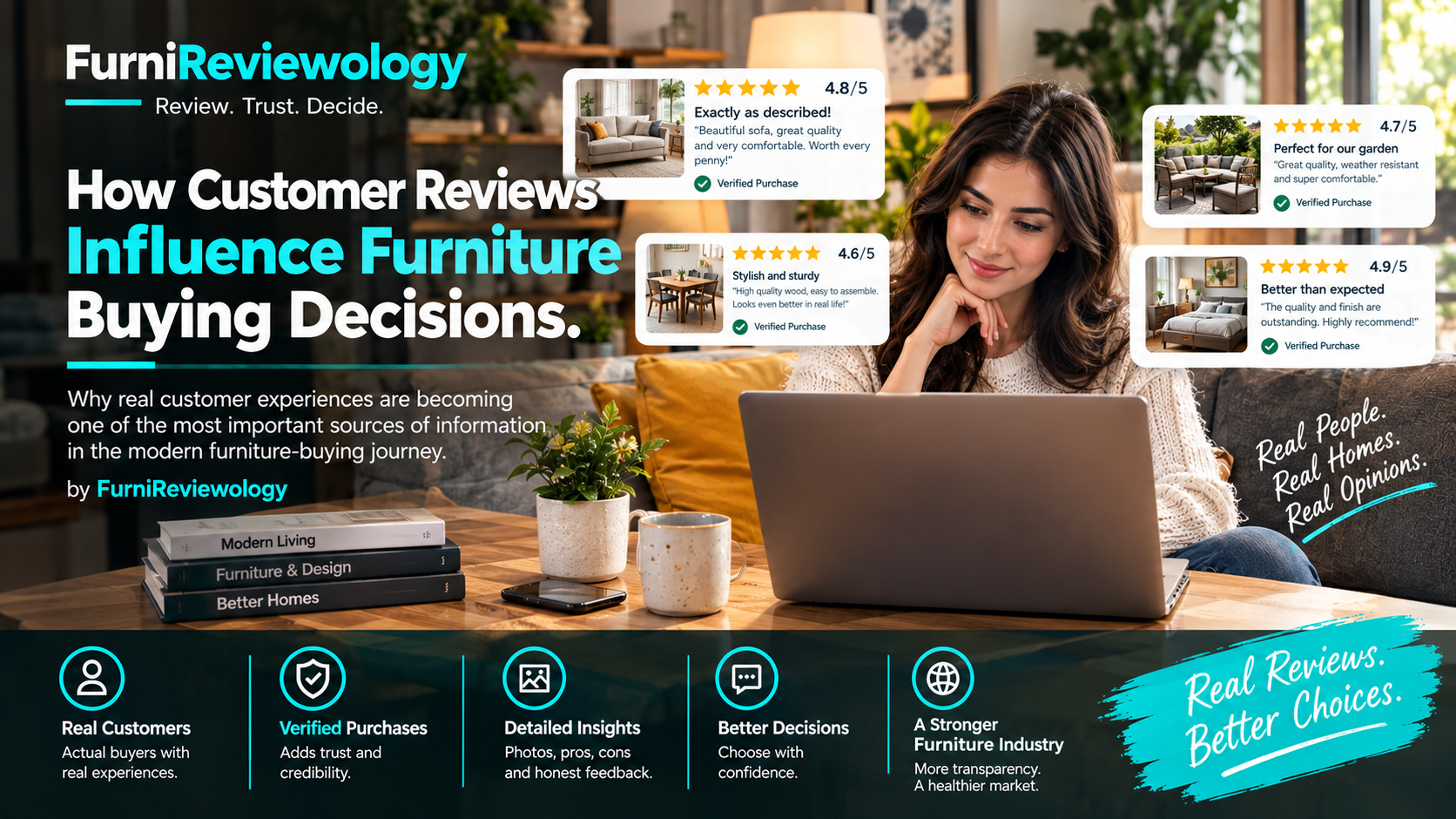
What happened to people who actually bought and used this furniture?
That question has made customer reviews an increasingly important part of the furniture-buying journey.
Reviews can provide information that product photographs, advertisements and catalogues cannot easily communicate. They can reveal how furniture performs after months of use, whether delivery was reliable, how comfortable a product is in everyday life, whether materials behave as expected, and how a furniture company responds when something goes wrong.
For buyers, reviews can reduce uncertainty.
For furniture businesses, reviews can strengthen—or challenge—digital reputation.
And for the wider furniture industry, reviews can become a valuable source of market intelligence, consumer intelligence and trust data.
However, reviews should not be treated as unquestionable truth. A customer review is an individual experience, often shaped by personal expectations and circumstances. The most useful approach is to examine patterns, context, verification, recency and specific evidence rather than relying on a single comment or star rating.
This is where the modern furniture review ecosystem is evolving.
1. Why Furniture Is Different From Many Other Purchases
Furniture occupies a unique position in consumer purchasing.
A buyer may see a product online and immediately understand its general appearance.
But appearance is only one part of furniture quality.
A buyer may also need to know:
- Is the sofa comfortable?
- Does the dining chair remain stable?
- Does the table surface scratch easily?
- Does the cabinet hardware work smoothly?
- Does the mattress remain comfortable?
- Does outdoor furniture withstand the local environment?
- Is the fabric easy to maintain?
- Is assembly difficult?
- Was delivery handled properly?
- Does the manufacturer respond to problems?
- Does the furniture still perform well after months or years?
Many of these questions cannot be answered adequately by a product photograph.
Customer reviews provide a window into the post-purchase experience.
2. Reviews Reduce Uncertainty
Every furniture purchase contains some degree of uncertainty.
Before purchasing, a buyer may know:
- the advertised price
- dimensions
- materials stated by the seller
- available colors
- product photographs
- warranty terms
- delivery information
But the buyer may not know exactly how the furniture will perform in real life.
Reviews can help reduce that information gap.
For example, a product description might say:
“Comfortable upholstered dining chair.”
A customer review might explain:
“We use these chairs every day in our dining area. The seat is relatively firm, which works well for longer meals, and after approximately nine months the frame remains stable.”
That additional information can help a buyer determine whether the product matches their own needs.
3. Customer Reviews Add a Human Perspective
Furniture marketing is normally created by the seller.
Reviews provide another perspective: the perspective of the customer.
This does not automatically make reviews more accurate than marketing.
But it makes them different.
A catalogue may show:
Beautiful furniture in a carefully designed interior.
A customer may tell you:
How that furniture actually behaves after six months in a busy home.
That difference is important.
The customer perspective can reveal practical details that businesses may not emphasize in promotional material.
4. Reviews Influence the Discovery Stage
Customer reviews can influence purchasing decisions before the buyer has even decided which product to purchase.
Someone searching for:
- sofas
- outdoor furniture
- dining tables
- hotel furniture
- office chairs
- bedroom furniture
may use reviews to identify which businesses or products deserve further investigation.
The journey can therefore look like:
Search → Discovery → Reviews → Comparison → Evaluation → Purchase
This means reviews are increasingly connected to furniture search visibility.
A business that is easy to find but has little useful information may still leave buyers uncertain.
A business that is discoverable and supported by credible customer experiences provides more information for the evaluation stage.
5. Reviews Help Buyers Create Shortlists
Imagine a customer is searching for a new sofa.
They find 30 possible products.
Instead of investigating all 30 in detail, they may begin filtering based on:
- price
- style
- dimensions
- material
- availability
- reviews
Reviews can help narrow the field.
A buyer may eliminate products where repeated reviews mention:
- poor construction
- uncomfortable seating
- delivery problems
- difficult assembly
- poor customer service
At the same time, repeated positive observations may encourage further investigation.
The review therefore becomes a filtering mechanism.
6. Star Ratings Provide a Quick Signal
Star ratings remain useful because they are easy to understand.
A buyer can quickly distinguish between:
2.8 stars
and
4.7 stars.
But star ratings are only the beginning.
A rating does not tell the buyer:
- why someone gave that rating
- what the customer purchased
- how long they used it
- what environment it was used in
- what expectations the customer had
- whether the issue was product-related or service-related
Therefore:
Use the rating to identify a signal. Read the reviews to understand the signal.
7. Detailed Reviews Can Change a Buyer's Perception
Suppose a dining table has a 4.5-star rating.
A buyer might initially think:
“There must be some problem.”
But then they read the reviews.
They discover that most customers praise:
- stability
- finish
- design
- ease of cleaning
while several customers mention that assembly takes longer than expected.
That changes the interpretation of the rating.
The product may not have a fundamental quality problem.
The lower ratings may relate primarily to assembly.
This demonstrates why review context matters.
8. Reviews Help Buyers Understand Real-World Quality
Product specifications tell buyers what a manufacturer says about a product.
Customer reviews can tell buyers what customers experienced.
These are different information categories.
Consider a chair described as:
“Heavy-duty commercial chair.”
A buyer may still ask:
- How long has it been used?
- How many people use it each day?
- Does the frame remain stable?
- Does the upholstery wear?
- Is it easy to clean?
- Does it require maintenance?
A detailed commercial customer review can potentially answer questions that specifications cannot.
9. Reviews Are Especially Valuable for Durability
Durability is one of the most difficult furniture characteristics to evaluate before purchase.
A product can look strong.
It can feel solid in a showroom.
But long-term performance requires time.
Customer reviews can provide ownership information such as:
“After two years…”
“After 18 months…”
“After six months of daily use…”
This is particularly valuable because furniture is generally purchased for years, not days.
However, buyers should distinguish between:
short-term impressions
and
long-term evidence.
A review written after three days cannot establish five-year durability.
10. Reviews Reveal How Furniture Performs in Different Environments
Furniture performance is heavily influenced by environment.
This is especially true for outdoor furniture.
For example, outdoor furniture used:
- under a roof
- in a dry climate
- occasionally
may perform differently from furniture used:
- beside a swimming pool
- in direct sunlight
- in heavy rain
- in high humidity
- every day
- in a commercial hospitality environment
A review becomes more valuable when it explains these conditions.
Instead of simply saying:
“Good outdoor furniture.”
a reviewer might say:
“The furniture has been outside for approximately one year in a humid environment and receives direct afternoon sunlight. The frame remains stable, although the fabric requires regular cleaning.”
That is much more useful.
11. Reviews Influence Perceptions of Comfort
Comfort is highly subjective.
A sofa that is comfortable for one person may be too soft or too firm for another.
A dining chair that works perfectly for one restaurant may not suit another.
Therefore, reviews should be interpreted according to the reviewer's preferences and circumstances.
Useful information might include:
- seat firmness
- seat depth
- back support
- cushion thickness
- sitting duration
- user size
- intended use
A review that says:
“Very comfortable”
provides limited information.
A review that says:
“The seat is relatively firm and provides good support during long meals”
is more useful to someone with similar preferences.
12. Reviews Help Buyers Evaluate Materials
Furniture buyers often encounter technical terms that may not immediately communicate real-world performance.
Reviews can help translate material choices into practical experiences.
For example:
Wood
Customers may discuss:
- surface feel
- grain
- scratches
- maintenance
- stability
Fabric
Customers may discuss:
- cleaning
- staining
- fading
- softness
- wear
Metal
Customers may discuss:
- stability
- finish
- corrosion
- weight
Outdoor materials
Customers may discuss:
- sunlight exposure
- rain
- humidity
- maintenance
- fading
This creates a bridge between technical specification and lived experience.
13. Reviews Influence Perceived Value
Price alone does not determine value.
A RM2,000 sofa may represent better value for one buyer than a RM1,200 sofa if it lasts considerably longer or provides better service.
Reviews can help buyers evaluate the relationship between:
Price + Quality + Performance + Service + Longevity
For example, customers may explain:
- whether they felt the furniture was worth the money
- whether the quality matched expectations
- whether maintenance costs were high
- whether replacement parts were available
- whether the product lasted as expected
This makes reviews particularly useful when comparing furniture at different price points.
14. Reviews Can Reveal the Difference Between Cheap and Good Value
Low price and good value are not the same thing.
A very inexpensive chair may require replacement after a short period.
A more expensive chair may last much longer.
Customer experiences can help buyers examine the broader cost of ownership.
For example:
Purchase price
delivery
assembly
maintenance
repairs
replacement
can be more important than the initial price alone.
Reviews can provide clues about these hidden costs.
15. Reviews Influence Trust in Furniture Businesses
Buyers are not only evaluating products.
They are also evaluating companies.
A customer may ask:
“Can I trust this furniture company?”
Reviews can provide information about:
- communication
- delivery
- responsiveness
- warranty
- after-sales service
- problem resolution
- product consistency
This is especially important when buying online or from a business located far away.
For international furniture purchases, trust can become even more important because the buyer may have limited ability to physically inspect the business or product beforehand.
16. Negative Reviews Can Influence Decisions Strongly
Negative reviews naturally attract attention.
A buyer may become concerned after seeing:
“The frame broke after four months.”
or:
“The delivery was delayed by three weeks.”
But a negative review should not automatically be interpreted as proof that the business or product is poor.
The buyer should investigate:
- Is the complaint specific?
- Is there supporting evidence?
- How long was the product used?
- Was it used appropriately?
- Did other customers report the same issue?
- Did the business respond?
- Was the problem resolved?
A single negative experience may be unusual.
A recurring problem across many credible reviews deserves more attention.
17. Business Responses Can Change the Meaning of a Negative Review
Consider two situations.
Situation A
Customer reports a damaged product.
The company ignores the complaint.
Situation B
Customer reports a damaged product.
The company responds, investigates, replaces the product and explains the resolution.
The original problem is still relevant.
But the second scenario provides additional information about the company's customer-service behavior.
This is why buyers should read both:
the review
and
the business response.
18. Verified Reviews Can Increase Confidence
Not all review systems use the same verification methods.
Where available, verification can provide additional context that the reviewer has a legitimate relationship with the product or business.
Possible forms include:
- verified purchase
- verified ownership
- verified transaction
- verified project
- authenticated reviewer
- supporting documentation
Verification does not guarantee that every statement is objectively correct.
A genuine customer can still have a subjective opinion.
But verification can strengthen confidence in the underlying customer relationship.
19. Reviews Help Compare Furniture Brands
Suppose a buyer is comparing three furniture companies.
Instead of asking only:
Which company has the highest rating?
the buyer can investigate:
Product quality
What do customers say about construction?
Durability
What happens after one or two years?
Delivery
Are orders delivered reliably?
Service
How does the company communicate?
Problem resolution
What happens when something goes wrong?
Value
Do customers believe the furniture justifies its price?
This creates a multidimensional comparison rather than a single-number comparison.
20. Reviews Influence B2B Furniture Purchases
Customer reviews are often associated with consumer shopping.
But they can be extremely valuable for businesses.
A hotel purchasing furniture may want to know:
- Has another hotel used this supplier?
- Can the supplier handle volume?
- Were project deadlines met?
- Was product quality consistent?
- How was installation?
- Were replacement components available?
- How did the supplier respond to problems?
A restaurant may ask:
- Can the chairs withstand heavy use?
- Are they easy to clean?
- How durable are the finishes?
An interior designer may ask:
- Was customization accurate?
- Did the supplier meet specifications?
- Was communication reliable?
These are review questions with significant commercial implications.
21. Reviews Are Powerful for Custom Furniture
Custom furniture involves additional uncertainty.
The buyer may be evaluating not just an item but an entire process:
Brief → Design → Quotation → Material Selection → Production → Delivery → Installation → After-Sales
A customer review can reveal how effectively the furniture company managed each stage.
This makes reviews particularly valuable for:
- bespoke furniture
- hotel projects
- restaurant furniture
- office interiors
- residential interior projects
- architectural projects
22. Reviews Can Influence Online and Offline Purchasing
Reviews do not replace physical furniture experiences.
Many buyers still want to:
- visit showrooms
- sit on sofas
- touch fabrics
- inspect finishes
- test chairs
- examine construction
But reviews can influence whether they decide to visit a particular showroom or supplier in the first place.
The modern journey can therefore be:
Online research → Reviews → Shortlist → Showroom visit → Comparison → Purchase
Or:
Search → Reviews → Product inquiry → Sample → Purchase
Online and offline purchasing are increasingly interconnected.
23. Customer Photos Add Another Dimension
Customer-generated photographs can help buyers understand:
- actual scale
- real-world color
- installation
- room proportion
- outdoor placement
- signs of wear
- product condition
For furniture, scale is especially important.
A sofa can look perfectly proportioned in a professional photograph.
In a real apartment, it may dominate the room.
Customer photographs can provide a different perspective.
24. Review Recency Matters
Furniture businesses and products evolve.
A company may:
- change suppliers
- improve products
- introduce new materials
- change delivery partners
- update policies
- expand after-sales services
Therefore, an old review may not accurately represent the current experience.
At the same time, older reviews can be valuable for understanding long-term product performance.
The best approach is to examine both recent and historical reviews.
Ask:
What is happening now?
and
What has happened over time?
25. Review Volume Matters—But So Does Review Quality
A business with thousands of reviews provides a large amount of data.
But quantity alone is not enough.
A useful review ecosystem considers:
- depth
- specificity
- diversity
- recency
- verification
- consistency
- reviewer context
Ten detailed reviews may tell you more about a specific issue than a thousand one-word comments.
Therefore:
Review volume is data. Review quality is intelligence.
26. Review Patterns Matter More Than Individual Reviews
One customer's experience should be treated as one data point.
If many independent customers report similar experiences, the pattern becomes more meaningful.
For example, if multiple customers independently mention:
- strong packaging
- comfortable seating
- delayed delivery
- easy assembly
these patterns may help buyers understand the overall customer experience.
But buyers should still investigate the context behind the pattern.
27. Reviews Can Expose the Difference Between Expectations and Reality
Many negative reviews are fundamentally about expectation gaps.
A customer may expect:
- luxury quality at a low price
- completely maintenance-free outdoor furniture
- extremely soft seating
- instant delivery
- perfect color matching
The product may not actually be defective.
The expectations may simply differ from the product's intended characteristics.
This is why buyers should read reviews alongside:
- product specifications
- dimensions
- warranty
- materials
- care instructions
- seller information
A review is one source of evidence—not the only one.
28. Reviews Can Improve Buying Questions
A particularly valuable function of reviews is helping buyers become better researchers.
Suppose several reviews mention that a table surface requires careful maintenance.
The buyer can ask the seller:
What cleaning products are recommended?
Suppose customers mention color variation.
The buyer can ask:
Is variation normal for this material?
Suppose reviews mention long lead times.
The buyer can ask:
What is the current production and delivery timeline?
Reviews therefore turn previous customer experiences into better pre-purchase questions.
29. The Psychology of Social Proof
Customer reviews also function as social proof.
When people see that others have purchased and used a product, uncertainty can decrease.
This is particularly relevant when:
- the brand is unfamiliar
- the product is expensive
- the purchase is online
- the buyer cannot visit a showroom
- the supplier is overseas
- the product is new to the market
But social proof should not become blind proof.
Popularity does not automatically equal quality.
A large number of reviews can indicate widespread usage, but buyers should still examine what those reviews actually say.
30. Reviews Can Be Especially Important for Lesser-Known Furniture Brands
Large furniture brands often benefit from:
- established reputations
- physical stores
- advertising
- media coverage
- recognizable names
Smaller manufacturers may not have those advantages.
Reviews can help reduce the information gap.
A lesser-known furniture business with detailed customer experiences can provide buyers with evidence that would otherwise be difficult to find.
This is particularly relevant to:
- SMEs
- micro manufacturers
- artisans
- regional furniture companies
- custom furniture makers
- specialist suppliers
A credible review can help an unknown company become discoverable and understandable.
31. Reviews Connect Discovery With Trust
This is where furniture search and furniture reviews become closely connected.
A buyer may first discover a business through search.
But discovery creates another question:
“Can I trust this company?”
Reviews can help answer that question.
The journey becomes:
Search → Find → Review → Compare → Trust → Decide
This is an important evolution in the furniture ecosystem.
32. The Role of FISE and FurniReviewology
The furniture industry has a discovery problem and a trust problem.
A furniture business can exist for decades yet remain difficult for global buyers to discover online.
A search ecosystem can help solve the discovery challenge.
A review ecosystem can help solve the trust challenge.
This creates a natural relationship between FISE and FurniReviewology.
FISE is focused on helping the world find furniture businesses.
FurniReviewology is focused on helping the world understand and trust them through meaningful furniture experiences and reviews.
The two functions complement one another:
Discovery without trust is incomplete.
Trust without discovery is difficult to scale.
33. Reviews Can Become Furniture Intelligence
The future of customer reviews may go far beyond displaying comments.
Imagine a furniture intelligence system capable of analyzing thousands of reviews and identifying recurring themes:
Comfort
What do customers repeatedly say?
Durability
How does performance change over time?
Materials
Which materials receive consistent feedback?
Delivery
Are delays recurring?
Service
How effectively are problems resolved?
Maintenance
What do owners need to do?
Environment
How does the furniture perform indoors versus outdoors?
This transforms unstructured customer commentary into structured information.
34. AI Will Increase the Importance of Good Review Data
As artificial intelligence becomes more involved in product discovery and recommendation, review data may become increasingly influential.
An AI system can potentially summarize:
“Customers frequently praise the chair's stability and comfort but mention that assembly takes longer than expected.”
That summary could save a buyer considerable research time.
But AI needs reliable underlying information.
If the review ecosystem contains large quantities of:
- spam
- duplicate content
- misleading reviews
- vague comments
- fabricated experiences
then the resulting intelligence can be weakened.
This is why verification and review quality matter.
35. What Buyers Should Look for in Reviews
Before making a furniture decision, buyers can ask:
Is the review specific?
Does it explain what actually happened?
Is the reviewer connected to the product?
Is there evidence of purchase or use where available?
How long was the furniture used?
Short-term impressions and long-term experiences are different.
What environment was it used in?
Indoor, outdoor, residential or commercial?
Are both strengths and weaknesses discussed?
Balanced information can be more useful.
Are there photographs?
Where appropriate, visual evidence can help.
Does the business respond to problems?
Look at the response as well as the complaint.
Are there recurring patterns?
One review is one data point; repeated experiences deserve closer attention.
36. What Furniture Businesses Should Learn From Reviews
Businesses should not treat customer reviews merely as a reputation score.
They should treat them as feedback about the entire customer journey.
A furniture company can learn from reviews about:
- product design
- materials
- packaging
- logistics
- installation
- communication
- warranty
- customer expectations
- recurring defects
- service opportunities
A company that listens carefully to customers can potentially improve both products and processes.
37. Businesses Should Encourage Honest Reviews—Not Only Positive Reviews
A healthy review ecosystem requires authenticity.
Businesses should avoid creating a culture where customers feel pressured to provide only positive feedback.
Instead, companies can encourage customers to share genuine experiences.
Useful questions include:
- What did you like most?
- How long have you used the product?
- What could be improved?
- How was delivery?
- How was installation?
- How did the product perform?
- Would you purchase again?
- What should future buyers know?
These questions produce more useful information than simply asking:
“Please give us five stars.”
38. The Most Valuable Review May Not Be Five Stars
Consider:
★★★★★
“Excellent!”
Now consider:
★★★★☆
“We have used the dining table daily for 14 months. The construction remains solid and the finish is attractive. We particularly like how easy it is to clean. The only issue is that the surface shows fingerprints easily, so it needs frequent wiping.”
Which one teaches a future buyer more?
The four-star review.
This is an important lesson.
The objective of a review ecosystem should not be to maximize stars. It should be to maximize useful information.
39. Reviews Should Help Buyers Make Their Own Decisions
A trustworthy review platform should not tell every buyer what to purchase.
Different buyers have different needs.
A furniture product may be:
- ideal for a hotel
- unsuitable for an Airbnb
- excellent for a family
- unnecessary for a small apartment
- suitable for occasional outdoor use
- unsuitable for direct coastal exposure
The purpose of reviews is to provide information so buyers can determine whether the product matches their own circumstances.
That is more useful than a simplistic universal verdict.
40. Building a Culture of Furniture Review Literacy
As reviews become more influential, buyers need to become better at reading them.
Review literacy means understanding that:
A star is a signal.
A review is an experience.
Verification provides additional context.
Patterns provide stronger insight than isolated comments.
Time matters.
Usage conditions matter.
Personal preferences matter.
Business responses matter.
Specifications still matter.
This approach produces more informed furniture purchasing.
41. The Furniture Review of the Future
The future furniture review may not look like a simple paragraph followed by five stars.
It could contain structured information such as:
Product: Dining Chair
Reviewer: Verified Buyer
Usage: Restaurant
Duration: 18 Months
Frequency: Daily
Environment: Indoor Commercial
Comfort: Detailed experience
Durability: Detailed experience
Maintenance: Detailed experience
Delivery: Detailed experience
Service: Detailed experience
Photographs: Available
Overall Experience: Detailed explanation
This creates a much richer information system.
Instead of simply asking:
“What rating did it receive?”
the buyer can ask:
“How did this furniture perform in circumstances similar to mine?”
That is a much more powerful question.
42. From Customer Reviews to a Global Furniture Trust Infrastructure
The global furniture industry is vast and fragmented.
There are manufacturers, artisans, retailers, wholesalers, exporters, designers, component suppliers, hospitality specialists and countless other businesses.
Many are difficult for buyers to discover.
Others may be easy to discover but difficult to evaluate.
This creates two interconnected needs:
Discovery
Can the buyer find the business?
Trust
Can the buyer understand the business experience?
Reviews can play a central role in the second question.
When combined with search, business information and product intelligence, reviews can become part of a broader furniture trust infrastructure.
43. FurniReviewology: Turning Experience Into Trust
The larger vision of FurniReviewology is therefore not simply about collecting ratings.
It is about creating a furniture-focused environment where experiences can become useful information.
The principle is simple:
Review. Understand. Compare. Trust. Decide.
For consumers, this can mean better purchasing information.
For businesses, it can mean stronger reputation signals.
For suppliers, it can mean greater visibility into customer expectations.
For the industry, it can mean a richer source of market intelligence.
And for the wider digital ecosystem, it can mean better data for search and AI.
44. The New Furniture Buying Journey
The traditional furniture journey could be described as:
See → Visit → Touch → Buy
The modern journey is increasingly becoming:
Search → Discover → Read → Compare → Verify → Visit/Ask → Buy → Review
The customer does not disappear after purchase.
The customer becomes part of the information ecosystem.
Their experience can help the next buyer.
That creates a continuous cycle:
Purchase → Experience → Review → Information → Future Decision
This is one of the most important changes taking place in digital furniture commerce.
Conclusion: Customer Experience Is Becoming Furniture Intelligence
Customer reviews influence furniture buying decisions because they help bridge the gap between what furniture looks like and what furniture is actually like to own and use.
They can reveal information about:
- comfort
- quality
- durability
- materials
- maintenance
- delivery
- installation
- customer service
- warranty
- value
- long-term performance
But reviews should be read intelligently.
A five-star rating does not automatically prove quality.
A negative review does not automatically prove failure.
A large number of reviews does not automatically prove authenticity.
The most useful information comes from examining specific experiences, reviewer context, verification, ownership duration, usage conditions, evidence, business responses and recurring patterns.
For furniture buyers, this means moving beyond the question:
“How many stars does this furniture have?”
toward the more valuable question:
“What can I learn from the experiences of people who actually used it?”
For furniture businesses, the lesson is equally important.
Customer reviews are no longer merely a marketing feature attached to a product page.
They can become:
feedback, reputation, evidence, product intelligence and trust infrastructure.
And as search engines and AI systems become increasingly important in furniture discovery, the quality of this information will matter even more.
The future furniture marketplace will not be built only around products.
It will be built around information about products, experiences with products and trust in the businesses behind them.
Because ultimately:
A photograph shows what furniture looks like. A specification tells you what it is supposed to be. A customer review can tell you what happened when someone actually lived with it.
And that experience can be one of the most valuable pieces of information available before making a furniture purchase.
The Global Furniture Ecosystem
FISE helps the world find them.
The Furniture Times tells their story.
FurniReviewology helps the world trust them.