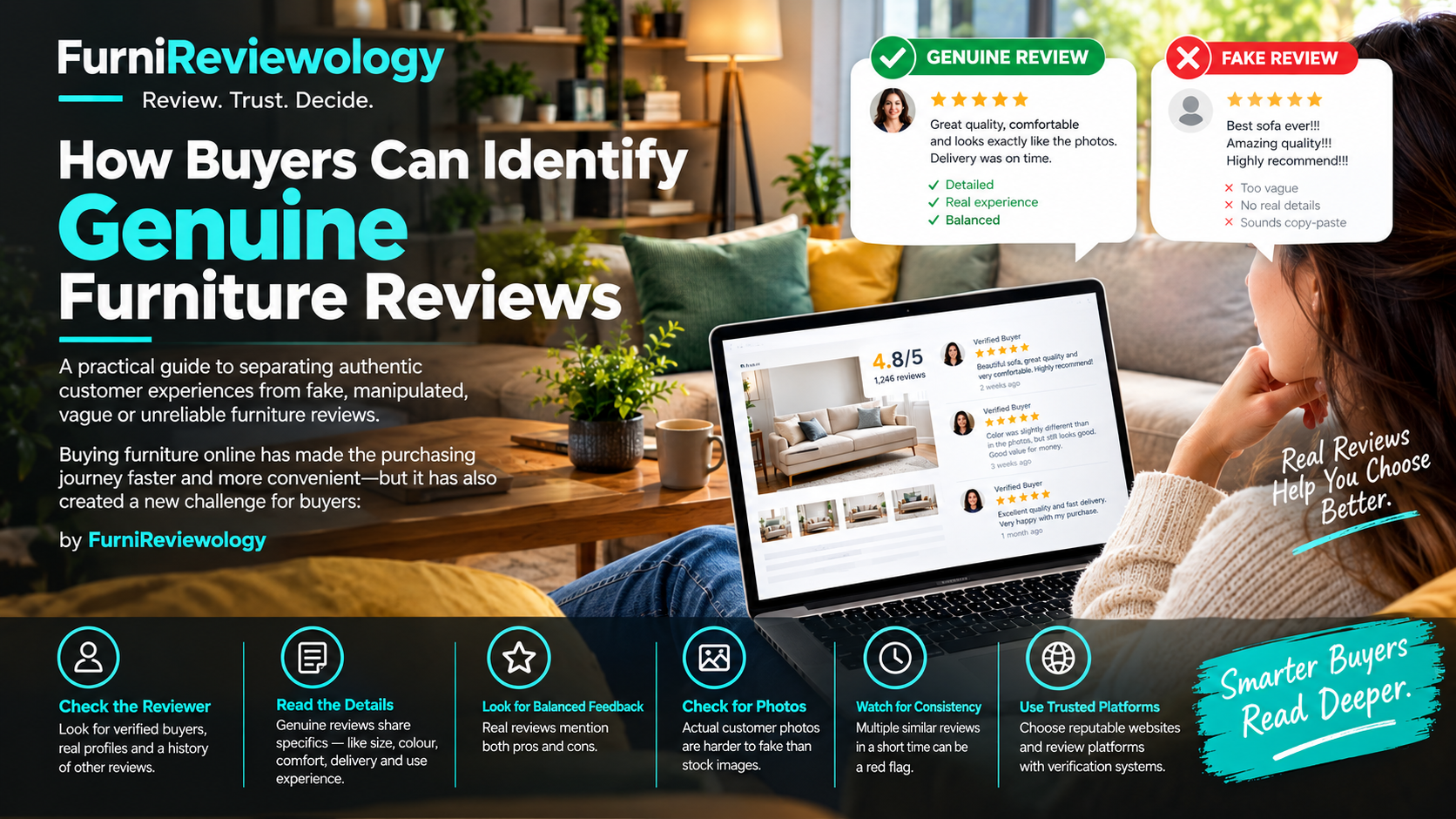
Can you trust the reviews you are reading?
A furniture product may have hundreds or even thousands of reviews. A brand may display an impressive five-star rating. A retailer may describe itself as highly trusted. A furniture manufacturer may receive glowing testimonials across multiple platforms.
But numbers and positive language do not automatically mean that the information is reliable.
For a buyer considering a sofa, dining set, bed, office chair, outdoor furniture collection, mattress, wardrobe, hotel furniture package or custom-made product, reviews can influence a significant purchasing decision.
That makes review authenticity extremely important.
A genuine furniture review can provide valuable insight into:
Product quality
Materials
Comfort
Construction
Durability
Delivery
Installation
Customer service
Warranty support
Maintenance
Value for money
Real-world performance
A fake or misleading review can do the opposite.
It can create an artificial impression of quality, hide genuine weaknesses and potentially cause buyers to make expensive decisions based on unreliable information.
This is why consumers need to learn how to read beyond the stars.
And this is why the furniture industry needs stronger standards around transparency, verification and responsible reviewing.
What Is a Genuine Furniture Review?
A genuine furniture review is an account based on a real person's actual experience with a furniture product, business, service or buying process.
It does not have to be positive.
It does not have to be negative.
It simply needs to represent a real experience honestly and fairly.
A genuine review might say:
“We purchased the dining table six months ago. The finish still looks good, but one corner developed a small scratch during the first month. The company responded quickly and offered replacement support.”
That review contains context.
It describes:
What was purchased
How long it was used
A positive observation
A negative observation
A customer-service experience
This is much more informative than:
“Amazing product! Five stars!”
Why Authentic Furniture Reviews Matter
Furniture is often a long-term purchase.
A buyer may spend hundreds, thousands or substantially more depending on the product and application.
Commercial buyers can spend considerably more on:
Hotels
Resorts
Restaurants
Offices
Property developments
Educational facilities
Healthcare environments
Public spaces
A misleading review can therefore have significant consequences.
Authentic reviews help buyers make decisions based on actual experience rather than marketing alone.
They can also help responsible businesses demonstrate their reputation.
1. Look for Specific Details
One of the strongest indicators of a useful review is specificity.
Compare:
“Great furniture. Highly recommended.”
with:
“We purchased four outdoor lounge chairs for a covered terrace and have used them for approximately nine months. The frames remain stable and the cushions have been easy to clean. The chairs are comfortable, although the seat is firmer than we expected.”
The second review contains information that another buyer can evaluate.
Look for details about:
Product type
Materials
Size
Usage
Comfort
Construction
Durability
Delivery
Service
Maintenance
A review does not have to contain every detail, but genuine experiences often include concrete observations.
2. Look for a Clear Usage Context
A useful review should tell you something about how the furniture was used.
Ask:
Where was it used?
How often was it used?
Who used it?
For how long?
This is particularly important for furniture.
A chair used occasionally at home is not equivalent to one used continuously in a restaurant.
A sofa in a guest room is not necessarily comparable to one used daily by a large family.
An outdoor table under a covered terrace may experience different conditions from one exposed to sun and rain every day.
Context makes a review more meaningful.
3. Check How Long the Reviewer Has Used the Furniture
Furniture performance changes over time.
A review written immediately after delivery mainly tells you about:
Appearance
Packaging
Delivery
Initial comfort
Assembly
A review written after six months, one year or several years can potentially tell you more about:
Durability
Wear
Stability
Cushion performance
Finish
Hardware
Maintenance
This is why ownership duration is an important review signal.
A statement such as:
“I have used this chair for 18 months in my home office.”
provides more context than:
“Just received it today—looks great!”
Both experiences can be legitimate, but they answer different questions.
4. Look for Balanced Reviews
Genuine experiences are rarely completely one-dimensional.
A reviewer may love the design but dislike the assembly process.
They may praise the quality but consider the price high.
They may like the product but criticize delivery.
Balanced reviews can therefore be particularly informative.
For example:
“The table is beautifully finished and very stable, but assembly took longer than expected and the instructions could be clearer.”
This is more useful than an exaggerated statement such as:
“Absolutely perfect in every way!”
A balanced review does not automatically prove authenticity, but it can provide stronger informational value.
5. Be Careful With Excessively Generic Praise
Reviews containing only generic promotional language deserve closer attention.
Examples include:
“Amazing quality!”
“Best product ever!”
“Excellent company!”
“Highly recommended!”
“Five stars! Perfect!”
These may be genuine.
But by themselves, they provide very little evidence.
Ask:
What exactly was good?
Was it:
Comfort?
Material?
Delivery?
Design?
Durability?
Customer service?
Price?
Specificity makes praise more useful.
6. Look for Personal Experience
Authentic reviews often contain first-hand observations.
For example:
“We use the chairs every evening.”
“After six months, the cushions remain supportive.”
“The wardrobe was installed in our bedroom.”
“We ordered a custom dining table for our restaurant.”
These statements establish a relationship between the reviewer and the product.
By contrast, a review that sounds like a company advertisement may deserve additional scrutiny.
7. Examine the Language
Language alone cannot prove whether a review is genuine.
However, it can provide clues.
Be cautious when many reviews use:
Identical wording
Similar sentence structures
Repeated promotional phrases
Excessive marketing terminology
Unusually polished language without personal detail
The same unusual expressions
If ten supposedly independent reviewers all describe a sofa using almost identical language, that may be worth investigating.
Authentic customers tend to describe experiences in their own ways.
8. Look for Repeated Patterns Across Reviews
One review can be misleading.
A pattern across many independent reviews can be much more informative.
Suppose dozens of customers independently mention:
Comfortable seating
Strong construction
Slow delivery
That pattern provides useful information.
Likewise, if many reviewers independently mention:
Poor packaging
Difficult assembly
Excellent customer service
the combination becomes significant.
The objective is to identify patterns rather than isolated comments.
9. Read Both Positive and Negative Reviews
Do not read only five-star reviews.
Negative reviews can reveal information that positive reviews do not.
Look at:
Five-star reviews
What do customers love?
Four-star reviews
What could be improved?
Three-star reviews
What compromises exist?
Two-star reviews
What problems are appearing?
One-star reviews
Are there serious recurring issues?
Then look at the company's responses.
This provides a much more complete picture.
10. Pay Attention to the Company's Response
The response to a review can be almost as informative as the review itself.
Imagine a customer says:
“One chair arrived damaged.”
A responsible business might respond by acknowledging the issue and explaining how it will be addressed.
Another business might respond aggressively.
The difference tells you something about the company's approach to customer relationships.
Look for responses that demonstrate:
Professionalism
Accountability
Courtesy
Problem-solving
Clear communication
A company does not have to agree with every review.
But its response can demonstrate how it handles criticism.
11. Check Whether Reviews Are Verified
Where a platform offers verification, look for it.
Possible indicators include:
Verified purchase
Verified customer
Verified transaction
Verified business interaction
Verification can increase confidence that the reviewer had a real relationship with the product or business.
However, verification should not be interpreted as an absolute guarantee that every statement is correct.
A verified buyer can still have a subjective opinion.
The purpose of verification is to strengthen the provenance of the experience, not to eliminate subjectivity.
12. Consider the Number of Reviews
Review volume can provide useful context.
Compare:
4.9/5 from 12 reviews
with:
4.7/5 from 3,500 reviews
Neither score automatically wins.
The larger review base may provide a broader range of experiences.
The smaller review base may still be meaningful if the reviews are detailed and relevant.
The key question is:
How much evidence supports the rating?
13. Check the Recency of Reviews
Furniture products and businesses can change.
A review from five years ago may describe:
An older product
A previous manufacturer
A previous retailer
An old delivery system
A discontinued material
A previous customer-service team
Recent reviews can provide more relevant information about current performance.
Older reviews can still be useful, particularly for long-term durability, but buyers should understand their age.
14. Look for Photographs
Customer photographs can provide useful visual evidence.
They may show:
Actual colour
Real-world size
Finish
Wear
Installation
Damage
Furniture in a normal environment
Professional product photography shows the intended presentation.
Customer photographs can show the real-world presentation.
Both have value.
However, photographs should also be interpreted carefully because lighting, cameras and editing can change appearance.
15. Look for Reviews From Similar Buyers
This is one of the most important principles.
A review is more useful when the reviewer's circumstances resemble yours.
If you are purchasing furniture for a hotel, look for hospitality experiences.
If you are furnishing a restaurant, look for commercial-use reviews.
If you are buying outdoor furniture, look for reviews from similar climates and environments.
If you are furnishing a home, residential experiences may be more relevant.
The best review is not necessarily the most positive one.
It is often the one that is most relevant to your situation.
16. Be Careful With Sudden Waves of Perfect Reviews
A sudden increase in overwhelmingly positive reviews can deserve closer examination.
For example:
A business has very few reviews for years, followed by hundreds of highly enthusiastic reviews within a short period.
That does not prove manipulation.
There may be legitimate reasons.
Perhaps the company launched a major product.
Perhaps a campaign encouraged customers to review.
Perhaps the business moved to a new platform.
But unusual patterns should encourage buyers to investigate rather than automatically assume everything is genuine.
17. Look for Review Diversity
A healthy review profile may contain different types of customers.
You may see:
Short reviews
Long reviews
Positive experiences
Neutral experiences
Critical experiences
Different usage environments
Different product preferences
This diversity can make the overall information more useful.
A collection of reviews that all sound strangely identical deserves greater scrutiny.
18. Beware of Reviews That Sound Like Advertisements
A genuine customer might say:
“The chair looks good and is comfortable, but I found assembly slightly difficult.”
An advertisement might say:
“This premium, world-class luxury chair delivers an unparalleled experience with exceptional craftsmanship.”
The second statement may be accurate marketing language.
But it does not necessarily represent an independent customer experience.
When reading reviews, ask:
Does this sound like a customer describing an experience—or a company describing a product?
That simple question can be surprisingly useful.
19. Check the Reviewer Profile When Possible
On platforms that provide reviewer profiles, look for broader activity.
Does the person review:
Different furniture products?
Different businesses?
Products in different categories?
A variety of brands?
Or do they appear to have created an account solely to praise one business?
Again, this is not proof of anything.
But patterns can provide useful signals.
20. Don't Assume Every Negative Review Is Genuine Either
It is important to maintain balance.
Fake reviews are not necessarily positive.
A competitor, disgruntled individual or malicious actor could potentially create misleading negative content.
Therefore, do not automatically believe a one-star review simply because it criticizes a business.
Look for:
Specific facts
Dates
Product details
Clear explanations
Photographs where appropriate
Company responses
Evidence of actual interaction
The objective is not:
“Believe positive reviews.”
Nor is it:
“Believe negative reviews.”
The objective is:
Evaluate the evidence.
A Simple Furniture Review Authenticity Checklist
Before trusting a review, ask:
1. Is there specific information?
2. Does the reviewer describe actual usage?
3. Is the usage period mentioned?
4. Does the review explain both strengths and weaknesses?
5. Does the language sound personal rather than purely promotional?
6. Is the review relevant to your intended use?
7. Is the reviewer verified where verification is available?
8. Are there photographs or other supporting details?
9. Are similar experiences repeated across multiple reviews?
10. Is the review reasonably recent?
11. Does the business respond professionally?
12. Does the overall review profile appear natural and diverse?
The more of these questions you can answer confidently, the more useful the review information becomes.
A Five-Star Review Is Not Automatically the Best Review
This is an important point.
Consider:
Review A
★★★★★
“Amazing! Best sofa ever!”
Review B
★★★★
“We have used this sofa daily for 14 months. The frame remains stable and the fabric has held up well. The cushions are firmer than expected, so buyers looking for a soft sofa should consider this. Delivery was delayed by three days, but customer service communicated throughout the delay.”
Which review is more useful?
For most buyers, Review B provides considerably more information.
It may even be more trustworthy because it explains the experience rather than simply assigning praise.
Why Three- and Four-Star Reviews Can Be Extremely Valuable
Consumers sometimes focus exclusively on five-star ratings.
But four-star reviews often contain useful information about compromises.
For example:
“Excellent quality and attractive design, but the table is heavier than expected.”
Or:
“Very comfortable chair, although the armrests make it difficult to push completely under our desk.”
These observations can help buyers determine whether a product fits their specific needs.
A review does not need to be perfect to be useful.
Reviews Should Be Read as a Collection
Think of reviews as pieces of a larger puzzle.
One review provides one perspective.
Ten reviews provide several perspectives.
One hundred reviews can reveal patterns.
Thousands of reviews can potentially provide broader market intelligence—provided the information is authentic, relevant and properly interpreted.
This is why specialized review ecosystems can become valuable.
They can organize information rather than simply display it.
Furniture Reviews Need Furniture-Specific Questions
Generic review systems often ask:
“How was your experience?”
Furniture deserves more detailed questions.
For example:
Product Quality
How would you rate the construction?
Comfort
How comfortable is the furniture?
Design
Does the furniture meet your aesthetic expectations?
Durability
How has it performed over time?
Materials
Did the materials meet expectations?
Delivery
Was the furniture delivered safely and on schedule?
Installation
Was assembly or installation satisfactory?
Customer Service
How did the company respond to questions or problems?
Value
Was the furniture worth the investment?
Recommendation
Would you recommend it to someone with similar needs?
These questions produce more useful information.
The Role of FurniReviewology in Building Furniture Trust
The furniture industry is a vast global ecosystem.
It includes major international manufacturers as well as:
Small workshops
Independent artisans
Retailers
Designers
Exporters
Importers
Hospitality suppliers
Component manufacturers
Custom furniture businesses
Online furniture companies
Many of these businesses have valuable customer experiences scattered across different digital platforms.
FurniReviewology can help bring the concept of furniture reviews into a dedicated ecosystem where the focus is specifically on furniture products, furniture businesses and furniture experiences.
The objective should not be to create a platform where everyone receives five stars.
The objective should be to create a platform where buyers can find useful, transparent and trustworthy information.
From Reviews to Furniture Trust
A genuine review is valuable on its own.
But when reviews are organized and analyzed responsibly, they can become something much more powerful.
They can reveal:
Customer sentiment
Product strengths
Recurring weaknesses
Durability experiences
Service performance
Value perceptions
Supplier reliability
Market trends
This creates the possibility of transforming individual experiences into broader Furniture Intelligence.
The journey becomes:
Experience → Review → Evidence → Pattern → Intelligence → Trust
The Future of Authentic Furniture Reviews
Technology will continue to change how reviews are created, verified and analyzed.
The future may include:
Verified purchase reviews
Long-term ownership reviews
Photo-supported reviews
Video reviews
Structured furniture reviews
AI-assisted review summaries
Sentiment analysis
Product-specific review categories
Supplier reputation profiles
B2B furniture reviews
Hospitality furniture reviews
Sustainability reviews
Review authenticity signals
Artificial intelligence may eventually make it possible for buyers to ask:
“What are customers saying about this sofa after one year?”
or:
“What are the most common complaints about this furniture supplier?”
or:
“Is this outdoor furniture suitable for heavy commercial use?”
The quality of those answers will depend heavily on the quality of the underlying review data.
That makes authentic reviews more important—not less.
What Furniture Businesses Can Do to Encourage Genuine Reviews
Furniture companies can also contribute to a healthier review ecosystem.
They can:
Ask genuine customers for honest feedback.
Make reviewing easy.
Avoid pressuring customers to leave only positive reviews.
Respond professionally to criticism.
Encourage detailed feedback.
Address recurring problems.
Publish clear product specifications.
Be transparent about materials.
Explain warranty policies.
Provide accurate delivery information.
The objective should be to create an environment where customers feel comfortable telling the truth.
The Golden Rule of Furniture Reviews
There is one simple principle buyers should remember:
Don't ask only, “Is this furniture highly rated?”
Ask:
“Why is it highly rated?”
Then ask:
Who rated it?
What did they buy?
How long did they use it?
Where did they use it?
What did they like?
What didn't they like?
What happened when there was a problem?
Do other customers report similar experiences?
Those questions transform passive review reading into intelligent research.
Conclusion: Don't Just Count Stars—Understand the Experience
Furniture reviews can be among the most valuable sources of information available to buyers.
But not all reviews provide the same level of insight.
A five-star rating does not automatically prove quality.
A one-star rating does not automatically prove failure.
A large number of reviews does not automatically prove authenticity.
And a beautifully written review does not automatically mean it came from a genuine customer.
The smartest approach is to look for specificity, context, usage experience, balance, consistency, verification and evidence.
Read across multiple reviews.
Look for patterns.
Consider the reviewer's circumstances.
Read company responses.
Pay attention to long-term experiences.
And always ask whether the information is relevant to your own needs.
Furniture is too important to evaluate based solely on photographs, advertisements or a single number.
The modern buyer needs something deeper:
Information they can understand.
Experiences they can compare.
Evidence they can evaluate.
And trust they can build before making a decision.
That is the real purpose of a strong furniture review ecosystem.
FurniReviewology aims to contribute to that future by helping transform scattered customer experiences into a more transparent, useful and trustworthy source of furniture information.
Because the future of furniture buying is not simply about finding the most attractive product.
It is about finding the right product from the right business—with enough reliable information to make the decision with confidence.
The Global Furniture Ecosystem
Furniture Industry Search Engine - FISE helps the world find them.
The Furniture Times - TFT tells their story.
FurniReviewology helps the world trust them.