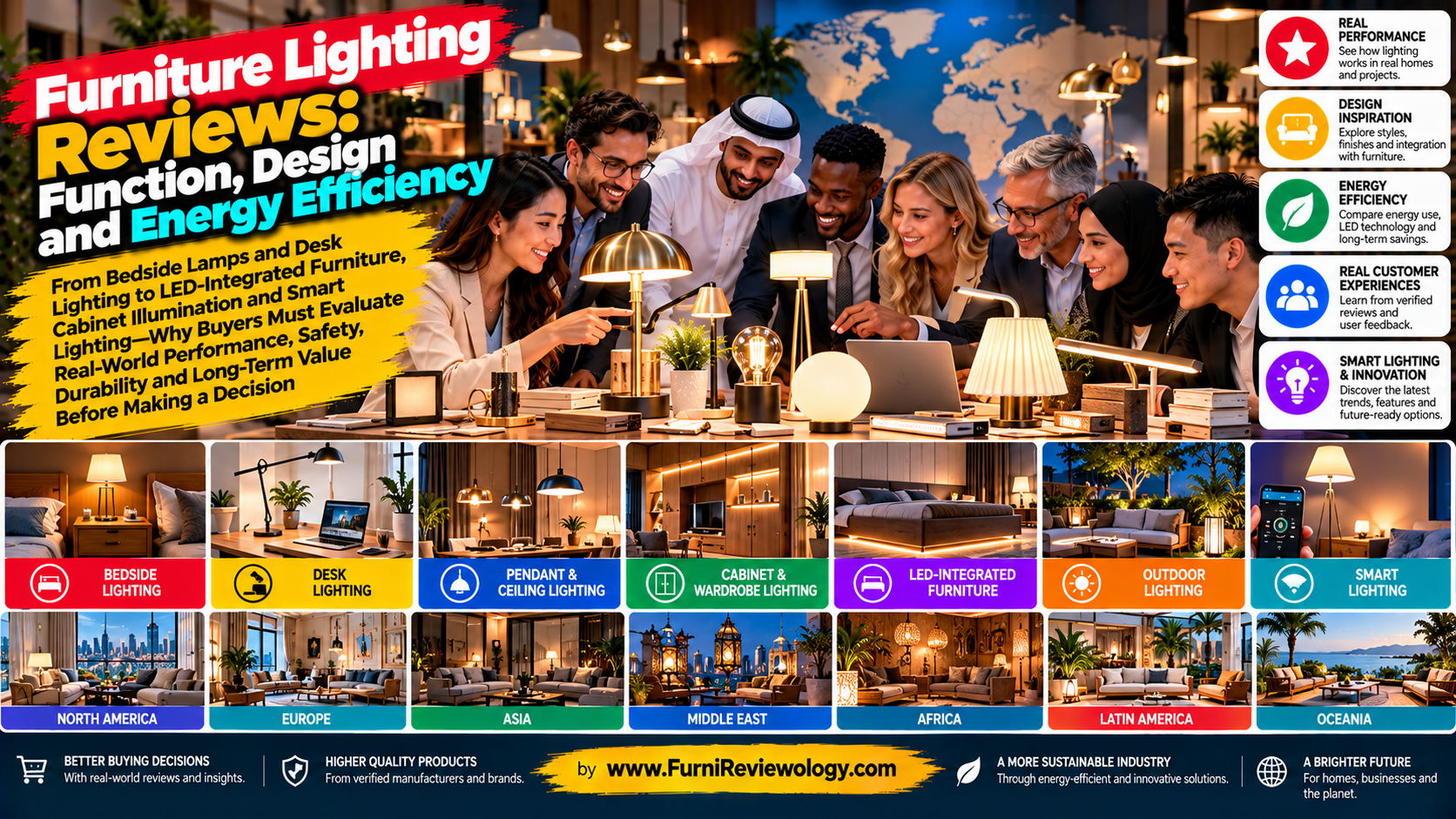
By The Furniture Times (TFT) Editorial Desk | FurniReviewology | Furniture Lighting Reviews | LED Furniture | Smart Lighting | Interior Furnishings | Energy Efficiency | Product Quality | Customer Experience | Global Furniture Ecosystem
Beautiful Lighting Can Transform Furniture. But Does It Perform as Promised?
A beautifully designed lamp can make an ordinary room feel extraordinary.
A well-positioned reading light can make a bedroom more comfortable.
An illuminated wardrobe can improve everyday convenience.
An LED-equipped dressing table can make grooming easier.
A thoughtfully designed desk lamp can support focused work.
And integrated lighting can transform the appearance and functionality of modern furniture.
But attractive photographs do not tell the whole story.
Does the light provide sufficient illumination?
Is it comfortable for the eyes?
Does it produce excessive glare?
Is the advertised color temperature accurate?
Does the LED system overheat?
How much electricity does it consume?
Can damaged components be replaced?
Will the light still perform consistently after months or years of use?
These are the questions that furniture lighting reviews should answer.
Lighting is increasingly part of the furniture buying experience, whether supplied as a standalone furnishing accessory or integrated into a larger furniture product.
Yet buyers often evaluate lighting primarily through appearance.
That creates a gap between product presentation and actual performance.
FurniReviewology encourages a more complete approach to furniture and interior lighting reviews—one that considers function, design, energy efficiency, durability, safety and genuine customer experience.
Because the best lighting product is not necessarily the brightest, most decorative or most expensive.
It is the product that performs reliably for its intended purpose.
1. Furniture Lighting Is More Than a Decorative Accessory
Lighting plays several roles in furniture and interior environments.
It influences visibility.
It affects comfort.
It supports tasks.
It contributes to safety.
It creates atmosphere.
It highlights materials and finishes.
It can improve the usability of storage furniture.
And increasingly, it forms part of connected home and commercial furnishing systems.
Consider the difference between a decorative bedside lamp and a task light used for detailed work.
Both may be attractive.
But they serve different purposes.
A decorative lamp may prioritize soft ambient illumination.
A desk lamp may require directional light, adequate task illumination and glare control.
A wardrobe light may need a reliable sensor and uniform coverage.
A hotel bedside light may need intuitive controls, durability and easy maintenance.
A useful review must evaluate the product against its intended application.
Judging every lighting product by the same criteria would overlook important differences.
2. Which Furniture Lighting Products Should Be Reviewed?
The furniture lighting category is broader than many consumers realize.
It includes both standalone lighting products associated with furnishing and lighting integrated into furniture itself.
| Lighting Category | Examples | Main Review Considerations |
|---|---|---|
| Table Lamps | Living-room and decorative lamps | Light quality, stability, appearance |
| Bedside Lamps | Reading and ambient lamps | Comfort, controls, glare |
| Desk Lamps | Office and study lighting | Task illumination, adjustability |
| Floor Lamps | Ambient and reading lights | Stability, light distribution |
| Cabinet Lighting | Kitchen and display cabinets | Coverage, installation, reliability |
| Wardrobe Lighting | Internal wardrobe illumination | Sensors, visibility, battery or power system |
| Vanity Lighting | Dressing tables and mirrors | Color rendering, evenness, glare |
| LED Bed Frames | Integrated headboard or under-bed lighting | Safety, controls, maintenance |
| Illuminated Shelving | Display cabinets and bookcases | Heat management, appearance |
| Smart Furniture Lighting | App-controlled or connected lighting | Connectivity, usability, reliability |
| Outdoor Furniture Lighting | Illuminated tables, seating and accessories | Weather suitability, electrical safety |
| Hospitality Furniture Lighting | Hotel headboards, bedside and task lighting | Durability, servicing, guest usability |
A good review should identify the specific product type before assessing its performance.
3. Function Comes First: Does the Light Actually Do Its Job?
The first question in any furniture lighting review should be simple:
Does the lighting perform the function for which it was purchased?
A lamp may look impressive in a showroom but fail to illuminate a desk properly.
A wardrobe light may switch on automatically but leave important storage areas in shadow.
A vanity mirror may feature bright LEDs but produce uneven illumination across the face.
A bedside lamp may provide adequate brightness but create uncomfortable glare.
These problems may not be visible in promotional photographs.
What reviewers should examine
Brightness: Is the light adequate for the intended task?
Distribution: Does illumination reach the areas where it is needed?
Glare: Is the light uncomfortable when viewed from normal positions?
Adjustability: Can the direction or intensity be changed?
Controls: Are switches, dimmers and sensors easy to operate?
Consistency: Does the light maintain stable performance?
Suitability: Is the product appropriate for reading, working, grooming, display or general ambience?
The important point is that brightness alone does not determine lighting quality.
A light can be powerful and still be poorly designed for its intended purpose.
4. Understanding Lumens, Lux, Watts and Color Temperature
Furniture lighting reviews become more useful when they explain basic technical measurements.
These terms are often confused.
Lumens: How Much Visible Light Is Produced?
Lumens measure luminous flux—the total quantity of visible light emitted by a source.
Higher lumen output generally means more total light.
But it does not automatically mean better illumination for a specific task.
The direction and distribution of light also matter.
Lux: How Much Light Reaches a Surface?
Lux measures illuminance.
One lux equals one lumen per square meter.
For task lighting, the illumination reaching the work surface can be more meaningful than the total lumen output of the lamp.
Watts: How Much Electrical Power Is Used?
Watts measure power consumption.
A higher wattage does not necessarily mean a brighter or better LED light.
Efficiency varies between products.
Color Temperature: What Does the Light Look Like?
Correlated color temperature, expressed in kelvin (K), describes whether white light appears relatively warm or cool.
<escape>Typical descriptions include:</escape>
Around 2700K: Warm white
Around 3000K: Warm white
Around 4000K: Neutral white
Around 5000K–6500K: Cooler, daylight-like white
These ranges are descriptive rather than universal rules.
The appropriate choice depends on the environment, task and user preference.
Color Rendering: How Naturally Do Colors Appear?
Color rendering affects how fabrics, wood finishes, upholstery and other materials appear under illumination.
The Color Rendering Index (CRI) is one commonly used measure, although it does not describe every aspect of color quality.
This is particularly relevant for dressing tables, showrooms, fabric selection and furniture displays.
A meaningful lighting review should explain performance in understandable language—not merely repeat numbers from the packaging.
5. Energy Efficiency: A Major Factor in Long-Term Value
Energy efficiency is one of the most important considerations when evaluating modern lighting.
LED technology has transformed lighting by enabling substantially lower energy consumption than traditional incandescent technology for comparable light output.
According to the U.S. Department of Energy, residential LEDs—particularly ENERGY STAR-rated products—use at least 75% less energy and can last up to 25 times longer than incandescent lighting.
However, actual performance depends on the product, operating conditions and quality of its components.
For buyers, the important questions are:
How much power does the product use?
How much light does it produce?
How many hours is it operated?
How long is it expected to last?
Can the light source or driver be replaced?
Illustrative electricity cost comparison
Consider two lamps producing broadly comparable useful illumination.
| Factor | Traditional Lamp | LED Lamp |
|---|---|---|
| Assumed power | 60 W | 9 W |
| Daily use | 5 hours | 5 hours |
| Annual energy | 109.5 kWh | 16.43 kWh |
| Assumed tariff | US$0.15/kWh | US$0.15/kWh |
| Annual electricity cost | US$16.43 | US$2.46 |
Under these illustrative assumptions, the LED lamp saves approximately US$13.97 per year in electricity.
Actual savings depend on local electricity prices, usage, comparable light output and product performance.
The calculation excludes purchase price, maintenance and replacement costs.
Energy efficiency should be evaluated through measurable consumption—not unsupported marketing claims.
6. Design Matters—but Good Design Must Support Usability
Lighting is also an important design element.
A lamp can complement furniture materials.
A lighting fixture can establish a visual identity.
Integrated LEDs can emphasize the geometry of a bed frame, shelving system or display cabinet.
But good design should extend beyond appearance.
A beautiful lamp with an unstable base may be unsuitable for a busy household.
An elegant bedside light with an awkward switch may be inconvenient.
A minimalist desk lamp that cannot be adjusted may fail to support different working positions.
A smart lamp that requires several complicated steps to operate may frustrate users.
Design evaluation should consider
Proportions.
Materials.
Finish quality.
Visual balance.
Ease of use.
Control placement.
Cable management.
Stability.
Cleaning.
Maintenance.
Compatibility with surrounding furniture.
Good furniture lighting combines visual appeal with practical usability.
7. LED-Integrated Furniture: A Growing Category With Special Risks
Lighting is increasingly integrated directly into furniture products.
Examples include:
Beds with illuminated headboards.
Wardrobes with automatic interior lights.
Dressing tables with LED mirrors.
Display cabinets with illuminated shelving.
TV consoles with decorative lighting.
Office desks with integrated task lights.
Outdoor tables with LED features.
These products can improve convenience and aesthetics.
But they introduce additional technical considerations.
A conventional table can remain useful even if a nearby lamp fails.
An integrated lighting system may be harder to repair because electrical components are built into the furniture.
Questions buyers should ask
Can the LED strip be replaced?
Is the driver accessible?
Are replacement components available?
Can the lighting system be repaired without damaging the furniture?
Is wiring protected from moving parts?
Does the installation allow appropriate heat dissipation?
What happens if the control module fails?
Does the warranty cover the lighting system separately from the furniture?
An illuminated furniture product should be evaluated as both furniture and an electrical product.
8. Durability: What Happens After the First Six Months?
A product may perform well during the first week.
But lighting quality should be assessed over time.
Potential problems include:
Dimming performance deterioration.
Flickering.
Color inconsistency.
Sensor failure.
Driver failure.
Loose connections.
Damaged switches.
Heat-related discoloration.
Corrosion.
Reduced battery performance.
Failure of integrated LED strips.
A credible long-term review should explain how the product behaves after regular use.
For example:
“The wardrobe light worked reliably for the first three months, but the motion sensor became inconsistent after six months.”
Or:
“The bedside lamp has maintained stable brightness after a year of daily use, and its touch controls remain responsive.”
Such information is more useful than a review saying only:
“Beautiful light. Five stars.”
Long-term performance is an important part of product quality.
9. Safety Must Never Be Treated as a Decorative Detail
Furniture lighting combines electrical components with materials such as wood, upholstery, plastics and composites.
This makes electrical safety particularly important.
Potential concerns include:
Overheating.
Damaged insulation.
Poor-quality adapters.
Exposed wiring.
Unstable fixtures.
Improper installation.
Inadequate protection against moisture.
Unsafe modifications.
Unsuitable outdoor electrical components.
Buyers should look for appropriate safety markings and documentation relevant to their country and product type.
Applicable standards and certification requirements vary by jurisdiction.
For example, the IEC 60598 series addresses safety requirements for many luminaires, while other standards may apply to drivers, LED modules, wiring and electrical accessories.
A certification claim should be checked against the actual product and relevant documentation.
Important warning
If a lighting product shows signs of overheating, burning smells, damaged wiring or electrical malfunction, stop using it and seek qualified assistance.
A decorative feature is never worth compromising electrical safety.
10. Smart Lighting: Convenience or Unnecessary Complexity?
Smart lighting is becoming increasingly common in homes, offices and hospitality environments.
Features may include:
App controls.
Voice assistant integration.
Scheduling.
Motion sensors.
Automatic dimming.
Color adjustment.
Remote access.
Scene presets.
Connectivity with home automation systems.
These functions can be useful.
But they also introduce potential problems.
A smart lamp may require an account.
An app may be unreliable.
Connectivity may fail.
Firmware updates may change behavior.
Some products may stop receiving software support.
What reviewers should test
Ease of initial setup.
Connection stability.
App usability.
Manual control availability.
Compatibility with stated systems.
Responsiveness.
Software support information.
Data and privacy considerations.
Behavior during internet outages.
A particularly important question is:
Can the light still perform its essential function when the smart features fail?
For many users, dependable basic operation is more valuable than an extensive list of rarely used features.
11. Furniture Lighting for Hospitality: Performance at Commercial Scale
Hotel and resort lighting requires a different level of evaluation.
A household may purchase two bedside lamps.
A hotel may purchase hundreds.
A minor defect in one product can become a significant operational problem when repeated across many rooms.
Hospitality buyers should evaluate:
Durability.
Guest comfort.
Ease of operation.
Maintenance access.
Replacement parts.
Consistency between units.
Energy consumption.
Installation requirements.
Cleaning compatibility.
Warranty support.
Supplier reliability.
A product that is attractive but difficult to service may create substantial long-term costs.
The lifecycle-cost principle
Hospitality procurement should consider more than purchase price.
Total cost can include:
Initial purchase.
Installation.
Electricity.
Maintenance.
Replacement components.
Labor.
Downtime.
Disposal.
Commercial lighting should be evaluated through lifetime operating value, not only initial appearance.
12. Outdoor Furniture Lighting: Weather Resistance Changes Everything
Outdoor furniture lighting is a distinct category.
It may include illuminated tables, garden furniture, patio accessories, decorative outdoor lamps and lighting integrated into outdoor structures.
Outdoor products face environmental conditions that indoor lighting does not.
Rain.
Humidity.
Dust.
Temperature variation.
UV exposure.
Corrosion.
Insects.
Physical impact.
A product marketed for outdoor use should have appropriate protection for its intended environment.
Ingress Protection (IP) ratings describe protection against solid objects and water under defined test conditions.
However, an IP rating alone does not establish suitability for every outdoor installation.
Buyers should also consider installation location, electrical connections, power supplies, material corrosion resistance and manufacturer instructions.
Never assume that a visually attractive LED product is suitable for outdoor furniture simply because it appears in a garden photograph.
13. How Customer Reviews Reveal Problems That Specifications Miss
Manufacturer specifications are important.
But they do not describe every real-world experience.
A product page may state:
“Touch control.”
A customer review may explain:
“The touch switch is difficult to locate in a dark room.”
A product page may state:
“Dimmable LED.”
A customer review may explain:
“The lowest brightness setting is still too bright for bedside use.”
A product page may state:
“Motion sensor.”
A customer review may explain:
“The sensor activates when someone walks past the wardrobe.”
These observations can reveal practical issues.
They should not automatically be treated as universal defects.
One customer's experience may depend on installation, usage, environment or product variation.
But when multiple detailed reviews describe similar problems, buyers have a reason to investigate further.
Useful reviews add context that product specifications alone cannot provide.
14. Reviews vs Ratings: Why Five Stars Are Not Enough
A star rating provides a quick impression.
But lighting performance is multidimensional.
A product may deserve high marks for appearance but lower marks for durability.
Another may be highly energy-efficient but poorly suited to reading.
A third may offer excellent illumination but have complicated controls.
That is why FurniReviewology encourages more informative, experience-based reviews.
A structured lighting review can evaluate separate criteria.
Suggested Furniture Lighting Review Scorecard
{@body const criteria = [{name:"Function and illumination",weight:25},{name:"Design and usability",weight:15},{name:"Energy efficiency",weight:15},{name:"Durability and reliability",weight:20},{name:"Safety and build quality",weight:15},{name:"Value and service",weight:10}]}
{@body const [ratings,setRatings] = DIL.useState([4,4,4,4,4,4])}
{@body const total = criteria.reduce((sum,c,i)=>sum+c.weight*ratings[i]/100,0)}
<box border radius="xl" padding={3} gap={3}>
<row align="center" justify="between">
Interactive lighting review scorecard
<badge color="secondary">Editorial example</badge>
</row>
<text color="secondary" size="sm">Rate each factor from 1 (poor) to 5 (excellent). The weighted result updates automatically.</text>
{#each criteria as c,i}
<box gap={1} key={c.name}>
<row justify="between" align="center">
<text weight="medium" size="sm">{c.name}</text>
<text size="xs" color="secondary" tabularNums>{c.weight}% weight · {ratings[i]}/5</text>
</row>
<slider min={1} max={5} step={1} value={ratings[i]} onChange={v=>setRatings(prev=>prev.map((x,j)=>i===j?v))}/>
</box>
{/each}
<divider/>
<row align="center" justify="between">
<box gap={1}>
<text color="secondary" size="xs">Weighted overall score</text>
<title size="2xl" color="default" tabularNums>{total.toFixed(2)} / 5</title>
</box>
<button size="sm" color="secondary" variant="outline" onClick={()=>setRatings([4,4,4,4,4,4])}>Reset ratings</button>
</row>
<caption>This is a proposed editorial assessment framework, not an official FurniReviewology scoring methodology or an independent product certification.</caption> </box>
The weighting can be adjusted according to the product.
For a desk lamp, illumination quality may deserve greater emphasis.
For an outdoor illuminated table, electrical safety and weather resistance may be more important.
For hospitality lighting, durability and maintainability may carry greater weight.
The purpose of a review is to explain performance—not hide important weaknesses behind one number.
15. What Makes a Furniture Lighting Review Genuinely Helpful?
A meaningful review should answer questions that future buyers are likely to ask.
A customer reviewing a bedside lamp could explain:
Where the lamp is used.
How long it has been used.
Whether the brightness is comfortable.
Whether the controls are convenient.
Whether the product feels stable.
Whether the light flickers.
Whether the finish has deteriorated.
Whether the electricity consumption matches expectations.
Whether the product was worth its price.
A review of LED-integrated furniture should also discuss installation, component replacement and service support.
Example of a weak review
“Great light. Very beautiful. Highly recommended.”
Example of a useful review
“I purchased this LED desk lamp four months ago for daily office work. The adjustable arm makes it easy to direct light onto my work surface, and the dimming function is useful in the evening. The base feels stable, although the touch controls sometimes require a second attempt. I have not experienced flickering so far.”
The second review provides context.
It identifies strengths and limitations.
It helps future buyers judge whether the product suits their needs.
The most valuable reviews are not necessarily the most positive. They are the most informative and credible.
16. Manufacturers and Brands: What Lighting Reviews Can Teach You
Furniture lighting reviews are not only useful to buyers.
They can also provide valuable product-development feedback.
Manufacturers may discover recurring complaints about:
Brightness.
Glare.
Switch placement.
Cable length.
Color temperature.
Sensor sensitivity.
Assembly instructions.
Power adapters.
Replacement parts.
Packaging damage.
Warranty service.
These observations can support product improvement.
For example, repeated complaints about difficult-to-replace LED modules may encourage a manufacturer to redesign service access.
Feedback about unstable lamp bases may lead to better engineering.
Complaints about confusing smart controls may inform interface improvements.
Customer reviews can become an important source of product intelligence when businesses analyze them responsibly.
Manufacturers should distinguish isolated complaints from recurring patterns and investigate technical concerns before drawing conclusions.
17. The Hidden Cost of Cheap Furniture Lighting
A low purchase price can be attractive.
But a cheap lighting product may become expensive if it requires frequent replacement.
Consider the potential costs:
Replacement lamps.
Electrical repairs.
Installation labor.
Higher energy consumption.
Product downtime.
Damaged furniture finishes.
Customer dissatisfaction.
Waste disposal.
A product with a higher initial price may offer better long-term value if it is durable, efficient and repairable.
But a higher price does not automatically guarantee superior quality.
Buyers should evaluate evidence.
Questions worth asking
Is the warranty meaningful?
Are replacement parts available?
Does the manufacturer publish useful specifications?
Can the product be serviced?
Are there credible long-term reviews?
Does the product meet relevant safety requirements?
Value is what the product delivers over time—not simply what it costs on the day of purchase.
18. Sustainability and Repairability: The Next Important Review Dimension
Energy efficiency is only one aspect of sustainability.
A highly efficient LED product may still create waste if it cannot be repaired.
An integrated furniture light may require replacement of an entire assembly because one small component has failed.
That raises questions about product design.
Can the LED module be replaced?
Can the power supply be serviced?
Are components standardized?
Is the product designed for disassembly?
Are replacement parts available?
Can the furniture continue functioning without the lighting system?
Furniture and lighting manufacturers have an opportunity to improve product longevity through thoughtful design.
Consumers and professional buyers can encourage better practices by asking these questions before purchase.
A genuinely sustainable lighting product should consider energy consumption, durability and end-of-life management together.
19. How FurniReviewology Can Support Better Lighting Decisions
The furniture industry needs credible, detailed and relevant customer experiences.
FurniReviewology's mission is to contribute to a more transparent furniture review ecosystem.
Lighting reviews can help buyers compare more than appearance and advertised features.
They can provide context about:
Product performance.
Durability.
Energy consumption.
Customer service.
Installation.
Repairability.
Value.
Real-world usability.
Review platforms should also encourage authenticity.
A verified purchase or experience indicator, where supported, can provide useful context, but it does not guarantee that every statement in a review is accurate.
Businesses should not manipulate reviews, suppress legitimate negative feedback or misrepresent customer experiences.
Trust grows when reviews are genuine, specific and useful—not when every product receives five stars.
20. A Practical Checklist Before Buying Furniture Lighting
Before purchasing a lamp or LED-integrated furniture product, evaluate the following.
Function
Does it provide appropriate illumination for the intended purpose?
Design
Does it complement the furniture and room without sacrificing usability?
Energy Efficiency
Are power consumption and light output clearly stated?
Comfort
Is the light suitable for the intended task, without excessive glare or distracting flicker?
Safety
Is the product appropriate for its installation environment and supported by relevant safety information?
Durability
Are materials, controls and electrical components designed for regular use?
Maintenance
Can failed components be replaced or serviced?
Warranty
What is covered, for how long, and under what conditions?
Reviews
What do genuine customers report after extended use?
Total Cost
Does the product offer reasonable long-term value?
A buyer who considers these factors is better prepared to make an informed decision.
21. Furniture Lighting Companies: Your Products Need More Than Attractive Photographs
Manufacturers and brands should recognize that lighting buyers need meaningful product information.
If you manufacture furniture lighting, publish clear specifications.
If you sell LED-integrated furniture, explain the lighting system.
If you supply commercial lighting, document relevant technical performance.
If you produce outdoor illuminated furniture, provide appropriate environmental and electrical information.
If you sell smart lighting, explain connectivity requirements and basic operation.
If your product is repairable, communicate how replacement parts can be obtained.
And encourage genuine customers to share their experiences.
A product that performs well deserves a review that explains why. A product with weaknesses deserves honest feedback that can help future buyers and manufacturers.
22. The Future of Furniture Lighting: Smarter, More Efficient and More Integrated
Furniture lighting is likely to continue evolving through several overlapping trends.
More efficient LEDs.
Better light distribution.
Improved dimming.
Smarter sensors.
More integrated furniture designs.
Modular electrical components.
Greater attention to repairability.
Improved user controls.
Connected lighting systems.
More detailed product information.
However, innovation should be judged by actual benefits.
A product is not necessarily better because it has more features.
A smart system is not necessarily better because it requires an app.
An integrated LED product is not necessarily better because it looks futuristic.
The most meaningful innovation improves usability, reliability, efficiency or long-term value.
That is the standard future furniture lighting reviews should apply.
The Furniture Industry Needs Better Lighting Reviews—Not Just Brighter Marketing
Lighting influences how furniture looks, feels and functions.
It can improve comfort.
It can enhance productivity.
It can make storage easier to use.
It can contribute to hospitality experiences.
It can reduce energy consumption.
It can also create problems when products are poorly designed, difficult to maintain or unsuitable for their intended environment.
Buyers need more than product photographs and promotional descriptions.
They need information grounded in actual use.
Manufacturers need more than sales figures.
They need meaningful feedback.
Retailers need more than star ratings.
They need insights into customer satisfaction.
And the wider furniture ecosystem needs more credible ways to evaluate products.
Furniture lighting reviews should illuminate the truth about performance—not simply promote the appearance of a product.
Review the Function. Examine the Design. Measure the Efficiency. Understand the Value.
Share Your Furniture Lighting Experience
Have you purchased a desk lamp, bedside lamp, illuminated wardrobe, LED bed frame, dressing-table mirror, smart lighting product or outdoor illuminated furniture?
Your experience may help another buyer.
Share what worked.
Explain what disappointed you.
Describe how long you have used the product.
Discuss its illumination, design, reliability, energy consumption and maintenance.
Include relevant photographs where appropriate and where you have permission to share them.
Avoid unsupported claims.
Your experience can help another buyer make a better-informed decision.
Explore FurniReviewology:
Furniture manufacturers, lighting brands, retailers and suppliers can also use customer feedback to identify improvements and communicate product information more transparently.
The Global Furniture Ecosystem
The Furniture Industry is a $1 Trillion USD Ecosystem in the world.
Furniture Industry Search Engine — FISE helps the world find them.
The Furniture Times — TFT tells their story.
FurniReviewology helps the world trust them.