By The Furniture Times (TFT) Editorial Desk | Furniture Industry Search Engine (FISE) | Searchology | Digital Infrastructure | Furniture Business Discovery | AI Search | Global Furniture Ecosystem | Industry Intelligence
The Furniture Industry Does Not Need Another List of Company Names. It Needs a Better Way to Find the Right Companies.
Imagine a furniture buyer searching for a manufacturer capable of producing 2,000 customized outdoor dining chairs for a hospitality project.
The buyer does not simply need a company name.
They need answers.
Which companies manufacture commercial outdoor furniture?
Which manufacturers work with aluminum?
Which businesses offer customized finishes?
Which suppliers have hospitality project experience?
Which companies export internationally?
Which manufacturers can potentially meet the required quantity and specifications?
Which suppliers are located in the buyer's preferred sourcing markets?
A conventional business directory may provide hundreds of company names.
But a long list of names is not the same as a useful sourcing solution.
The real challenge is not finding furniture businesses. It is finding furniture businesses that match specific requirements.
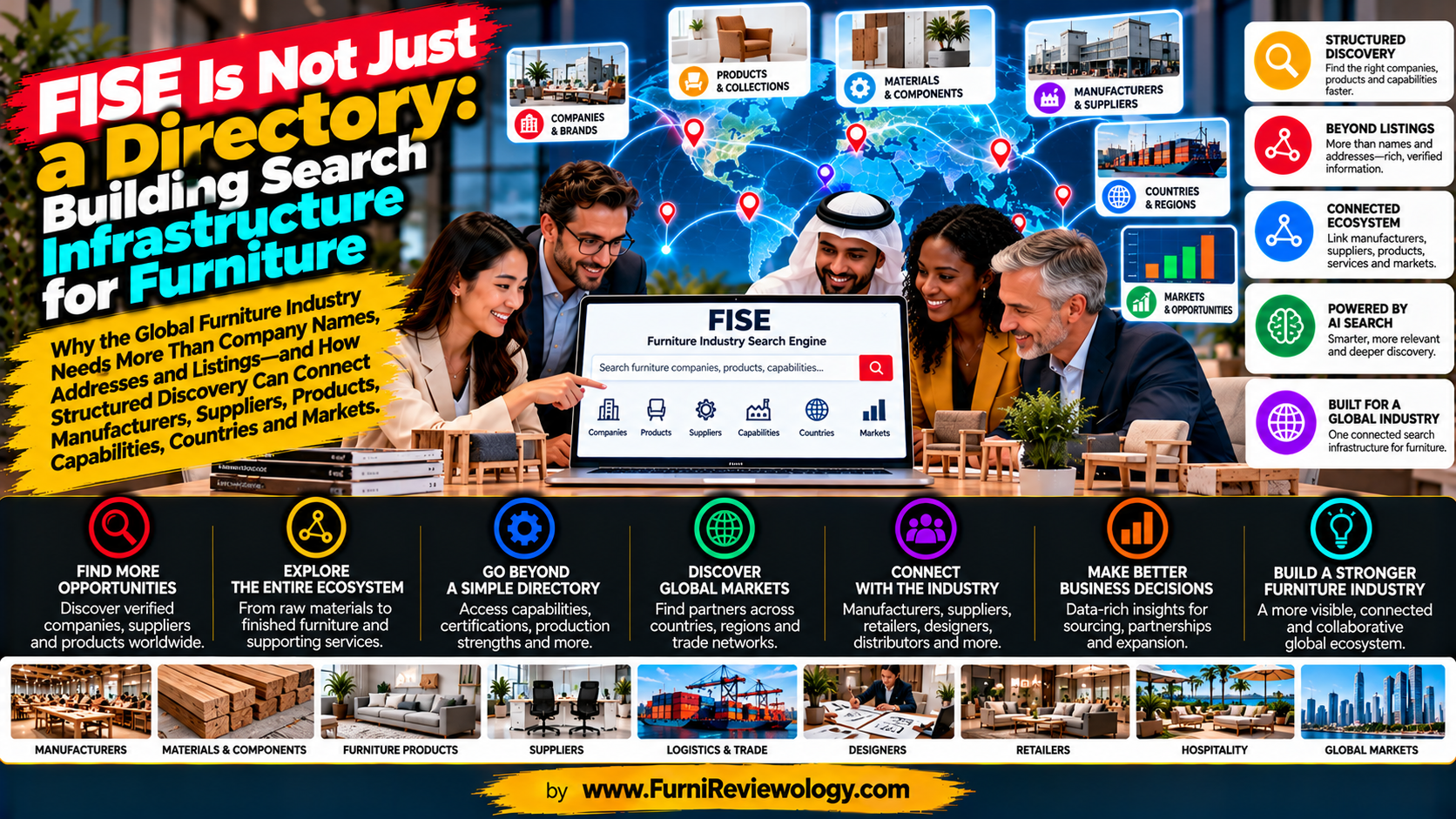
This distinction is central to the mission of the Furniture Industry Search Engine (FISE).
FISE is being developed around a bigger ambition than simply collecting business listings.
It aims to create a structured discovery environment for the global furniture ecosystem.
An environment where business information can be organized around what companies do, what they manufacture, what they supply, where they operate and which markets they serve.
Because the furniture industry needs more than visibility.
It needs searchability.
1. A Directory Tells You Who Exists. Search Infrastructure Helps You Discover Who Is Relevant.
Traditional business directories have served industries for decades.
They organize company information, usually by name, location or business category.
A typical directory entry may contain:
Company name
Business address
Telephone number
Website
Email address
Business category
Short company description
This information is useful.
It establishes a basic business identity and gives potential customers a way to make contact.
But furniture sourcing frequently requires much more detailed information.
A manufacturer may produce residential furniture, hospitality furniture, office furniture or specialist contract furniture.
A supplier may offer timber, upholstery fabric, hardware, foam, machinery or furniture components.
A designer may specialize in product development, commercial interiors or customized furniture.
A conventional listing may not capture these distinctions adequately.
FISE's vision is to move from basic company identification toward structured industry discovery.
That means organizing business information so users can search by relevant requirements, not simply browse names.
2. What Makes FISE Different From a Conventional Business Directory?
The difference is not that directories are obsolete.
Many directories already offer advanced search filters, verified profiles and product catalogues.
The meaningful distinction lies in the depth of industry-specific information and how that information is connected.
| Conventional Basic Directory | FISE's Structured Discovery Vision |
|---|---|
| Company name and contact information | Company identity plus industry-specific capabilities |
| Broad business categories | Detailed furniture product and service classifications |
| Search by name or location | Search by company, category, country, product and capability |
| General company descriptions | Structured manufacturing and supply information |
| Individual business listings | Connections among businesses, products and industry segments |
| Basic contact discovery | More informed supplier identification and shortlisting |
| Limited industry context | Furniture-specific terminology and classifications |
| Static listing approach | An evolving information environment designed for updated business data |
The objective is not to dismiss business directories. It is to build upon their foundations.
A listing answers:
Who is this company?
Structured discovery can help answer:
Is this company potentially relevant to what I need?
That is a significant difference.
3. Furniture Search Is More Complicated Than General Business Search
The furniture industry is not one product category.
It includes an enormous range of products, materials, business types and commercial requirements.
Consider the word chair.
It could mean:
Dining chair.
Office chair.
Ergonomic chair.
Outdoor chair.
Restaurant chair.
Hotel chair.
Auditorium chair.
Healthcare chair.
School chair.
Lounge chair.
Recliner.
Stackable chair.
Folding chair.
A buyer searching for one of these products may have highly specific requirements.
Material.
Dimensions.
Finish.
Load capacity.
Application.
Manufacturing standards.
Customization.
Quantity.
Delivery market.
A broad search for chair manufacturers may not identify the most relevant suppliers.
The search environment needs to understand the furniture industry's vocabulary.
The deeper the industry classification, the more meaningful the discovery process can become.
4. From Company Listings to Structured Furniture Data
At the heart of FISE's vision is a simple principle:
Furniture businesses should be described in ways that people and digital systems can understand.
Consider two hypothetical company profiles.
Company A — Basic Directory Listing
ABC Furniture Sdn. Bhd.
Malaysia
Furniture Manufacturer
Website and telephone number
Company B — Structured Industry Profile
ABC Furniture Sdn. Bhd.
Country: Malaysia
Business Type: Manufacturer and Exporter
Product Categories: Outdoor Dining Chairs, Outdoor Tables, Commercial Seating
Materials: Aluminum, Synthetic Rattan, Outdoor Fabrics
Capabilities: OEM, Custom Finishes, Project Manufacturing
Industries Served: Hospitality, Restaurants, Resorts, Commercial Outdoor
Markets Served: Domestic and International, subject to the company's actual operations
Catalogue: Product collections and specifications
Contact: Official business contact details
Both profiles identify a company.
But the second provides more information that a buyer can use to determine potential suitability.
The additional information does not prove the company is qualified, certified or reliable.
It simply makes the company's stated capabilities clearer.
Structured information creates the possibility of more precise discovery.
5. The Eight Dimensions of Furniture Searchability
A furniture-specific search environment should recognize multiple dimensions of business identity.
Company
Who is the business?
Its official name, identity, location and contact information.
Business Type
What role does the company play?
Manufacturer, supplier, exporter, importer, wholesaler, retailer, designer, logistics provider, technology company or professional service provider.
Product Category
What does it make or supply?
Residential furniture, office furniture, outdoor furniture, hospitality furniture, components, materials, accessories or specialist products.
Manufacturing Capability
What can it do?
Custom manufacturing, OEM, ODM, upholstery, CNC processing, metal fabrication, woodworking, finishing or project-based production.
Material
What does it work with?
Timber, metal, aluminum, fabric, foam, glass, stone, composites and other relevant materials.
Geography
Where does it operate?
Country, region, city, manufacturing location or service territory.
Industry Application
Who does it serve?
Residential, hospitality, healthcare, education, workplace, commercial, outdoor living or institutional markets.
Market Reach
Where does it supply?
Local, national, regional or international markets, according to verified or accurately declared business information.
These dimensions can be combined to create more meaningful searches.
For example:
Manufacturer + Outdoor Furniture + Aluminum + Hospitality + Malaysia
That is much more specific than simply searching for furniture companies.
6. The Searchology Approach: Search by What You Need, Not Only by Who You Know
The traditional furniture industry relies heavily on established relationships.
Buyers contact suppliers they already know.
Manufacturers attend trade fairs.
Exporters work through agents.
Retailers depend on existing distributors.
Professional networks remain valuable.
But they should not be the only way to discover businesses.
A buyer may need a capability that does not exist within their current network.
A manufacturer may need an alternative component supplier.
A designer may need a specialist fabricator.
An importer may want to explore another manufacturing market.
A startup may need a factory willing to develop a new product.
This is where structured discovery can complement personal networks.
Search should help people discover new relationships—not replace the relationships that make business possible.
FISE's Searchology concept is built around that broader opportunity.
Search. Connect. Discuss. Deal.
7. The Hidden Furniture Supply Chain Needs Search Infrastructure Too
A basic furniture directory often emphasizes finished-furniture companies.
But the industry extends far beyond finished products.
Consider the businesses supporting furniture production.
Timber processors.
Panel manufacturers.
Foam suppliers.
Fabric manufacturers.
Metal fabricators.
Hardware companies.
Mechanism manufacturers.
Machinery suppliers.
Packaging businesses.
Quality testing laboratories.
Logistics providers.
Furniture repair specialists.
Software companies.
Product designers.
These businesses may be difficult to discover through a consumer-oriented furniture search.
Yet they are essential to manufacturers and professional buyers.
FISE's ecosystem approach recognizes that the furniture industry is a network of interconnected capabilities.
Search infrastructure should reflect that reality.
A manufacturer searching for specialized drawer slides has a furniture-industry requirement.
A hotel developer searching for contract furniture has a furniture-industry requirement.
A furniture factory searching for CNC machinery has a furniture-industry requirement.
The search experience should recognize the differences between these requirements while keeping them within the broader industry context.
8. Search Infrastructure Is Also About Relationships Between Data
A conventional listing is often a standalone record.
A more connected discovery environment can organize relationships between different types of information.
Consider the following journey:
COMPANY
↓
PRODUCTS
↓
MATERIALS
↓
CAPABILITIES
↓
INDUSTRIES SERVED
↓
MARKETS
↓
CATALOGUES
↓
BUSINESS CONTACT
A buyer who discovers a product may want to know which company manufactures it.
A buyer who discovers a company may want to explore its product catalogue.
A procurement team may want to identify other businesses offering similar capabilities.
A designer may want to discover manufacturers working with a particular material.
The value comes from making these connections easier to explore.
A business listing is one record. Search infrastructure is the system that helps relevant records connect.
9. Why the Furniture Industry Needs a Common Digital Vocabulary
One of the less visible challenges in furniture search is inconsistent terminology.
The same product may be described in different ways.
A company may use sofa.
Another may use couch.
Another may use upholstered seating.
A manufacturer may describe its service as custom furniture manufacturing.
Another may use OEM furniture.
Another may use contract production.
Some terms overlap, but they do not always mean exactly the same thing.
A useful furniture search system needs carefully designed classifications and relationships between terms.
This can include:
Product categories.
Related terms.
Materials.
Applications.
Manufacturing processes.
Business types.
Geographic information.
Technical specifications.
The goal is not to eliminate the industry's diversity of language.
It is to help users discover relevant businesses even when different companies describe similar capabilities differently.
Search infrastructure requires an understanding of the industry—not merely a database of names.
10. Why Structured Furniture Information Matters in the AI Era
AI-assisted search makes the need for clear business information even more important.
A user may ask:
“Find companies manufacturing customized aluminum outdoor furniture for hotel projects in Southeast Asia.”
That request contains several distinct requirements.
Product type.
Material.
Customization.
Industry application.
Geography.
To respond usefully, a discovery system needs relevant information about businesses and their capabilities.
Structured information can help systems interpret those relationships.
However, no listing format or structured-data implementation guarantees that an AI system will include or recommend a company.
Search results depend on many factors, and AI-generated answers can contain errors.
The appropriate strategy is therefore not to promise automatic AI visibility.
It is to make accurate business information easier to access, interpret and evaluate.
The future of furniture searchability begins with better information—not artificial promises of guaranteed recommendations.
11. What Search Infrastructure Must Get Right
A useful industry search platform needs more than a large number of listings.
It needs information quality.
A database containing thousands of incomplete, outdated or duplicated profiles may create more confusion than value.
For structured discovery to work well, several principles matter.
Accurate Business Identity
Companies should be clearly identified, with current contact and location information.
Relevant Classification
Products, services and capabilities should be assigned to appropriate industry categories.
Updated Information
Companies should maintain current catalogues, capabilities and business details.
Transparent Claims
Manufacturing capacity, certifications and market coverage should be represented accurately.
Clear Distinction Between Listing and Verification
A published profile should not automatically be interpreted as an independently verified business.
Search Relevance
Results should aim to match user requirements rather than merely display businesses with the most promotional language.
Responsible Data Practices
Company information should be handled with appropriate privacy, security and accuracy controls.
Useful Connections
Products, companies, categories and other information should be organized in ways that help users navigate the ecosystem.
These are important design principles for the development of credible industry discovery infrastructure.
12. The Difference Between Being Listed and Being Searchable
This is the question every furniture business should consider.
Is your company merely listed—or is it meaningfully searchable?
A company can appear in a directory without providing enough information to match specific buyer requirements.
For example:
A listing may say:
Furniture Manufacturer.
But the company may actually specialize in:
Commercial dining chairs.
Solid-wood tables.
Custom hotel casegoods.
Outdoor aluminum furniture.
Office workstations.
Furniture components.
Each specialization represents a different potential search opportunity.
If that information is missing, the company's profile may be less useful to relevant buyers.
This is why FISE encourages businesses to think beyond basic identification.
Your listing should explain what your company actually does.
13. A Practical Searchability Framework for Furniture Companies
Before creating or updating an industry profile, prepare the following information.
| Information Area | What to Prepare |
|---|---|
| Company Identity | Official business name and contact details |
| Location | Country, city and relevant operating locations |
| Business Type | Manufacturer, supplier, exporter, retailer, etc. |
| Product Categories | Main products and collections |
| Materials | Materials used or supplied |
| Capabilities | Manufacturing and service specializations |
| Applications | Industries and customer segments served |
| Markets | Geographic markets actually supplied |
| Catalogue | Current products, images and specifications |
| Supporting Evidence | Relevant projects, certifications or documented experience |
| Contact | Accurate business communication channels |
The goal is not to fill a profile with exaggerated marketing claims.
The goal is to help relevant buyers understand the business.
14. Manufacturers: Your Factory Has More Searchable Information Than You Think
Many manufacturers already possess extensive operational information.
Production processes.
Product categories.
Material specifications.
Machinery capabilities.
Finishing options.
Design services.
Export experience.
Project references.
Product catalogues.
Quality-control procedures.
But much of that information remains inside internal documents, sales presentations and factory records.
Some information is confidential and should remain private.
Other information can be communicated publicly in a useful, accurate form.
For example, a manufacturer may not disclose proprietary production methods but can describe its general manufacturing capabilities.
A company may not publish confidential customer contracts but can explain the market segments it serves.
Searchability is not about exposing confidential business information. It is about making relevant public information easier to discover.
15. Why This Matters for Furniture SMEs and Emerging Markets
The global furniture industry includes businesses of every size.
Large manufacturers often have dedicated export departments, marketing teams and established international networks.
Smaller businesses may depend more heavily on referrals, regional relationships and occasional exhibitions.
Yet a smaller business may possess exactly the capability a buyer needs.
A specialized upholstery workshop.
A family-owned woodworking factory.
A custom furniture producer.
A regional component manufacturer.
A skilled artisan.
A furniture technology startup.
A structured discovery environment can provide an additional opportunity for such businesses to present their capabilities.
It does not eliminate commercial differences or guarantee orders.
But it can help reduce the dependence on brand recognition alone.
The right supplier should have an opportunity to be discovered because of what it can do—not only because of how well known it is.
16. FISE + TFT + FurniReviewology: Search Infrastructure Needs Information and Trust
Search infrastructure becomes more useful when connected to other relevant information.
The global furniture ecosystem needs at least three complementary layers.
The Furniture Times — TFT
TFT tells their story.
Industry news, company developments, interviews, product launches, market intelligence and editorial coverage can help explain the businesses behind furniture.
Furniture Industry Search Engine — FISE
FISE helps the world find them.
Structured business discovery can help users identify relevant companies, products, capabilities, countries and industry segments.
FurniReviewology
FurniReviewology helps the world trust them.
Genuine customer experiences and reviews can contribute additional context to product and supplier evaluation.
Together, these layers support a connected information journey:
STORY → SEARCH → EVALUATION → TRUST → CONNECTION
A company profile is not a quality certificate.
A news article is not a supplier audit.
A review is not proof of every claim.
But relevant information from different sources can help buyers make more informed decisions.
17. A 30-Day Action Plan: Move Beyond a Basic Directory Listing
Furniture companies can begin improving their industry searchability immediately.
Week One — Define Your Business Identity
Write a clear description of your company.
Identify your business type, location, products and primary markets.
Week Two — Organize Your Capabilities
Document the materials, manufacturing processes, customization options and industry applications relevant to your business.
Week Three — Prepare Your Product Information
Update your catalogue.
Organize products by category.
Prepare accurate images, descriptions and specifications.
Week Four — Strengthen Your Discovery Presence
Explore FISE and relevant industry platforms.
Create or update available business profiles.
Ensure company information is consistent.
Test how easily potential buyers can understand your capabilities.
Review gaps and make improvements.
The objective is not simply to appear in another directory.
It is to build a more useful digital furniture-industry identity.
18. The Furniture Industry Needs Participation, Not Just Technology
A search engine cannot describe every company's capabilities without reliable information.
Manufacturers must contribute accurate product data.
Suppliers must explain what they provide.
Exporters must identify their markets.
Designers must describe their specializations.
Component manufacturers must classify their products.
Technology companies must explain their solutions.
Industry organizations can encourage participation.
Buyers can help by identifying the information they need for effective sourcing.
The quality of a discovery ecosystem depends partly on the quality and relevance of the information businesses contribute.
Technology provides the structure. Industry participation gives that structure value.
FURNITURE COMPANIES: DON'T JUST GET LISTED. BECOME SEARCHABLE.
If your company is connected to furniture, ask yourself:
Can buyers discover us by product category?
Can they identify our manufacturing capabilities?
Can they find us by country?
Can they understand which markets we serve?
Can they explore our catalogue?
Can they distinguish us from unrelated businesses?
Can they contact us easily?
If important information is missing, now is the time to improve it.
LIST YOUR BUSINESS ON FISE
FurnitureIndustrySearchEngine.com
Manufacturers — Describe your production capabilities.
Suppliers — List your products and specializations.
Exporters — Present your international supply identity.
Retailers — Identify your brands and product categories.
Designers — Showcase your professional capabilities.
Component Manufacturers — Make your technical products discoverable.
Material Suppliers — Explain what you supply.
Machinery Companies — Present your equipment and services.
FurnitureTech Startups — Introduce your solutions.
SMEs and MSMEs — Build your searchable industry presence.
Search. Connect. Discuss. Deal.
Listings, search placement, verification, enquiries and business results depend on actual platform functionality and individual circumstances. Participation does not guarantee commercial outcomes.
The Future of Furniture Search Is Not a Longer Directory
The furniture industry already has many business lists.
It has websites.
It has catalogues.
It has trade-show directories.
It has marketplaces.
It has professional networks.
It has association memberships.
What remains difficult is connecting relevant information into a more coherent discovery experience.
That is the opportunity FISE is pursuing.
Not simply collecting company names.
Not simply publishing addresses.
Not simply creating another place for businesses to appear.
But developing an industry-focused environment where company information, product categories, manufacturing capabilities, materials, locations and markets can become easier to explore.
A directory helps establish that a company exists.
Structured discovery helps explain why that company may be relevant.
Search infrastructure connects the information that makes discovery more useful.
That is the distinction.
That is the ambition.
And that is why FISE is not just a directory.
The Furniture Industry Has Built the Products. Now It Is Time to Build the Discovery Infrastructure.
The Global Furniture Ecosystem
The Furniture Industry is a $1 Trillion USD Ecosystem in the world.
Furniture Industry Search Engine — FISE helps the world find them.
The Furniture Times — TFT tells their story.
FurniReviewology helps the world trust them.
Search. Connect. Discuss. Deal.