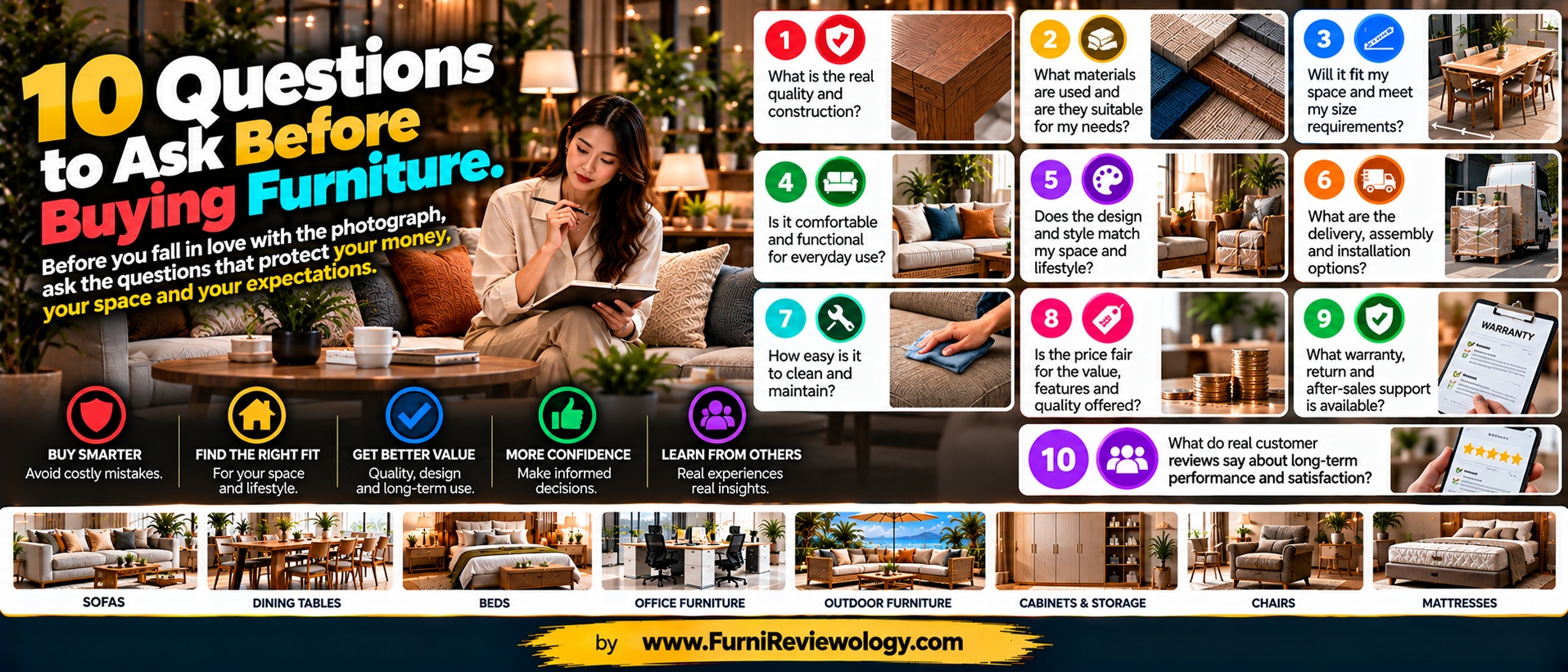
Furniture is not an impulse purchase for most people.
A sofa occupies a major part of a living room. A dining table can define an entire dining space. A bed affects how a bedroom functions. Office furniture can influence how a workplace operates. Outdoor furniture must withstand the environment in which it is placed.
Yet furniture is often purchased on one simple reaction:
“I like how it looks.”
That is not enough.
Whether you are buying from a furniture showroom, manufacturer, retailer, marketplace or online store, better questions lead to better information.
The following 10 questions can help buyers investigate before making a purchase.
1. Who Am I Actually Buying From?
Start with the seller.
Ask:
Who owns or operates the business?
Where is the company located?
How long has it been operating?
Can I contact someone directly?
Does it have a physical business presence?
What do customers say about its service?
Is the seller the manufacturer, retailer, distributor or marketplace seller?
For unfamiliar online sellers, the FTC recommends researching the company and product using searches such as the company name plus “review,” “complaint” or “scam.”
Why this matters
You are not only buying furniture.
You are entering into a transaction with a business.
The quality of that relationship can matter if something goes wrong.
2. What Exactly Am I Buying?
Never assume that the photograph tells the whole story.
Ask:
What exactly is included in the price?
Check:
product name;
model;
quantity;
dimensions;
accessories;
cushions;
covers;
hardware;
installation;
assembly;
warranty;
customisation.
A styled photograph might show a complete room while the listed price covers only one item.
Before paying, know exactly what will arrive.
3. Will It Actually Fit?
This question sounds obvious.
It is one of the easiest to overlook.
Measure the furniture and the space.
Check:
Width
Depth
Height
Seat height
Clearance
Doorway width
Hallway width
Lift/elevator dimensions
Stairway access
Don't measure only the room.
Measure the route from the delivery vehicle to the final location.
A sofa can fit perfectly inside your living room and still be impossible to bring through the front door.
The rule:
Measure twice. Order once.
4. What Is It Really Made From?
A product description saying “wood,” “leather,” “metal,” “rattan” or “fabric” may not provide enough information.
Ask for the actual specification.
For wood:
Solid wood?
Veneer?
MDF?
Particleboard?
Engineered wood?
Which species?
For upholstery:
What fabric?
What composition?
What filling?
What frame?
For outdoor furniture:
What material?
What finish?
What weather exposure is it designed for?
What maintenance is required?
For metal:
What type of metal?
What coating or finish?
What corrosion protection?
The more expensive the furniture, the more important the specification becomes.
5. What Do Real Customers Say About It?
Don't stop at the star rating.
Read the reviews.
Then read the critical reviews.
Then look elsewhere.
The FTC advises consumers to examine reviews across multiple sources and warns that some reviews and ratings can be fake, misleading or manipulated. It also recommends considering the reviewer, the source and the timing of reviews rather than relying on the rating alone.
Look for repeated comments about:
comfort;
durability;
colour;
construction;
assembly;
delivery;
packaging;
customer service;
actual appearance;
performance after use.
Don't ask only:
“How many stars?”
Ask:
“What was the actual experience?”
6. What Is the Total Cost?
The displayed price is not necessarily the final price.
Calculate:
Furniture
Delivery
Assembly
Installation
Taxes or duties, where applicable
Accessories
Other charges
The FTC recommends comparing the total cost, including shipping, handling, delivery, taxes and other fees.
Ask the seller:
“What is the complete amount I will have to pay to receive and use this furniture?”
That is the number you should compare.
7. When Will It Arrive—and What Happens If It Is Late?
A delivery date can be just as important as the price.
Especially when buying furniture for:
a new home;
renovation;
hotel opening;
restaurant opening;
office relocation;
property rental;
event;
commercial project.
Ask:
Is the item in stock?
Is it made to order?
When will production finish?
When will it ship?
What is the estimated delivery date?
What happens if the date changes?
Will the delivery team bring it inside?
Is assembly included?
The FTC advises consumers to check promised shipping times and keep records of delivery commitments.
Never build an important project around an unconfirmed delivery assumption.
8. What Happens If I Change My Mind?
Read the return policy before buying, not after.
Ask:
Can I return it?
How many days do I have?
Who pays return shipping?
Is there a restocking fee?
Are sale items returnable?
Are customised products returnable?
Are assembled products returnable?
Will I receive a refund or store credit?
The FTC specifically recommends checking return deadlines, return-shipping costs and possible restocking fees before purchasing.
Custom furniture requires particular attention.
A customised product may have different cancellation or return conditions from standard stock furniture.
Get those terms in writing.
9. What Happens If the Furniture Arrives Damaged or Is Not What I Ordered?
This question should be answered before payment.
Ask:
“What is your process if the furniture arrives damaged, incomplete, defective or materially different from what was advertised?”
Find out:
Who should be contacted?
How quickly must you report the problem?
Are photographs required?
Will the company repair it?
Will it replace it?
Will it refund it?
Who pays the collection or return cost?
When buying through an online marketplace, also check whether the marketplace itself offers dispute or refund protection. Different marketplaces provide different levels of buyer assistance.
Save your evidence.
Keep:
order confirmation;
invoice;
product listing;
photographs;
messages;
delivery documentation;
payment records.
10. Is This Furniture Right for the Way I Will Actually Use It?
This is the question buyers often forget.
A beautiful product can still be the wrong product.
Ask:
Where will it be used?
Indoor?
Outdoor?
Hotel?
Restaurant?
Office?
Home?
Rental property?
How heavily will it be used?
Occasionally?
Daily?
Commercially?
Who will use it?
Adults?
Children?
Guests?
Customers?
Employees?
What maintenance will it require?
Cleaning?
Re-finishing?
Covering?
Indoor storage?
Special treatment?
Does the warranty cover my intended use?
This is particularly important for commercial and hospitality furniture.
A product suitable for occasional residential use may not have the same requirements as furniture intended for intensive commercial environments.
The 10 Questions at a Glance
| Question | What You Need to Know |
|---|---|
| 1. Who am I buying from? | Seller identity, reputation and contact information |
| 2. What exactly am I buying? | Product, quantity, specifications and inclusions |
| 3. Will it fit? | Furniture dimensions and delivery route |
| 4. What is it made from? | Materials, construction and finish |
| 5. What do customers say? | Detailed and credible review experiences |
| 6. What is the total cost? | Product + delivery + taxes + additional charges |
| 7. When will it arrive? | Stock status, delivery schedule and service |
| 8. Can I return it? | Return period, shipping and restocking conditions |
| 9. What if something goes wrong? | Damage, defects, replacement and refund process |
| 10. Is it right for my use? | Environment, intensity, users, maintenance and warranty |
The 5-Minute Pre-Purchase Test
Before buying, especially an expensive piece of furniture, take five minutes and answer:
SELLER
Do I know who I'm buying from?
PRODUCT
Do I know exactly what I'm getting?
SPACE
Have I measured everything?
EXPERIENCE
Have I read meaningful customer experiences?
PROTECTION
Do I understand delivery, returns and warranty terms?
If you cannot answer these questions, slow down.
You do not have to reject the furniture.
You simply need more information.
Don't Let the Photograph Make the Decision
Furniture photography is designed to create desire.
That's its job.
But buyers need information as well as inspiration.
A photograph cannot tell you everything about:
construction;
comfort;
durability;
delivery;
customer service;
warranty;
return conditions;
long-term experience.
That is why furniture buying should move beyond:
See → Like → Buy
toward:
Discover → Research → Measure → Compare → Review → Verify → Decide
The Role of Furniture Reviews
This is where furniture reviews become particularly valuable.
A product specification tells you what the company says the product is.
A review can tell you what the buyer experienced.
Those are different forms of information.
A meaningful furniture review can explore:
Product expectations → Purchase → Delivery → Assembly → First use → Performance → Customer service → Long-term experience
That creates a much richer picture than a star rating alone.
A rating gives you a number.
A review can give you context.
And context matters when the purchase involves hundreds or thousands of dollars.
Buyers: Ask Before You Pay
Don't be embarrassed to ask questions.
Ask the retailer.
Ask the manufacturer.
Ask the designer.
Ask the marketplace seller.
Ask for specifications.
Ask for photographs.
Ask about delivery.
Ask about warranty.
Ask about returns.
Ask what happens if something goes wrong.
A professional seller should be able to explain the important terms of the transaction.
If the answers remain unclear, that information itself is useful.
Uncertainty is a reason to investigate—not a reason to rush.
Furniture Companies: Make These Questions Easy to Answer
There is also a lesson here for the furniture industry.
If buyers repeatedly ask:
What is it made from?
What are the dimensions?
When will it arrive?
What is included?
What is the warranty?
Can I return it?
then furniture companies should make those answers easy to find.
A strong furniture product page should not force buyers to send five emails simply to understand the product.
Better information creates better buying conditions.
Manufacturers, brands and retailers should consider publishing:
complete dimensions;
materials;
specifications;
care instructions;
delivery terms;
warranty information;
return conditions;
clear photographs;
assembly information;
relevant certifications;
frequently asked questions.
The Connected Furniture Buying Journey
The modern furniture buyer increasingly needs several types of information.
FISE — Discovery
Who makes this?
Where are they?
What do they manufacture?
What capabilities do they have?
TFT — Story
Who are they?
What are they launching?
What are they doing?
What is happening in the industry?
FurniReviewology — Trust
What are the experiences?
What do buyers say?
What should I understand before deciding?
Together:
Find → Understand → Review → Decide
That is a more useful furniture information journey than simply looking at a photograph and clicking “Buy.”
The Final Question
After asking all ten questions, there is one final question:
“Do I have enough information to make my own decision?”
If yes, you can move forward with greater clarity.
If no, keep researching.
There is no prize for buying furniture fastest.
Take your time before making an expensive commitment.
The objective is not to eliminate every possible risk.
It is to replace guesswork with information.
The Global Furniture Ecosystem
The Furniture Industry is a $1 Trillion USD Ecosystem in the world
Furniture Industry Search Engine — FISE helps the world find them.
The Furniture Times — TFT tells their story.
FurniReviewology helps the world trust them.
Before buying furniture:
Ask.
Measure.
Research.
Compare.
Review.
Verify.
Then decide.
The better the questions, the better informed the furniture decision.