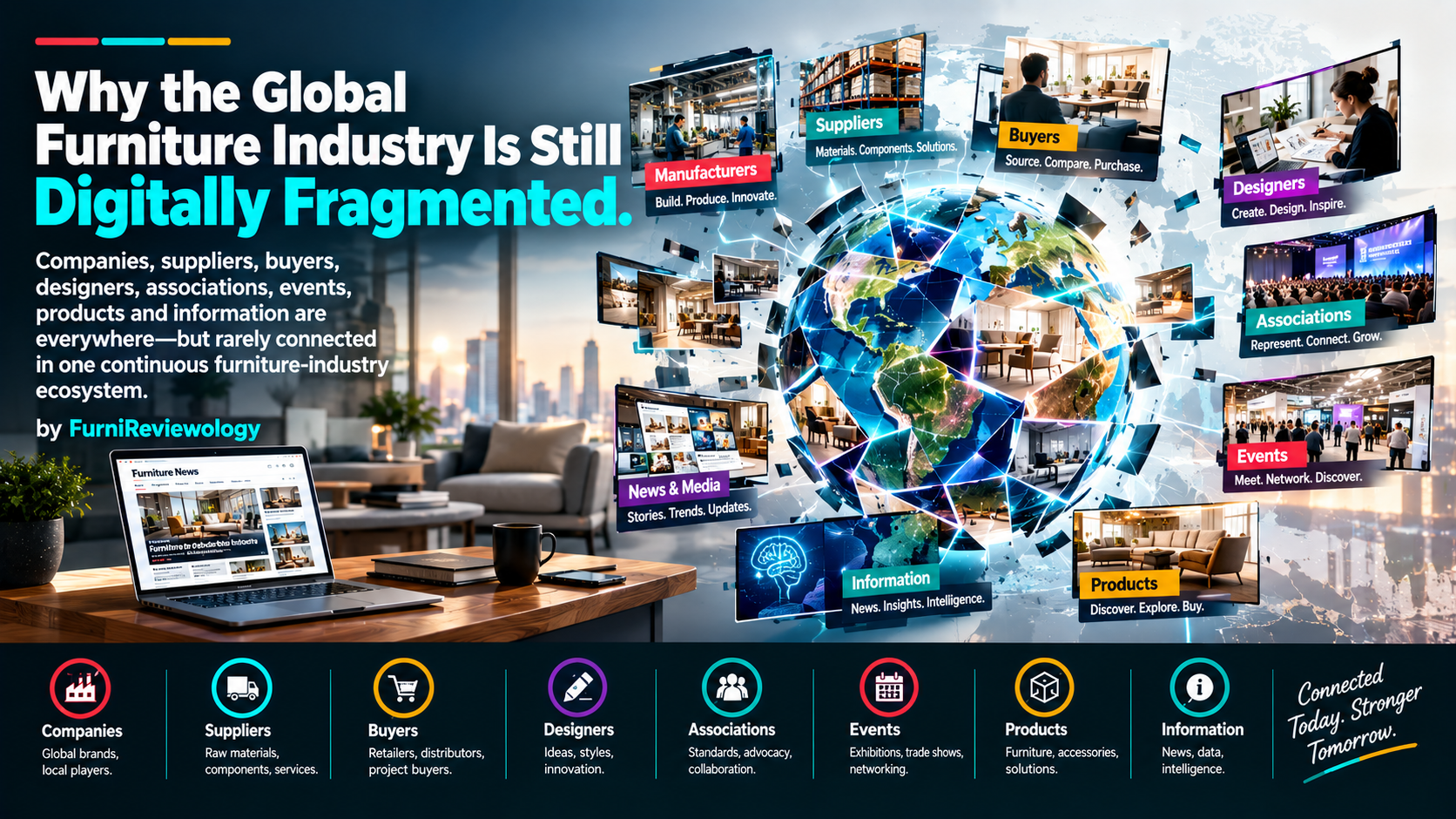
By The Furniture Times (TFT) Editorial Desk | Furniture Industry Ecosystem | Digital Fragmentation | Furniture Business | Global Sourcing | Industry Visibility | Furniture Technology
The global furniture industry is not disconnected.
It is connected in thousands of different ways.
Manufacturers sell to buyers.
Suppliers serve manufacturers.
Designers work with factories.
Architects specify products.
Retailers source from wholesalers.
Hotels purchase from contract-furniture suppliers.
Associations represent companies.
Trade fairs bring buyers and exhibitors together.
Universities educate future professionals.
Startups develop new technologies.
Media organizations publish industry news.
And businesses communicate every day through websites, email, social media, marketplaces, catalogues, trade portals and messaging applications.
The physical and commercial furniture ecosystem is therefore highly interconnected.
But digitally, something different is happening.
The information is fragmented.
A company may have one website.
Its products may appear on another platform.
Its latest news may be on LinkedIn.
Its catalogue may be a PDF.
Its trade-fair profile may exist for only a few days or weeks.
Its association membership may appear on an association website.
Its reviews may exist somewhere else.
Its factory capabilities may not be published at all.
Its executives may be visible on social media.
Its job vacancies may be posted on a recruitment platform.
Its events may appear on a completely separate calendar.
Its suppliers may be discovered through personal relationships.
And its buyers may be searching across all of these channels simultaneously.
This is the digital fragmentation problem.
The Furniture Industry Has Plenty of Information
The problem is not that furniture information does not exist.
There is an enormous amount of it.
The problem is that the information often lives in separate information islands.
Consider a furniture manufacturer.
A buyer might discover:
the company website through Google;
its latest collection through Instagram;
its factory capabilities through a trade-fair exhibitor page;
its catalogue through a PDF;
its company news through a press release;
its management team through LinkedIn;
its association membership through an industry council;
its reviews through another website;
and its contact details through a completely different source.
The buyer has to assemble the picture.
The company does not necessarily control the journey.
This is not unique to one country.
It is a structural challenge created by the way the internet evolved: information was published wherever individual organizations found it useful to publish it.
The result is a massive collection of valuable information—but not necessarily a single, connected furniture-industry information layer.
Fragmentation Starts With the Company
The first level of fragmentation is the individual business.
A furniture company may maintain multiple digital identities:
Website
Social media
Marketplace account
Trade-fair profile
Business directory
Catalogue
PDF brochures
Press releases
Video channels
Recruitment profiles
Association membership
Customer-review platforms
Each channel may serve a legitimate purpose.
The problem begins when these identities do not connect properly.
A product may have one name on a catalogue and another on a marketplace.
A company may describe itself as a manufacturer in one place and as a wholesaler somewhere else.
Its capabilities may be clearly explained in a brochure but absent from its website.
Its current contact information may exist on one platform while an older version remains elsewhere.
Its latest products may be visible socially but difficult to discover through broader industry searches.
The information exists—but the information architecture is weak.
Then Comes the Supplier Problem
Furniture manufacturing is not simply about the finished product.
Behind every table, sofa, bed, chair or cabinet can be a network of:
timber suppliers
panel manufacturers
veneer suppliers
metal companies
foam producers
fabric suppliers
leather suppliers
hardware manufacturers
glass suppliers
finishing specialists
machinery companies
packaging providers
logistics companies
component manufacturers
These businesses may be essential to the furniture supply chain.
Yet a buyer searching for a particular capability may not know where to look.
A specialist component manufacturer may have an excellent factory but a limited digital presence.
A small upholstery workshop may have decades of experience but no searchable structured profile.
A machinery supplier may be well known within a regional network but almost invisible internationally.
This creates what can be called the hidden supplier problem:
The right supplier may exist, but the buyer may not know how to find it.
Buyers Are Forced to Become Information Investigators
Now consider the problem from the buyer's side.
Suppose a hotel developer needs furniture for a new project.
The buyer may need:
outdoor furniture
guest-room furniture
restaurant furniture
lounge seating
custom pieces
lighting
materials
replacement components
The buyer may search Google.
Then LinkedIn.
Then trade-fair websites.
Then industry directories.
Then social media.
Then supplier websites.
Then association databases.
Then personal contacts.
Then perhaps a sourcing agent.
Then emails.
Then phone calls.
Then spreadsheets.
Then another round of verification.
This can work.
The global furniture industry has been doing it for years.
But it is not necessarily an efficient digital information journey.
Major trade platforms demonstrate both the strength and the limits of specialized channels. MIFF, for example, connects hundreds of exhibitors with thousands of international buyers and has added digital tools alongside its physical exhibition.
That is valuable.
But a four-day exhibition, an association database, a company website and a social-media profile each solve different parts of the problem.
The broader question is:
Where does the information connect when the exhibition ends?
Trade Fairs Are Powerful—but Temporary
Furniture trade fairs remain central to international sourcing.
They bring together manufacturers, buyers, designers, associations, media and other industry participants in one physical environment.
MIFF describes itself as a major sourcing platform connecting global buyers with furniture manufacturers and reports participation from hundreds of exhibitors and buyers from more than 140 countries and regions.
EFE similarly positions its exhibition as a sourcing and business platform connecting Malaysian furniture manufacturers with international buyers.
These platforms are important.
But there is a fundamental difference between:
an industry meeting place
and
a permanent industry information layer.
An exhibition has dates.
A digital industry ecosystem can remain accessible throughout the year.
A trade fair can introduce a company.
A connected industry platform can continue carrying that company's identity, news, products, opportunities and information beyond the event.
The future does not require choosing between physical events and digital platforms.
It requires connecting them.
Associations Have Information—but It Is Often Institution-Specific
Furniture associations perform essential industry functions.
They represent members.
They organize exhibitions.
They conduct training.
They communicate with governments.
They support trade development.
They promote industry interests.
For example, the Malaysian Furniture Council lists activities including exhibitions, seminars, training, educational courses and international affiliations.
The Singapore Furniture Industries Council likewise maintains information about major trade platforms and furniture-related industry activities.
These organizations provide valuable information.
But every association naturally operates within its own membership, geography and organizational purpose.
That means a global furniture buyer may still need to move from:
Association A → Association B → Trade Fair C → Directory D → Company Website E.
The information is useful.
The journey remains fragmented.
Designers Live in Another Information World
Furniture designers have their own ecosystem.
Their work may appear through:
design studios
architecture websites
design publications
social media
competitions
exhibitions
portfolios
universities
manufacturer collaborations
A designer may be deeply influential but difficult to discover by someone searching specifically for furniture expertise.
A manufacturer may be looking for a designer.
A hotel may be looking for a design consultant.
A furniture brand may be looking for a product-development partner.
A design student may be looking for an industry mentor.
All of these people may be part of the same furniture ecosystem.
Yet their digital identities frequently remain separated.
The industry knows these people exist.
The wider digital ecosystem does not always make them easy to discover.
Events Are Fragmented Too
The furniture industry does not have one event.
It has thousands of events across the world.
Trade fairs.
Design weeks.
Exhibitions.
Conferences.
Seminars.
Awards.
Buyer missions.
Business forums.
Factory tours.
Networking events.
Educational programmes.
Startup events.
A company operating internationally may need to monitor multiple calendars just to understand what is happening.
And events are not isolated from the rest of the industry.
An event involves:
Organizers + exhibitors + buyers + designers + speakers + associations + media + sponsors + products + launches + opportunities.
Yet these elements often live on separate pages, platforms and databases.
The event exists.
The participants exist.
The products exist.
The stories exist.
But the connections between them can disappear when the event closes.
News Is Fragmented Across the Industry
Furniture news is another major information island.
A company announcement may appear on its own website.
Another story may appear in a trade publication.
A market announcement may be published by an association.
An event update may appear on an exhibition website.
A product launch may appear on social media.
A CEO interview may appear in a magazine.
A regulatory update may appear on a government website.
A technology announcement may appear on a technology publication.
The furniture professional therefore becomes responsible for monitoring multiple information streams.
This creates an important opportunity for specialized furniture media.
A furniture platform should not merely publish stories.
It can help organize the industry's stories.
The Fragmentation Problem Is Also a Vocabulary Problem
There is another layer that is easy to overlook.
Different companies describe similar capabilities differently.
One company may say:
Hospitality Furniture
Another:
Hotel Furniture
Another:
Contract Furniture
Another:
Project Furniture
Another:
Commercial Furniture
All may be relevant to the same buyer.
The same problem occurs with materials, manufacturing processes, product categories and markets.
This matters because discovery depends not only on whether information exists—but also on whether the information can be understood in the language used by the person searching.
As digital search becomes more sophisticated, structured and consistent business information becomes increasingly important.
The office-furniture sector's current work around Digital Product Passports illustrates a related challenge: product and value-chain data must be organized so that it can be usable, reliable and trustworthy across the value chain.
The lesson is broader than product passports.
Information architecture is becoming part of industry infrastructure.
Fragmentation Is Not the Same as Competition
This distinction matters.
The furniture industry does not need every organization to become part of one commercial company.
It does not need every association to merge.
It does not need every trade fair to become identical.
It does not need every furniture company to use the same business model.
Competition is healthy.
Different platforms can specialize.
Different countries can have different industry bodies.
Different trade fairs can serve different markets.
Different publications can have different editorial approaches.
The problem is not diversity.
The problem is disconnected information.
A connected ecosystem can actually preserve diversity while making discovery easier.
The Global Trade Environment Makes Connectivity More Important
The broader global trading environment is itself becoming more complex.
The World Economic Forum's 2026 TradeTech Paradox report describes a world experiencing both increasing digital connectivity and growing fragmentation in global trade, highlighting the need for technology and cooperation to work together.
The furniture industry operates inside that wider environment.
Companies are dealing with changing markets, trade relationships, logistics, technology and sourcing requirements.
In such an environment, knowing where information is becomes almost as important as having the information itself.
The Real Problem: Information Exists in Islands
Think of the furniture ecosystem as an archipelago.
There is an island for:
Companies.
Another for:
Products.
Another for:
News.
Another for:
Trade fairs.
Another for:
Associations.
Another for:
Designers.
Another for:
Jobs.
Another for:
Education.
Another for:
Classifieds.
Another for:
Reviews.
Another for:
Startups.
Another for:
Suppliers.
Another for:
Buyers.
The islands are full of activity.
But the bridges between them are incomplete.
That is the digital fragmentation problem.
What Would a Connected Furniture Ecosystem Look Like?
A more connected ecosystem would allow information to travel naturally.
Imagine a manufacturer profile.
From that one profile, a visitor could discover:
Company
↓
Products
↓
Catalogue
↓
Capabilities
↓
News
↓
Interviews
↓
Events
↓
Reviews
↓
Contacts
↓
Opportunities
The same company could then be discoverable through different entry points.
A buyer could begin with a product.
A journalist could begin with a company story.
A designer could begin with a capability.
A procurement professional could begin with a country.
A student could begin with a career.
An investor could begin with a startup.
The information does not need to exist in one page.
It needs to be connected.
This Is Where TFT's Ecosystem Vision Begins
The Furniture Times is built around a broader proposition:
The furniture industry should have a digital environment designed specifically around the way the furniture industry actually works.
That means connecting multiple layers.
TFT — The Story Layer
News, press releases, interviews, features and industry intelligence.
FISE — The Discovery Layer
Companies, products, categories, countries, capabilities and industry search.
FurniReviewology — The Trust Layer
Reviews, experiences, reputation and buyer information.
TFT Business Directory
Companies and industry identities.
TFT Catalogue
Products, collections and catalogues.
TFT Classifieds
Buy, sell, source, supply and business opportunities.
TFT Academy
Courses, training and professional development.
TFT Jobs
Jobs, careers and professional resumes.
TFT Awards
Recognition and industry participation.
TFT Events
Trade fairs, exhibitions, conferences and business events.
TFT Business Tours
Factories, furniture capitals, sourcing markets and industry visits.
TFT Associations & Councils
Industry organizations and professional bodies.
TFT Startup Ecosystem
Emerging companies, FurnitureTech, AI, DesignTech and ManufacturingTech.
The objective is not to eliminate the specialist platforms already serving these functions.
It is to create a connected furniture-industry layer where these pieces can be easier to discover together.
The Company That Is Invisible in One Place Can Become Visible in Many
This creates an important opportunity for smaller companies.
A global furniture ecosystem should not be built only around the largest brands.
It should also provide pathways for:
SMEs.
Factories.
Workshops.
Artisans.
Component manufacturers.
Specialist suppliers.
New designers.
Startups.
New exporters.
Emerging brands.
A company does not need to be famous before it can be discoverable.
It needs information that explains:
Who it is.
Where it is.
What it does.
What it makes.
Who it serves.
What capabilities it has.
How it can be contacted.
That is the foundation of a searchable digital identity.
The Action Plan for Furniture Companies
Digital fragmentation cannot be solved by one platform alone.
Every company has a role.
Start with the basics.
1. Create One Consistent Company Identity
Use the same company name, description, location and contact information across major channels.
2. Explain What You Actually Do
Do not simply say:
“Furniture Manufacturer.”
Explain the categories, materials, capabilities and industries you serve.
3. Make Your Products Discoverable
List product categories and collections in language buyers actually use.
4. Document Your Capabilities
Tell buyers what your factory can produce—not only what is currently in your showroom.
5. Connect Your Digital Channels
Your website, catalogue, social profiles, event profiles and industry listings should reinforce one another.
6. Publish Your News
Do not keep major developments hidden inside the company.
7. List Your Business on Industry Platforms
A structured industry profile can provide another discovery pathway.
8. Participate in Industry Events
But do not allow your visibility to disappear when the event ends.
9. Build Your Professional Network
Digital discovery should support—not replace—human relationships.
10. Start Now
Do not wait until a buyer asks:
“Where can I find a supplier like you?”
The Now-or-Never Lesson
“Now or never” does not mean every furniture company must immediately abandon existing channels.
It means something more practical:
The digital environment is evolving.
Search is evolving.
AI-assisted discovery is evolving.
Buyer expectations are evolving.
Product information requirements are evolving.
Global sourcing is evolving.
Companies that continue treating their digital presence as a collection of disconnected pages may make it harder for others to understand the full value of what they offer.
The opportunity is to start organizing that information now.
Not when the next buyer arrives.
Not when the next trade fair begins.
Not when a competitor launches a new platform.
Not when AI becomes the dominant discovery interface.
Start building the digital identity today.
From Fragmentation to Connection
The global furniture industry does not need to become less diverse.
It needs to become easier to navigate.
The manufacturer should be connected to the product.
The product should be connected to the company.
The company should be connected to its story.
The story should be connected to its people.
The people should be connected to opportunities.
The opportunity should be connected to the buyer.
The buyer should be able to discover the supplier.
And after discovery, the buyer should have better information with which to evaluate trust.
That is the journey:
Story → Discovery → Information → Connection → Trust → Opportunity
The Furniture Industry Is Too Important to Remain Digitally Scattered
The industry already has the companies.
It already has the products.
It already has the people.
It already has the events.
It already has the associations.
It already has the knowledge.
It already has the buyers.
It already has the technology.
It already has the stories.
What remains is connecting the information.
That is the opportunity.
The Furniture Times is building the story layer.
FISE — Furniture Industry Search Engine is building the discovery layer.
FurniReviewology is building the trust layer.
Together, they represent a broader vision for a connected furniture ecosystem.
Your Company Is Part of the Solution
If you manufacture furniture, list your company.
If you supply components, list your capabilities.
If you are a designer, build your professional identity.
If you operate a furniture brand, tell your story.
If you organize an event, submit your event.
If you represent an association, list your organization.
If you offer education, bring your courses to the industry.
If you have jobs, list them.
If you are building a startup, make it discoverable.
If you have products, list them.
If you have a catalogue, make it available.
If you have industry news, submit it.
If you have expertise, share it.
Don't add another disconnected information island.
Help build the bridge.
The Global Furniture Ecosystem
The Furniture Industry is a $1 Trillion USD Ecosystem in the world.
The industry is already connected through factories, products, trade, people and markets.
The next challenge is connecting the digital information surrounding those relationships.
Furniture Industry Search Engine — FISE helps the world find them.
The Furniture Times — TFT tells their story.
FurniReviewology helps the world trust them.