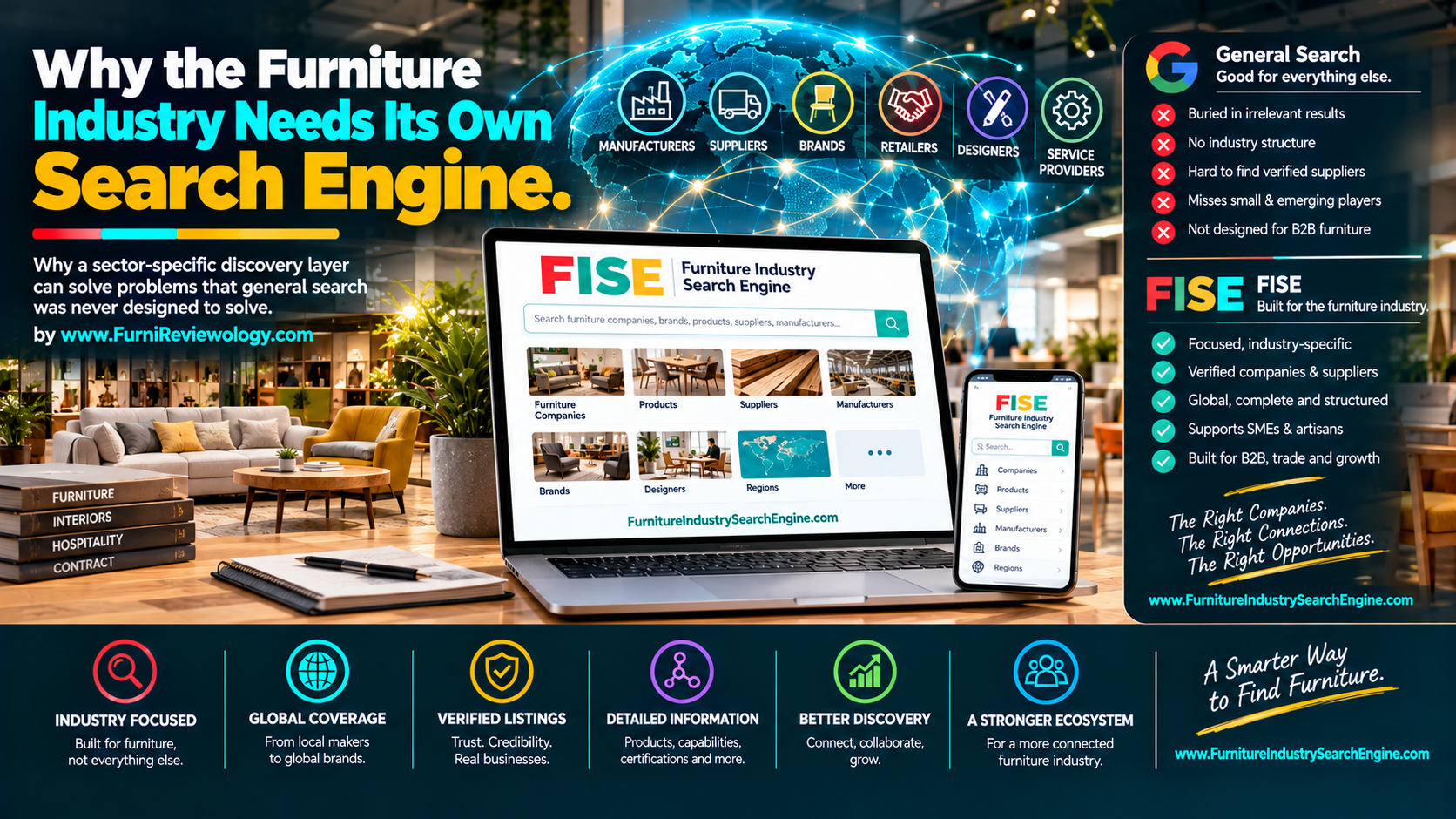
By The Furniture Times (TFT) Editorial Desk | Furniture Search | FISE | Searchology | Furniture Industry | Digital Discovery | Global Sourcing
The global furniture industry has a search problem.
Not because there are no search engines.
There are.
The problem is that the furniture industry is too specialised, too fragmented and too structurally complex to rely on generic discovery alone.
A buyer looking for a furniture manufacturer is not simply looking for a website.
A procurement team looking for a supplier is not simply looking for a company name.
A hotel looking for a contract furniture partner is not necessarily looking for the most famous furniture brand.
A designer looking for a specialist manufacturer may not even know what company to search for.
They know what they need.
They know the material.
They know the product.
They know the quantity.
They know the location.
They know the required capability.
They know the market.
They know the project.
But they may not know who can do it.
That is the problem a furniture-specific search and discovery layer can address.
And that is the fundamental thinking behind FISE — Furniture Industry Search Engine.
This Is Not an Argument Against General Search
Let's make one thing clear.
General search engines are enormously useful.
FISE does not need to replace them.
It does not need to compete with every search query on the internet.
The proposition is different:
A specialised industry can benefit from a specialised discovery environment designed around its own structure.
Think about other sectors.
People use general search to find information about almost everything.
But professionals also use specialised systems for:
medical research;
scientific literature;
financial information;
travel;
property;
jobs;
academic research;
industrial sourcing;
e-commerce;
professional services.
Why?
Because specialisation changes the quality and structure of discovery.
Furniture deserves the same thinking.
The Furniture Industry Is Not One Product
This is the first reason.
When someone says:
“I need furniture.”
That statement is almost meaningless.
What furniture?
A sofa?
A dining table?
A hotel bed?
An office workstation?
An outdoor chair?
A hospital cabinet?
A school desk?
A restaurant table?
A mattress?
A custom reception counter?
A furniture component?
A piece of machinery?
A material?
A replacement part?
The furniture ecosystem contains thousands of product types, materials, applications and business relationships.
A useful discovery layer therefore needs to understand context.
The Buyer Does Not Always Know the Supplier's Name
This is perhaps the biggest argument for specialised discovery.
Imagine a hotel developer in another country needs:
500 outdoor chairs + 100 tables + custom colours + commercial-grade materials + export capability.
The buyer may not know a single suitable manufacturer's name.
Searching for:
“Furniture manufacturer”
may produce an enormous number of results.
Searching for:
“outdoor hospitality furniture manufacturer”
is better.
But even that may not answer everything.
The buyer may also need:
country;
city;
production capability;
MOQ;
customisation;
material;
export markets;
project experience;
lead time;
business type;
catalogue;
contact details.
This is no longer simply a keyword problem.
It is a business discovery problem.
The Industry Has Its Own Vocabulary
Furniture professionals speak a different language from ordinary consumers.
Consider terms such as:
OEM
ODM
contract furniture
hospitality furniture
commercial furniture
casegoods
upholstery
joinery
components
hardware
foam
veneer
solid wood
rattan
outdoor-grade materials
custom manufacturing
project furniture
flat-pack
knock-down furniture
institutional furniture
furniture fittings
contract manufacturing
These terms carry specific meaning inside the industry.
A sector-specific search environment can be designed around these concepts rather than treating every furniture business as a generic webpage.
That is one of the principles behind FISE's Searchology approach: organising furniture businesses around industry-specific categories, locations, capabilities and business information.
Search the Way Furniture Buyers Actually Think
The biggest opportunity is to move beyond:
“Search by company name.”
toward:
“Search by requirement.”
Imagine a buyer wants:
Product: Outdoor dining chair
Industry: Hospitality
Material: Aluminium + synthetic fibre
Capability: Commercial production
Market: Export
Location: Southeast Asia
The buyer is not really searching for a company.
The buyer is searching for a combination of characteristics.
That is what an industry-specific discovery layer can organise.
Furniture Search Should Understand Business Types
The furniture industry is not made up of one type of business.
A search environment should distinguish between:
Manufacturer
Makes the product.
Supplier
Provides materials, components or products.
Exporter
Serves international markets.
Importer
Brings products into a market.
Retailer
Sells to end customers.
Wholesaler
Distributes products.
Designer
Creates designs or specifications.
Artisan
Produces specialised or handcrafted work.
Component Manufacturer
Produces parts used by other furniture companies.
Machinery Supplier
Provides production equipment.
Logistics Provider
Moves, stores or installs furniture.
Technology Company
Provides software, automation, AI or other technology.
Association
Represents an industry or professional community.
Startup
Develops new products, technologies or business models.
A generic search result does not necessarily organise these roles around the furniture supply chain.
A furniture search engine can.
Search by Capability, Not Just Category
This is where the concept becomes even more powerful.
Suppose a buyer needs a company capable of:
high-volume custom manufacturing.
The company might describe itself as:
a furniture manufacturer;
a contract manufacturer;
an OEM supplier;
a hospitality supplier;
a custom furniture producer.
The words may differ.
The underlying capability may be similar.
A specialised discovery system can attempt to organise businesses around what they can actually do, not merely what they call themselves.
That means a furniture search engine can potentially support searches such as:
Manufacturers capable of producing custom hotel furniture.
Suppliers of furniture hardware in a specific country.
Exporters specialising in outdoor furniture.
Companies manufacturing components for upholstered furniture.
Designers specialising in hospitality projects.
Machinery suppliers serving furniture factories.
This is the difference between:
finding a page
and
finding a capability.
Geography Matters Enormously in Furniture
Furniture is a physical industry.
Location matters.
A buyer may care about:
country;
state;
province;
city;
industrial cluster;
port access;
manufacturing region;
export market.
A buyer sourcing furniture from Malaysia has different logistical considerations from a buyer sourcing from Italy, India, Vietnam, China, Turkey, Poland, Mexico or the United States.
The global furniture industry is geographically distributed.
A useful discovery layer therefore needs to make geography part of the search experience.
FISE's current business profiles illustrate this model by structuring company information around location, business category and other industry attributes.
The Furniture Industry Has a Hidden Long Tail
Search naturally favours businesses with strong digital footprints.
That can create a problem.
A highly capable small manufacturer may have:
an old website;
limited SEO;
little social-media activity;
no international marketing department;
few backlinks;
minimal digital PR.
But it may have excellent manufacturing capabilities.
Meanwhile, a larger company may have a much stronger digital presence.
That does not automatically mean the larger company is more suitable for a particular buyer.
This creates an important principle:
Digital visibility and manufacturing capability are not the same thing.
A furniture-specific industry platform can provide another route for smaller businesses to document what they actually do.
This is particularly relevant to SMEs, workshops, artisans and specialist suppliers that may otherwise remain difficult to discover. TFT's Searchology coverage has specifically highlighted the challenge of digitally invisible furniture businesses.
Trade Fairs Are Powerful—But Temporary
Furniture trade fairs remain important places for discovery.
They create:
meetings;
product launches;
buyer connections;
demonstrations;
networking;
negotiations;
relationships.
But the physical event eventually ends.
The exhibition hall closes.
The booths disappear.
People fly home.
Business cards go into drawers.
Contacts become scattered.
A digital discovery layer can provide continuity.
Instead of:
Trade Fair → Meeting → Business Card → Forgotten
the industry can move toward:
Trade Fair → Company Discovery → Digital Profile → Product Information → Continued Contact
FISE does not replace trade fairs.
It can complement them.
The physical industry and digital industry should reinforce each other.
Personal Networks Are Valuable—But They Have Limits
Furniture is a relationship-driven industry.
That is not a weakness.
Relationships create trust.
Experience creates confidence.
Referrals reduce uncertainty.
But a new buyer entering the industry may not have those relationships.
A startup may not have them.
A young procurement professional may not have them.
An international buyer entering a new market may not have them.
A furniture-specific search engine can reduce the dependency on:
“Who do you know?”
and introduce another starting point:
“What exactly are you looking for?”
That does not eliminate relationships.
It can create more opportunities for relationships to begin.
The Search Problem Is Also a Language Problem
Imagine two companies.
Company A describes itself as:
“Manufacturing specialist in outdoor seating solutions.”
Company B describes itself as:
“Commercial outdoor furniture producer.”
Company C says:
“Patio furniture manufacturer.”
Company D says:
“Hospitality outdoor furniture supplier.”
A buyer may need essentially similar capabilities but encounter four different vocabularies.
This is why industry taxonomy matters.
A specialised search environment can create common categories and relationships between related terms.
That can make the industry easier to navigate.
Product Search Is Only One Part
A true furniture discovery layer should not stop at:
“Find a sofa.”
It should eventually help people discover:
Companies
Who makes it?
Products
What do they make?
Capabilities
What can they customise?
Materials
What is it made from?
Locations
Where is it produced?
Markets
Where is it sold or exported?
Industries
Who is it designed for?
People
Who designs or manufactures it?
Stories
What is happening inside the company?
Reviews
What experiences have buyers reported?
Events
Where can the company be met?
Opportunities
What jobs, partnerships, products or commercial opportunities exist?
This is where FISE becomes part of a broader furniture information architecture.
Search + Journalism + Reviews
A furniture search engine becomes even more useful when connected to other forms of industry information.
This is where the TFT Group's three-layer model becomes important.
TFT — The Furniture Times
The Story Layer
Tells the industry what is happening.
Company stories.
News.
Interviews.
Press releases.
Analysis.
People.
Events.
Industry developments.
FISE
The Discovery Layer
Helps people find:
Companies.
Products.
Categories.
Capabilities.
Locations.
Markets.
Services.
FurniReviewology
The Trust Layer
Helps people explore:
Reviews.
Experiences.
Reputation.
Buyer perspectives.
Company performance information.
The resulting journey becomes:
Story → Search → Trust
Or:
Read → Find → Evaluate
That is much more powerful than treating each platform as an isolated website.
Why Furniture Companies Should Care
This is not only a buyer problem.
It is a business problem.
Ask yourself:
Can a buyer find your company without knowing your name?
If the answer is no, you have a discoverability problem.
Can they understand:
what you manufacture?
Can they identify:
where you are?
Can they see:
what markets you serve?
Can they understand:
your capabilities?
Can they find:
your products?
Can they discover:
your company story?
Can they evaluate:
your credibility?
If the answer to several of these questions is no, your company may be digitally present but commercially difficult to discover.
Why “Being Online” Is No Longer Enough
For years, the basic digital advice was:
Get a website.
That remains important.
But the digital economy has moved beyond that.
A business can have a website and still be difficult to discover.
It can have social media and still be difficult to discover.
It can have a catalogue and still be difficult to discover.
It can attend trade fairs and still be difficult to discover six months later.
It can have excellent products and still be difficult to discover.
The new question is:
Is your business information structured around the way people actually search for furniture?
That is the problem FISE is designed to address.
The AI Era Makes Industry Structure More Important
Search is also evolving toward conv