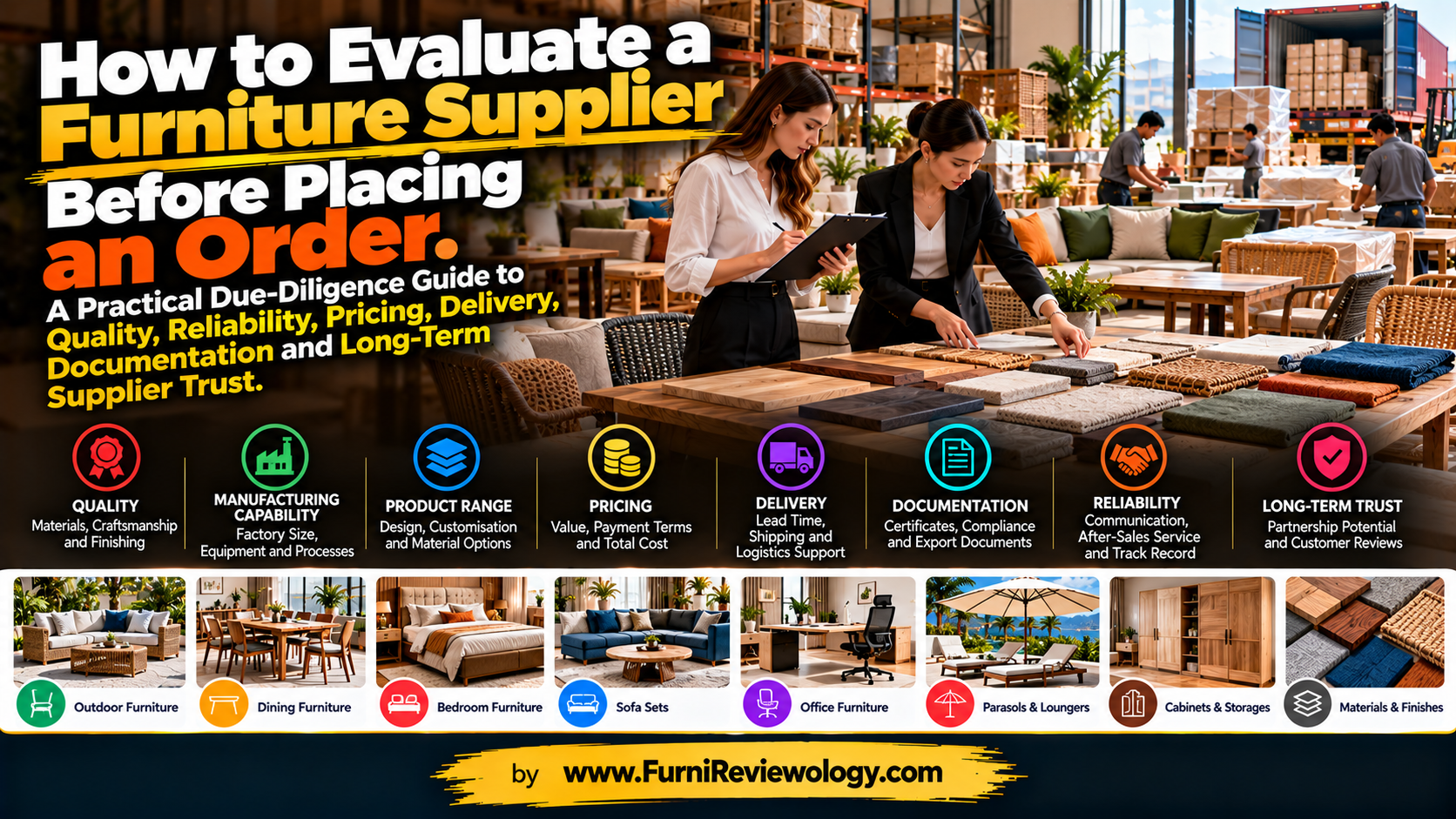
Choosing a furniture supplier is one of the most important decisions a buyer can make before placing an order.
Whether you are purchasing a single collection, furnishing a hotel, stocking a retail store, supplying an interior-design project, importing containers or establishing a long-term sourcing relationship, the supplier you choose can directly affect your costs, timelines, customer satisfaction and reputation.
A supplier may offer attractive furniture.
The price may look competitive.
The catalogue may be impressive.
The salesperson may respond quickly.
The website may look professional.
But none of these factors, by themselves, answer the most important question:
Can this supplier reliably deliver what you are actually paying for?
That question requires due diligence.
Evaluating a furniture supplier should therefore go beyond comparing quotations. Buyers should examine the supplier's identity, product quality, manufacturing or sourcing arrangements, materials, communication, commercial terms, delivery capability, documentation, warranty, reputation, problem-solving practices and long-term reliability.
The objective is not to find a supplier that appears perfect.
The objective is to gather enough relevant evidence to make an informed purchasing decision.
1. Start With the Supplier's Identity
Before discussing price, establish who the supplier actually is.
Depending on the market and type of transaction, buyers should look for information such as:
Legal business name
Registered business information where appropriate
Physical business address
Warehouse or factory address where relevant
Telephone number
Professional email address
Website
Product categories
Business history
Markets served
Sales representatives
Manufacturing or sourcing locations
A supplier that cannot clearly explain its identity creates unnecessary uncertainty.
This does not mean that a small furniture business without a sophisticated website is automatically unreliable.
Many legitimate businesses operate with modest digital infrastructure.
The important issue is traceability.
Can the buyer establish who the supplier is and how to contact the business if a problem occurs?
2. Understand What Kind of Supplier You Are Dealing With
The word supplier can describe several different business models.
A supplier may be:
A furniture manufacturer
A wholesaler
An importer
An exporter
A distributor
A trading company
A retailer
A sourcing agent
A marketplace seller
A combination of several of these
This distinction matters.
If a supplier is not the manufacturer, the buyer should understand where the furniture comes from.
Important questions include:
Who manufactures the product?
Where is it manufactured?
Who controls quality?
Who handles warranty claims?
Who is responsible for replacing defective goods?
Can the supplier provide consistent future supply?
There is nothing inherently wrong with buying through an intermediary.
But the commercial relationship should be understood before money changes hands.
3. Verify the Product You Are Actually Buying
Furniture catalogues can create confusion.
Two products may look almost identical in photographs while being significantly different in:
Materials
Dimensions
Construction
Hardware
Foam density
Fabric
Finishing
Weight
Structural strength
Outdoor suitability
Warranty
Packaging
Therefore, buyers should establish exactly what the quotation refers to.
A useful product specification may include:
Product name
Model number
Dimensions
Materials
Finish
Color
Upholstery
Hardware
Weight capacity where applicable
Assembly requirements
Packaging
Quantity
Unit price
The more valuable or complex the order, the more important detailed specifications become.
4. Do Not Evaluate Furniture Only From Photographs
Photography is useful for discovering furniture.
It is not a complete quality-control system.
A photograph may not reveal:
Joint construction
Material thickness
Hardware quality
Backside construction
Internal framing
Foam density
Weld quality
Surface preparation
Packaging quality
Stability
Actual dimensions
Whenever practical, request samples or detailed technical information before committing to a large order.
For custom furniture, approved samples can be especially important.
5. Ask About Materials
Material transparency is fundamental to furniture purchasing.
Buyers should understand what they are actually receiving.
For wooden furniture, questions might include:
Is it solid wood?
What wood species is used?
Is veneer used?
Is plywood used?
Is MDF or particleboard used?
Where are important structural components made?
For upholstered furniture:
What type of frame is used?
What foam is used?
What fabric is specified?
What are the upholstery details?
For outdoor furniture:
Is the frame aluminium, steel or another material?
What treatment protects metal surfaces?
Is the material intended for outdoor exposure?
What maintenance is required?
For metal furniture:
What metal is used?
How are joints constructed?
What finishing system is applied?
Is corrosion resistance relevant to the intended environment?
The correct questions depend on the product.
The principle is the same:
Know what you are buying.
6. Evaluate Construction, Not Just Appearance
Furniture quality is often hidden beneath the visible surface.
Buyers should examine construction where possible.
Depending on the product, this may include:
Frames
Are structural components appropriate for the intended load?
Joinery
Are connections properly constructed?
Hardware
Are hinges, slides, fasteners and fittings suitable?
Upholstery
Are stitching, seams, foam and internal structures appropriate?
Metalwork
Are welds and joints properly executed?
Finishing
Is the surface treatment even and appropriate?
Stability
Does the product remain stable during normal use?
A supplier should be able to explain important construction characteristics rather than relying entirely on marketing descriptions.
7. Check Whether the Supplier Can Meet Your Quantity
A supplier may be excellent at handling small orders but struggle with large projects.
Conversely, a large distributor may not be suitable for highly customized low-volume work.
Before ordering, ask:
What is the minimum order quantity?
What is the maximum practical production volume?
What is the current production schedule?
What is the normal lead time?
Can the supplier handle repeat orders?
Are products stocked or made to order?
Which items require special production?
Are some components outsourced?
The correct supplier depends partly on the size and nature of your order.
8. Understand Lead Times Before Paying
One of the most common purchasing mistakes is focusing heavily on price while treating delivery time as an afterthought.
For furniture projects, delays can affect:
Store openings
Hotel openings
Property handovers
Interior installations
Customer orders
Promotional campaigns
Cash flow
Warehouse capacity
Ask the supplier to clarify:
Order confirmation date
Production start date
Estimated completion date
Inspection date
Packing date
Dispatch date
Estimated shipping period
Expected delivery timeframe
For international purchases, distinguish between production lead time and transportation time.
They are not the same thing.
9. Evaluate Communication Before the Order
The period before an order is often an early indicator of how the relationship may operate.
Observe whether the supplier:
Responds within a reasonable timeframe
Answers questions directly
Provides requested documents
Understands specifications
Identifies ambiguities
Communicates price changes
Explains lead times
Keeps records
Provides consistent information
A supplier that is difficult to communicate with before receiving an order may become even more difficult when a production or delivery problem arises.
However, communication speed alone should not be treated as proof of supplier quality.
The accuracy and usefulness of communication matter too.
10. Get Everything Important in Writing
Important agreements should not depend entirely on verbal conversations.
Document key details such as:
Product specifications
Quantity
Price
Currency
Payment terms
Delivery terms
Lead time
Packaging
Quality requirements
Approved samples
Warranty
Installation
Inspection
Cancellation terms
Replacement arrangements
Written documentation reduces ambiguity.
It also gives both parties a reference point when questions arise later.
11. Compare Quotations Carefully
Comparing furniture suppliers purely by unit price can be misleading.
Suppose Supplier A quotes a lower price than Supplier B.
That does not necessarily mean Supplier A offers the lower total cost.
The quotations may differ in:
Materials
Packaging
Hardware
Finishing
Minimum quantities
Shipping terms
Installation
Warranty
Customization
Inspection
Payment terms
A better approach is to compare like with like.
Create a purchasing comparison that identifies exactly what each quotation includes.
12. Calculate the Total Cost
For international furniture purchasing, the product price may be only one part of the final cost.
Depending on the transaction, buyers may also face:
Packaging costs
Inland transportation
Export charges
Freight
Insurance
Customs duties
Taxes
Port charges
Warehousing
Local delivery
Installation
Assembly
Damage or replacement costs
Therefore:
The cheapest quotation is not necessarily the lowest total cost.
Buyers should calculate the expected landed or delivered cost where appropriate.
13. Understand Payment Terms
Payment arrangements should be understood before an order is confirmed.
Depending on the transaction, terms may involve:
Deposit
Balance payment
Payment upon production completion
Payment after inspection
Letter of credit
Bank transfer
Trade-finance arrangements
Marketplace payment systems
Buyers should understand:
When payments become due
What triggers each payment
What happens if production is delayed
What happens if goods fail agreed specifications
Whether deposits are refundable
What documentation is required
For significant transactions, buyers may wish to obtain appropriate professional or legal advice on contractual and payment risks.
14. Ask About Quality Control
A supplier should be able to explain how furniture is checked before delivery.
Questions may include:
Are materials inspected?
Is production inspected?
Is finished furniture checked?
Are dimensions verified?
Are finishes inspected?
Is packaging inspected?
Can the buyer conduct an inspection?
Are third-party inspections permitted?
For large orders, an inspection plan can reduce uncertainty.
The precise inspection method should depend on the value, complexity and risk of the order.
15. Samples and Pre-Production Approval
For standardized furniture, an existing sample may be sufficient.
For custom furniture, a pre-production approval process can be much more important.
A buyer may want to approve:
Dimensions
Materials
Finish
Color
Upholstery
Hardware
Construction details
Packaging
Once approved, the sample or specification can serve as a reference for production.
This creates greater clarity for both supplier and buyer.
16. Check Packaging
Furniture can be damaged even when the product itself is well manufactured.
Packaging therefore forms part of the purchasing experience.
Buyers should consider:
Carton strength
Protective materials
Corner protection
Moisture protection
Internal supports
Product separation
Stackability
Container loading
Labeling
For international shipping, packaging can become particularly important.
A supplier should understand the transportation environment the furniture will face.
17. Examine the Supplier's Delivery Record
Where reliable evidence is available, ask about previous delivery performance.
Useful questions include:
Does the supplier regularly export?
Which markets does it serve?
Has it supplied projects similar to yours?
Does it handle container shipments?
Can it provide relevant references?
How does it handle delays?
How does it handle shipping damage?
Past performance cannot guarantee future performance.
But relevant history can provide useful context.
18. Review Customer Experiences
Furniture supplier reviews can provide another source of evidence.
Look for detailed experiences rather than relying only on numerical ratings.
Useful review information might cover:
Product quality
Delivery
Communication
Packaging
Accuracy of specifications
Customer service
Warranty
Problem resolution
Repeat purchasing
Look for patterns.
One complaint may represent an isolated incident.
Several independent reports describing similar problems may justify further investigation.
Likewise, multiple positive experiences can provide useful supporting evidence, although they should not be treated as absolute proof.
19. Investigate Negative Reviews Carefully
Negative reviews deserve attention—but also context.
Ask:
What exactly happened?
Was the problem with the product, delivery, installation or communication?
Was the issue resolved?
Did the supplier respond?
Does the same problem appear repeatedly?
This approach is more informative than simply counting negative comments.
A supplier's response to criticism can also provide evidence about its approach to customer relationships.
20. Check Warranty and After-Sales Support
Before ordering, establish what happens if something fails.
Ask:
What is covered?
How long is the warranty?
What constitutes a manufacturing defect?
What is excluded?
How are claims submitted?
Who pays transportation?
Are replacement components available?
Can damaged parts be replaced?
What happens with discontinued products?
For commercial furniture, after-sales support can be especially important.
A hotel or retailer may need replacement parts long after the original order.
21. Evaluate Replacement and Spare-Part Capability
Some furniture products contain components that may eventually need replacement.
These can include:
Hinges
Handles
Slides
Casters
Gas lifts
Table components
Hardware
Cushions
Covers
Mechanical parts
A supplier that can provide appropriate replacement components can be more useful for long-term operations than one that treats every issue as a completely new purchase.
22. Check Customization Capability
If customization matters, do not assume that a supplier offering “custom furniture” can produce every requested specification.
Ask what can actually be customized.
This might include:
Dimensions
Colors
Fabrics
Finishes
Materials
Hardware
Branding
Packaging
Design details
Also ask about:
Minimum quantities
Design fees
Tooling
Prototype costs
Development time
Engineering limitations
Customization requires more than changing a color.
23. Understand the Supplier's Sustainability Claims
Environmental claims should be examined with the same care as quality claims.
If a supplier describes furniture as:
Sustainable
Eco-friendly
Green
Recyclable
Responsibly sourced
Low-impact
buyers should ask what those statements specifically mean.
Useful evidence may include:
Material documentation
Certifications
Testing
Sourcing information
Manufacturing practices
Recycled-content information
End-of-life information
Broad environmental language is less informative than specific, measurable information.
24. Consider Regulatory and Market Requirements
Furniture intended for one country may not automatically satisfy the requirements of another.
Depending on the product and destination market, buyers may need to consider:
Product safety
Fire requirements
Chemical restrictions
Labeling
Packaging requirements
Material regulations
Electrical requirements for furniture containing electrical components
Import documentation
The supplier should understand which requirements it can support.
However, buyers should also verify applicable destination-market requirements independently where the transaction is significant.
25. Protect Intellectual Property and Designs
Custom furniture can involve original designs.
If a buyer provides:
Drawings
CAD files
Product concepts
Brand designs
Proprietary specifications
the commercial agreement should address how those materials may be used.
Questions can include:
Who owns the design?
Can the supplier reproduce it?
Can it be sold to other customers?
Can photographs be published?
Are confidentiality obligations required?
The appropriate contractual protections vary by jurisdiction and project.
26. Look at Digital Consistency
A supplier's digital presence can provide useful information.
Compare information across:
Website
Business directories
Product catalogues
Social media
Marketplace profiles
Company documentation
Look for consistency in:
Company name
Address
Contact information
Product categories
Manufacturing claims
Business history
Inconsistencies do not automatically indicate wrongdoing.
But they can create questions that deserve clarification.
27. Can the Supplier Be Found and Verified Online?
Modern procurement increasingly begins with digital discovery.
Buyers may search for:
Furniture manufacturers
Furniture wholesalers
Outdoor furniture suppliers
Hospitality furniture suppliers
Custom furniture companies
Furniture exporters
Local furniture businesses
A supplier with a clear digital identity can be easier to research.
This is one reason discoverability is becoming increasingly important within the furniture industry.
If a supplier cannot be found, understood or independently researched, due diligence becomes more difficult.
28. Consider the Supplier's Business Continuity
For a long-term relationship, ask what happens if circumstances change.
Potential questions include:
Can the supplier continue supplying the product?
Are key materials dependent on one source?
Are products seasonal?
Can discontinued products be replaced?
Can the supplier maintain repeat production?
What happens during material shortages?
What happens when a product is redesigned?
For retailers and hospitality businesses, product continuity can be especially important.
29. Test the Supplier With a Small Order When Appropriate
When practical, a smaller initial order can provide useful real-world evidence.
It can reveal:
Actual product quality
Packaging
Delivery performance
Communication
Documentation
Customer service
Accuracy of specifications
This does not eliminate risk.
But it can provide more information than relying entirely on promises before a major order.
For certain projects, however, a small test order may not be practical or representative.
30. Do Not Confuse Professional Sales With Manufacturing Reliability
A skilled salesperson can create a positive first impression.
That is valuable.
But sales performance and manufacturing performance are different things.
A supplier should ultimately be evaluated on what happens throughout the complete purchasing cycle:
Inquiry → Quotation → Specification → Sample → Order → Production → Inspection → Packing → Delivery → Installation → After-Sales Support
Every stage can affect the buyer's experience.
31. A Practical Furniture Supplier Due-Diligence Scorecard
Instead of relying on one overall rating, buyers can document evidence across several categories.
| Evaluation Area | Questions to Ask |
|---|---|
| Identity | Who is the supplier and where is it based? |
| Business Model | Manufacturer, wholesaler, importer, agent or trader? |
| Product | What exactly is being supplied? |
| Materials | What materials and specifications are used? |
| Quality | How is quality controlled? |
| Capacity | Can the supplier handle the required quantity? |
| Lead Time | Is the delivery schedule realistic? |
| Pricing | What exactly does the quotation include? |
| Logistics | How will goods be packed and delivered? |
| Documentation | Are specifications and commercial terms documented? |
| Warranty | What happens after delivery? |
| Reputation | What do customer experiences indicate? |
| Transparency | Are important claims supported by evidence? |
| Compliance | Are destination-market requirements addressed? |
| Communication | Is information accurate and consistent? |
| Long-Term Support | Can the supplier support repeat orders and replacement needs? |
The purpose of such a scorecard is not to produce a simplistic “winner.”
It is to make the buyer's reasoning visible and organized.
32. Red Flags That Deserve Further Questions
Certain situations should encourage additional due diligence.
Examples include:
Unclear business identity
The supplier cannot clearly explain who the contracting company is.
Vague specifications
The quotation contains little information about what will actually be delivered.
Unusually low pricing
The price is significantly below comparable quotations without an obvious explanation.
Unrealistic delivery promises
The promised timeline appears inconsistent with the production requirements.
Refusal to provide basic documentation
Important specifications or commercial terms remain undocumented.
Unexplained changes
Material, price or delivery details repeatedly change without clear explanation.
No clear warranty process
The supplier cannot explain what happens when products fail.
Inconsistent company information
Business identity, addresses or manufacturing claims differ substantially across sources.
These are signals for further investigation, not automatic proof that a supplier is untrustworthy.
33. Questions to Ask Before Placing the Order
A buyer can use the following list during supplier discussions:
Are you the manufacturer or a trading/sourcing company?
Where is the furniture manufactured?
What materials are used?
Can you provide detailed product specifications?
Can I inspect a sample?
What is the production lead time?
What is the minimum order quantity?
What quantity can you realistically supply?
What quality-control process do you use?
Can independent inspection be arranged?
How will the furniture be packaged?
What are the delivery terms?
What documents will be provided?
What is included in the quoted price?
What are the payment terms?
What happens if products arrive damaged?
What happens if products do not match specifications?
What is the warranty?
Are spare parts available?
Can you provide relevant customer or project references?
What customization is possible?
Are sustainability claims supported by documentation?
Can you meet destination-market requirements?
How are complaints handled?
Can you support repeat orders?
The answers should be documented wherever they materially affect the purchase.
34. The Difference Between Supplier Evaluation and Supplier Reputation
These two concepts should not be confused.
Supplier reputation concerns what others say or what historical evidence suggests.
Supplier evaluation concerns whether the supplier is appropriate for your specific purchasing requirement.
A supplier can have an excellent reputation but still be unsuitable for a particular project.
For example, it may not have:
The required production capacity
The necessary customization ability
The correct materials
The required certification
The necessary delivery timeframe
Conversely, a smaller supplier with limited public visibility may be capable of fulfilling a specialized order very effectively.
The evaluation must therefore be contextual.
35. The Importance of Evidence
Good supplier evaluation is essentially an evidence-gathering exercise.
Evidence may come from:
Product samples
Technical specifications
Factory visits
Customer references
Reviews
Certifications
Test reports
Contracts
Photographs
Previous project records
Delivery history
Communication records
The stronger the purchasing risk, the more important evidence becomes.
A small household purchase may require limited due diligence.
A multi-million-dollar hospitality project requires considerably more.
36. Supplier Trust Is Built Before the Purchase—and Tested After It
The supplier evaluation process should not end when the purchase order is signed.
The actual order provides additional evidence.
After receiving the goods, buyers can evaluate:
Was the order accurate?
Were specifications followed?
Was quality consistent?
Was packaging adequate?
Was delivery on time?
Were documents correct?
Was communication effective?
How did the supplier respond to problems?
This information should be recorded.
It becomes part of the buyer's future supplier evaluation.
37. Build a Supplier Performance History
For businesses that purchase furniture repeatedly, one of the most valuable tools is a supplier-performance record.
After every major order, record:
Product Quality
Specification Accuracy
Delivery Performance
Packaging
Communication
Documentation
Problem Resolution
Warranty Support
Cost Changes
Customer Feedback
Over time, this creates a more meaningful picture than one initial quotation.
It can also help procurement teams identify recurring issues.
38. The Role of Furniture Reviews in Supplier Evaluation
Furniture reviews can become part of this larger information system.
A useful review can help buyers understand the actual experience behind the supplier relationship.
Instead of simply stating:
“Good supplier.”
A useful review might document:
What was purchased
When it was purchased
Quantity
Product category
Intended application
Delivery experience
Product performance
Communication
Problems encountered
Supplier response
Long-term experience
This transforms a review from a simple opinion into a useful purchasing reference.
39. Why Supplier Trust Matters to the Entire Furniture Ecosystem
Furniture does not move directly from manufacturer to final experience in every case.
The ecosystem can involve:
Manufacturer → Exporter → Supplier → Importer → Distributor → Retailer → Designer → Installer → Consumer
A weakness at one stage can affect the next.
That means supplier trust is not merely a procurement issue.
It affects:
Retailers
Designers
Contractors
Hotels
Resorts
Developers
Distributors
Consumers
Manufacturers themselves
Better supplier information can therefore improve the efficiency of the wider furniture ecosystem.
40. The Future of Supplier Evaluation
Furniture procurement is becoming increasingly digital.
Buyers can expect supplier evaluation to become more connected to:
Search
Business directories
Structured product data
Digital identities
Customer reviews
Verification
AI-assisted research
Supplier intelligence
Reputation monitoring
Artificial intelligence may eventually help buyers analyze large quantities of supplier information more efficiently.
But the principle will remain the same:
Better decisions require better evidence.
AI cannot compensate for missing, inaccurate or misleading source information.
That makes transparent supplier data increasingly important.
41. From Discovery to Due Diligence to Trust
The modern furniture purchasing journey can be viewed as a sequence:
Step 1 — Discover
Find potential suppliers.
Step 2 — Identify
Determine who they are.
Step 3 — Understand
Examine products, materials and capabilities.
Step 4 — Verify
Check documentation, samples, references and other evidence.
Step 5 — Compare
Evaluate relevant suppliers against your specific requirements.
Step 6 — Order
Establish clear commercial and technical terms.
Step 7 — Experience
Evaluate what actually happens during production and delivery.
Step 8 — Review
Document the experience.
Step 9 — Decide Again
Use the accumulated evidence when considering future purchases.
This creates a continuous trust cycle.
42. A Complete Furniture Supplier Evaluation Framework
Before placing an important order, buyers can organize their assessment into ten major areas:
1. Identity
Who exactly is the supplier?
2. Capability
Can the supplier deliver the required product and quantity?
3. Product
What exactly are you purchasing?
4. Quality
How is product quality demonstrated and controlled?
5. Commercial Terms
Are price, payment and responsibilities clear?
6. Logistics
Can the supplier reliably deliver the order?
7. Documentation
Are important requirements recorded?
8. Reputation
What does available customer and market evidence indicate?
9. After-Sales
What happens when something goes wrong?
10. Long-Term Fit
Can the supplier support your future requirements?
This framework can be applied to both small and large purchasing decisions, with the depth of due diligence adjusted according to risk.
Conclusion: Evaluate Before You Commit
A furniture supplier should never be evaluated solely on a catalogue, quotation or sales presentation.
The most useful evaluation looks at the complete relationship.
Who is the supplier?
Where does the furniture come from?
What materials are being used?
How is quality controlled?
Can the supplier meet the required volume?
Are the specifications clear?
Is the price genuinely comparable?
Can the supplier deliver on a realistic schedule?
What happens if something goes wrong?
What evidence exists from previous customers?
Can the supplier support you after the sale?
These questions transform furniture purchasing from a simple price comparison into a structured due-diligence process.
And that matters because the true cost of choosing the wrong supplier can extend far beyond the purchase price.
It can involve:
Delays
Replacements
Damaged goods
Customer complaints
Missed project deadlines
Lost sales
Additional logistics costs
Reputation damage
Lost business opportunities
By contrast, a well-evaluated supplier relationship can create a foundation for repeat business, predictable procurement and long-term commercial cooperation.
The goal is not to eliminate every possible risk.
No purchasing process can do that.
The goal is to understand the risks, gather relevant evidence, document expectations and make decisions based on more than promises alone.
In the evolving global furniture industry, supplier evaluation will increasingly become part of a broader trust infrastructure—one that connects discoverability, information, verification, customer experience and reviews.
Because before a buyer can trust the furniture, they often need to understand the business behind it.
Discover the supplier.
Understand the supplier.
Verify the supplier.
Experience the supplier.
Review the supplier.
Then decide whether the relationship deserves to continue.
The Global Furniture Ecosystem
FISE helps the world find them.
The Furniture Times tells their story.
FurniReviewology helps the world trust them.